It starts with a real problem: heat beyond label specifications
A buyer specifies "an e-paper label", assumes that means one thing, deploys it outdoors or in a sun-facing storefront, and may see slow updates, fading, unstable images or early failures in the second summer. The label may not be faulty; the display branch may simply be mismatched to the environment.
Here is the uncomfortable part, and we will say it as people who once used the shortcut too: for years many practitioners — including engineers inside this industry — treated "e-paper" and "E-Ink screen" as synonyms, as if there were one technology in one form. That shortcut hides useful details. E-paper is an umbrella covering several fundamentally different physics. Electrophoretic E-Ink is the most familiar and mature shelf-label route, while liquid-crystal e-paper routes are often considered when colour depth, pressure behaviour or high-temperature specifications become the deciding factor.
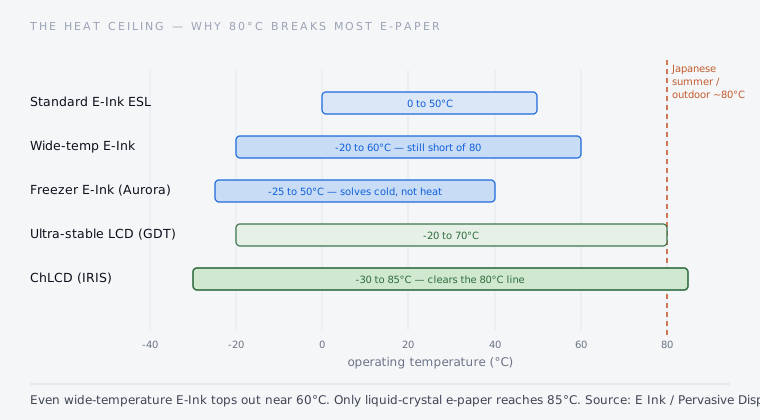
This article sets out a practical comparison. We walk through what actually qualifies as e-paper, take apart the four routes that matter — electrophoretic E-Ink, cholesteric LCD, and ultra-stable LCD, plus the legacy routes — name the main players in each, and then spend a full section on the customer's real question: how to evaluate an e-paper display when the surface-temperature requirement approaches 80°C. The short answer sits in the temperature chart in section 7; the reasoning is worth the read.
What actually counts as "e-paper"?
Start from the shared DNA, because it is what makes all these technologies feel similar in a demo and then behave completely differently in the field.
Group the technologies by how they achieve those traits and the family tree becomes clear. There are three branches: the electrophoretic route (moving pigment particles), the liquid-crystal route (reorienting liquid-crystal molecules), and a set of other reflective mechanisms that are now mostly historical.
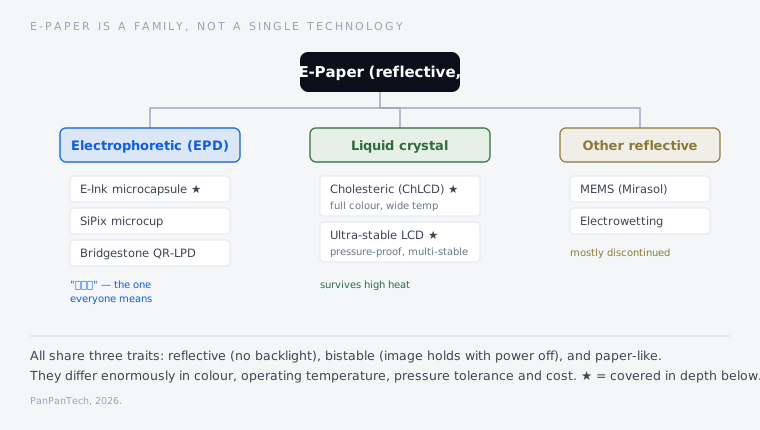
The rest of this guide walks the branches in order of commercial relevance: electrophoretic first (because it owns the market), then the two liquid-crystal routes (because they answer the heat-and-colour questions), then the legacy mechanisms for completeness.
Route 1 — Electrophoretic (E-Ink): the market default
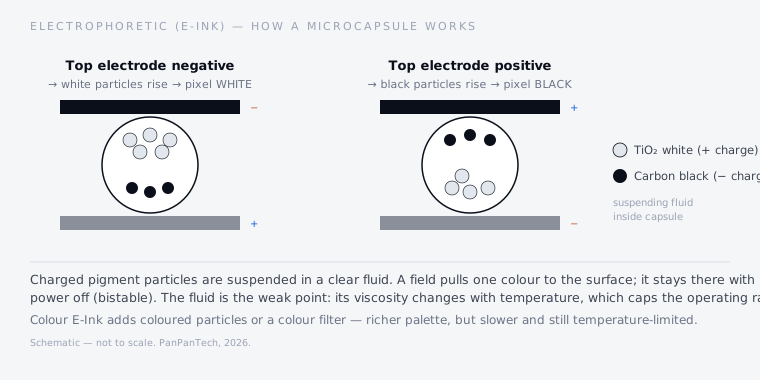
This is the "e-ink screen" almost everyone means when they say e-paper. It was commercialised out of research by MIT professor Joseph Jacobson and colleagues, and refined over decades. Each pixel contains microcapsules holding positively charged white titanium-dioxide particles and negatively charged black carbon particles suspended in a clear fluid. Apply a field and the chosen colour rises to the surface, where it stays without power.
AWhat it is brilliant at
Monochrome E-Ink produces the sharpest, highest-contrast black-and-white text of any reflective technology, with an extremely wide viewing angle and no angular colour shift. For an e-reader or a price-and-barcode shelf label, nothing beats it on legibility per milliwatt. It is also the most manufacturable and lowest-risk choice, with a deep supply chain behind it.
BWhere it struggles: colour and heat
Colour is the first limit. Colour E-Ink — the Spectra family and similar — adds coloured particles or a colour filter, but reaches only in the low thousands of colours (Spectra 6 is around 4,096) and refreshes a full colour image slowly, on the order of 15 seconds. That is fine for a price change, but less suited to vivid promotional imagery or frequent full-colour updates.
Temperature is the harder limit, and the one the customer hit. Standard E-Ink electronic shelf labels are specified for roughly 0–50°C. Wide-temperature variants extend that to about −20 to 60°C, and freezer-grade parts such as E Ink's Aurora reach −25°C on the cold side. But almost none exceed 60°C on the hot side — so 80°C outdoor or summer-storefront heat is outside the envelope of even the "heat-resistant" parts. Section 7 explains exactly why the fluid imposes that ceiling.
Sources: Pervasive Displays, wide-temperature E-Ink (−20 to +60°C) · E Ink ESL application · IRIS Optronics, EPD vs ChLCD.
CMain players
E Ink Corporation of Taiwan is widely reported as the leading supplier in this route, with well over 95% share, and OED is a secondary electrophoretic supplier. Their technical characteristics are similar because the underlying physics is the same. Within the electrophoretic branch there are also two lesser-used mechanisms — SiPix microcup and Bridgestone's electronic liquid powder — covered briefly in section 6.
Route 2 — Cholesteric LCD (ChLCD): colour and heat tolerance
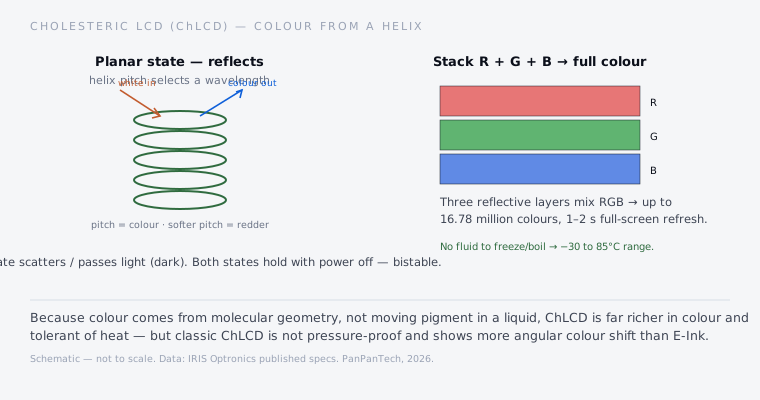
Cholesteric liquid crystal is a special phase whose molecules arrange in a helix. The pitch of that helix determines which wavelength of light it reflects — tune the pitch and you tune the colour. In its planar state the layer reflects a specific colour; in its focal-conic state it scatters or passes light and reads dark. Both states are stable without power, so the display is bistable like all e-paper.
AWhy the colour is in a different league
Because colour is produced by physically stacking red, green and blue reflective cholesteric layers and mixing them, ChLCD can render up to 16.78 million colours — genuine full colour, with vivid greens and blues that colour E-Ink generally does not match. A full-colour update takes 1-2 seconds versus roughly 15 seconds for a six-colour E-Ink panel. For promotional retail displays, digital-quality imagery and frequent visual updates, that gap can be decisive.
Sources: E Ink Spectra 6 vs ChLCD comparison · IRIS Optronics, e-paper colour gamut.
BWhy it survives heat
There is no suspending fluid whose viscosity collapses at temperature extremes. The image is held by liquid-crystal geometry, which tolerates a much wider window — IRIS Optronics specifies its full-colour ChLCD module from about ?30°C to +85°C. That upper figure is the key reason buyers evaluate ChLCD for outdoor and high-heat deployments: it is closer to the 80°C condition the customer was worried about, where many common E-Ink ESL specifications are exceeded.
Source: IRIS Optronics, Full-Colour ChLCD e-Paper Module (−30 to +85°C, three-layer reflective, bistable, sub-second per-colour refresh).
CThe honest trade-offs
Classic ChLCD is not free of weaknesses, and a good manufacturer names them. It is generally not pressure-proof — press the surface and the displayed image can disappear until refreshed — and it shows more angular colour shift than E-Ink, so the colour changes somewhat as you move off-axis. Reflectance and contrast are also different in character from E-Ink's crisp monochrome. These are the exact gaps the ultra-stable variant in the next section sets out to close.
DMain players
The cholesteric route has several serious names: IRIS Optronics (the full-colour module the customer noticed), BOE, AUO, HannStar and Kent Displays, among others. They differ in colour depth, module construction and maturity, but share the underlying liquid-crystal physics — full colour, wide temperature, with the pressure and angular-shift caveats above.
Route 3 — Ultra-stable LCD: fixing cholesteric's weak points
This is the newest of the four routes, pioneered by Gede (GDT). It keeps the heat tolerance and reflective, bistable nature of the liquid-crystal family, but re-engineers the cell to remove cholesteric LCD's two headline weaknesses: pressure sensitivity and structural complexity.
AThe core idea: no polyimide
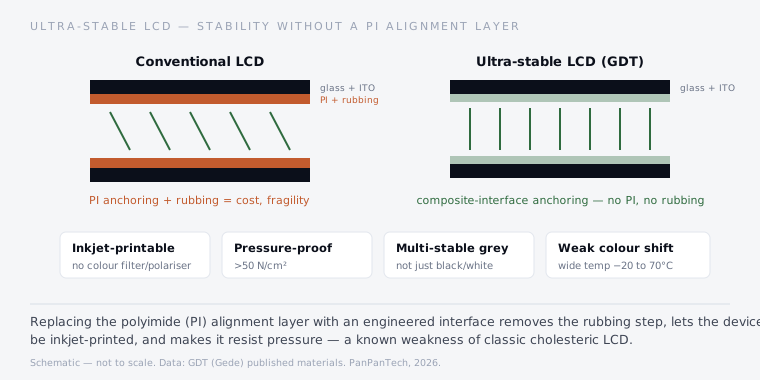
A conventional LCD relies on a rubbed polyimide (PI) layer to anchor and align the liquid crystal. Ultra-stable LCD replaces that anchoring with interactions engineered at a composite interface, tuned through interfacial force and side-chain structure. Removing the PI and the rubbing step simplifies the stack, and — because the process is compatible with inkjet printing — the display can be printed and packaged without the polariser and colour filter a normal LCD needs, which lowers cost and raises yield.
BWhat that buys you
Gede's own reflective LCD modules (the GDMLCD line) are described as sunlight-readable reflective LCDs with non-volatile memory — zero power to retain the image, power only to change it, no backlight — with high contrast, ultra-wide viewing angle and ultra-low deep-sleep current. In other words, the e-paper virtues, delivered through liquid crystal rather than pigment.
Source: GDT (Shenzhen Gede) published materials and GDMLCD module specifications, 2025 (pressure resistance >50 N/cm², multi-stable, bistable reflective, no-PI inkjet-printed process).
CWhere it sits
Ultra-stable LCD is the youngest and least broadly deployed of the four, so its supply chain is thinner than E-Ink's. But for applications that need heat tolerance and pressure resistance — outdoor signage, industrial and transport displays, touched public surfaces — it targets a gap the other three routes leave open.
Route 4 — The other reflective mechanisms (mostly legacy)
For completeness, several other e-paper mechanisms exist. They shaped the field but are now niche or discontinued, and you are unlikely to specify them for a new product. Knowing they exist prevents another round of "wait, that's e-paper too?"
Source: technology summaries per public references; commercial status per PanPanTech market tracking, 2026.
The practical takeaway: for a product decision today, the real choice is among electrophoretic E-Ink, cholesteric LCD and ultra-stable LCD. The others are context, not options.
The heat ceiling, explained — the section the customer really needed
This deserves its own section because it is the single most consequential difference between the routes, and the one buyers discover the hard way.
AWhy the fluid sets the limit
Recall the electrophoretic pixel: charged pigment particles migrating through a clear suspending fluid. That fluid is the main constraint. When it gets cold its viscosity rises, particles move sluggishly, and the image comes out grey, smeared, or fails to update. When it gets hot the system can degrade in other ways and reliability can drop. The electronics may tolerate a wider span, but the fluid mechanism often dictates the operating window. That is why many "wide-temperature" E-Ink ESL specifications still cluster around 60°C on the hot side: the display chemistry has to balance cold-side movement, hot-side reliability and cost.
BWhy liquid crystal escapes it
In cholesteric and ultra-stable LCD there is no pigment-in-fluid suspension doing the work. The image is held by the geometry and orientation of liquid-crystal molecules — a mechanism that tolerates a much broader temperature span. That distinction is visible in published ranges: IRIS specifies its ChLCD to about 85°C and Gede its ultra-stable LCD to about 70°C, while many E-Ink ESL specifications cluster at or below 60°C on the hot side.
CWhat this means for a real deployment
If your labels sit indoors at room temperature, E-Ink is often the most cost-effective and mature choice. But a west-facing storefront, an outdoor kiosk, a sun-exposed shelf, or simply a hot-climate summer can push the surface of a display toward 80°C. At that point the question is no longer only "which brand of e-ink" but "which e-paper physics is specified for this environment" — and liquid-crystal routes usually belong on the shortlist. The customer who asked us about IRIS ChLCD had identified a relevant technology path to evaluate. We cover the pairing of technology to environment in the selection section below, and the electronics-side reliability story in our ESL BOM teardown.
The full comparison, in one table
The numbers below are drawn from a supplier comparison table and public manufacturer specifications. Treat vendor-reported figures as directional and confirm the final datasheet for the exact model — but the shape of the differences is not in dispute.
Source: manufacturer comparison table (reflectance, contrast, temperature, pressure, share figures) plus public specifications from E Ink, IRIS Optronics and GDT, 2026. Vendor-reported values — confirm per model datasheet.
Read the table as a set of trade-offs rather than a scoreboard. A monochrome shelf label and a full-colour outdoor sign are not competing for the same technology; they are simply different jobs that land on different branches of the family tree.
How to choose: match the technology to the environment
The decision is driven far more by where the display lives and what it shows than by any single spec. Four common scenarios cover most retail and industrial cases.
A useful discipline: write down the worst-case surface temperature, the colour requirement and the touch exposure before comparing brands. Those three answers usually select the branch on their own, and only then does brand-level comparison within a branch make sense. The component-level reliability questions — panel grade, driver firmware, battery behaviour in the cold — are covered in our electronic shelf label teardown, and the underlying display capability on our e-paper & ESL technology page.
And to answer the customer's actual question directly: yes — for an 80°C outdoor requirement, cholesteric or ultra-stable LCD should be on the evaluation shortlist, and sourcing the right module for that environment is exactly the kind of problem our manufacturing and OEM team exists to solve.
Where e-paper is heading
Three directions define the current wave of development, and all three widen the gap between "e-paper = e-ink" and the reality of a diversifying family.
The market context is large and growing. Industry bodies project China's e-paper tablet shipments at roughly 3.1 million units in 2025 and global e-paper smart-retail shelf-label shipments at about 360 million pieces, and China's video-industry association began drafting an e-paper reader quality-grading standard in 2025. As colour and temperature-tolerant variants mature, the practical definition of "e-paper" keeps widening — which is exactly why treating it as one technology can lead to a mis-specified purchase.
Sources: industry figures per China Electronics Video Industry Association and public reporting, 2025; retina e-paper per published research, 2025.