Choose a commercial robot vacuum by the soil you are removing, not by the specification sheet. Dry dust and grit suit vacuuming; spills and grease need scrubbing. Get that match wrong and no amount of suction, runtime or AI navigation will make the floor look clean.
Updated 2026-07-21 · 14 min read
What is a commercial robot vacuum?
A commercial robot vacuum is an autonomous floor-cleaning machine built for repeatable facility work — offices, retail, hospitals, hotels, warehouses and public buildings. Unlike a home robot, it is selected by floor area per shift, cleaning mode, runtime, tank and bin capacity, safety behaviour around people, proof-of-work reporting and after-sales support.
Some models focus on vacuuming and sweeping. Others combine vacuuming with scrubbing, dust-pushing, mopping, disinfection, route reports and fleet management. The category label matters less than what the machine physically does to the floor.
For B2B buyers, the important question is not whether the robot can move by itself — every model on the market can. The important questions are whether it can clean the floor type you actually have, finish inside the shift window, work safely around people, and produce service records your facility team can hand to a tenant or an auditor.
The category is no longer niche. The IFR's World Robotics 2025 report puts professional cleaning robots third among service robot applications, with sales growing 34% to more than 25,000 units in 2024, and floor cleaning as the main application. That growth means more choice — and more suppliers whose specification sheets say the same thing.
The single most common sourcing mistake is buying a vacuum robot for a floor whose problem is not dust. Vacuuming removes dry particulate. It does nothing for spills, grease films, scuffs or dried-on residue — those need water, detergent, mechanical pressure and recovery.
Before comparing any two machines, walk the site and classify what is actually on the floor at the end of a working day. The answer decides the machine class, and everything else follows from it.
What is on the floorRight cleaning modeTypical site
Dust, grit, paper, packaging debrisVacuum or sweep — dry pickup into a binOffices, warehouses, back-of-house, corridors
Grease, oil films, food residueScrub with the right chemistry, often at higher pressureFood service, production areas, canteens
Mixed dry and wet through the dayMultifunction — sweep then scrub in one or two passesSupermarkets, hospitals, hotels
Coarse outdoor debris, leaves, gravelOutdoor sweeper with a large hopperCampuses, loading zones, car parks
Source: PanPanTech deployment experience, 2026. Most real sites contain two or more rows — decide which one dominates the daily shift.
A practical test: photograph the floor at the end of a shift, before any cleaning. If the surface looks dull rather than dusty, the problem is film, not particulate, and a vacuum robot will disappoint you no matter how well it navigates. Our autonomous floor scrubber guide covers the wet-cleaning side in detail, and the commercial cleaning robot overview compares all six machine families.
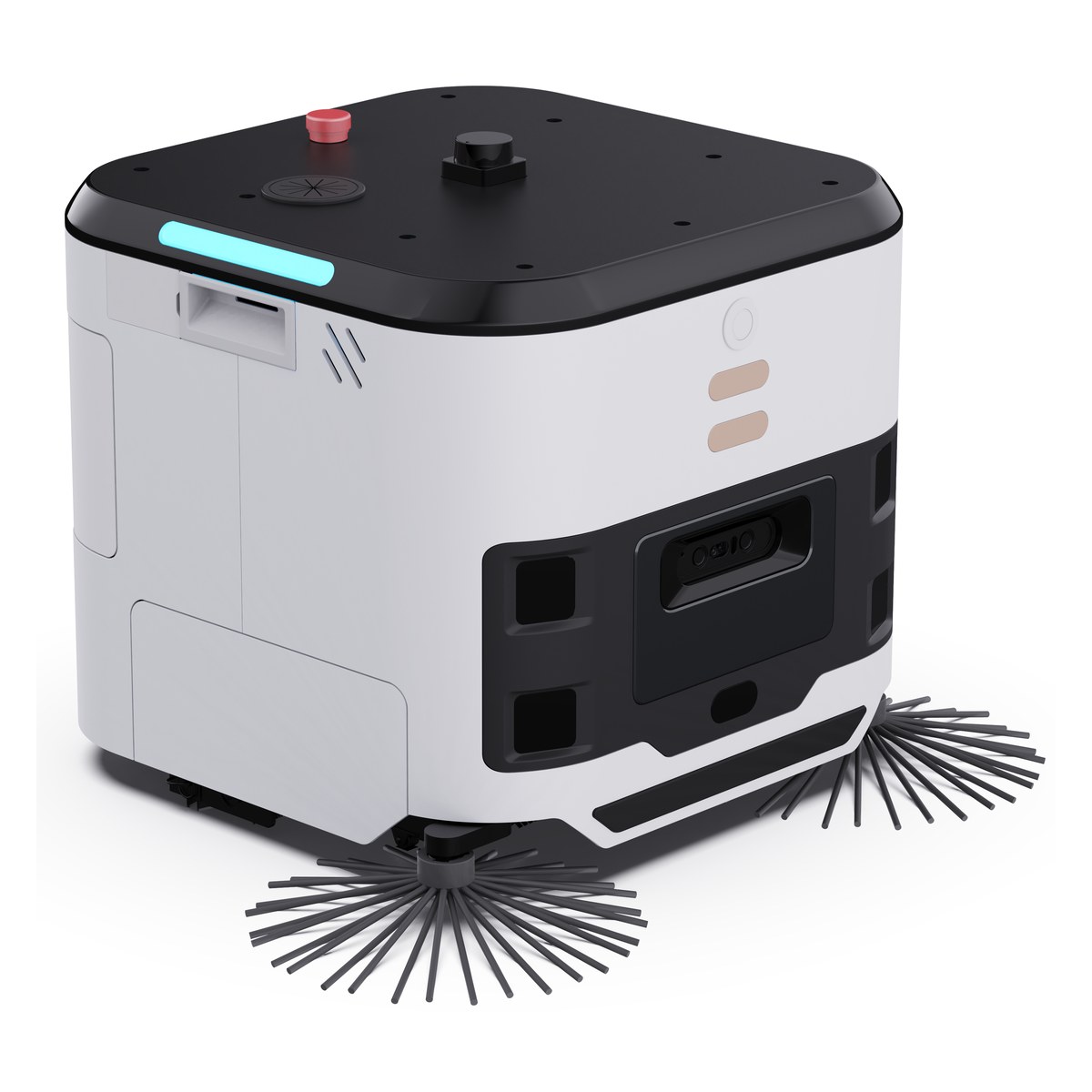
A compact commercial robot vacuum is most useful when the site's main problem is dry dust, grit, light debris and repeatable indoor routes.
Which robot class fits each facility?
Once the soil type is settled, match the machine to the building's geometry and traffic pattern rather than to its floor area alone. A smaller robot often beats a larger scrubber on a site with tight spaces and mixed public traffic.
Healthcare, laboratory, cleanroom-adjacentVacuum robot with sealed HEPA filtrationFilter class and housing seal, disinfection workflow, noise in patient areas
Source: PanPanTech product line and project experience, 2026. See the full range in the Smart Robots catalog.
Two site conditions override almost everything else. The narrowest passage the robot must clear sets a hard ceiling on machine width — measure it with a tape, not from a drawing, because racking and display fixtures move. And vertical transitions — thresholds, ramps, lift access — decide whether one robot can cover a multi-floor building or whether you need one per floor, which changes the budget entirely.
The specifications that actually predict coverage
Catalogue coverage figures are theoretical. Plan on roughly 50–70% of the quoted m²/h once turns, obstacle avoidance, docking, refills and re-cleaning are counted. Sizing a fleet on the marketing number is the most expensive avoidable error in this category.
Suppliers quote theoretical coverage — cleaning width multiplied by travel speed, as if the machine drove in an unobstructed straight line all shift. Real sites have columns, trolleys, pallets, customers, doorways and dead-ends. Ask for a practical coverage figure and how it was derived; a supplier who has run real deployments will have one.
SpecificationWhat it really tells youThe question to ask
Coverage (m²/h)A theoretical rate under ideal conditionsWhat is the practical rate on a site like mine, and from which deployment?
Cleaning widthPasses needed per aisle; drives real throughput more than speedDoes the head cover the full width, including edges?
RuntimeUsually quoted at the gentlest settingRuntime in the mode I will actually use, on aged batteries
Recharge timeDecides whether one robot can do two shiftsFull-cycle time, and does it auto-resume where it stopped?
Bin / tank capacityHow many staff interventions per shiftHow many empties or refills for my area — this is the hidden labour
Minimum aisle widthWhether the machine physically fits your siteWidth including turning clearance, not just the chassis
Climbing / thresholdWhether it can reach every zone unaidedMaximum threshold height and ramp slope, loaded
ReportingWhether you can prove the work was doneCoverage maps and exception alerts, or just a completion tick?
Source: PanPanTech specification review practice, 2026. Ranges vary by machine class — always work from the final datasheet for the exact model.
Bin capacity deserves particular attention because it is the specification that quietly reintroduces the labour you were trying to remove. A robot that needs emptying three times per shift has not eliminated a task; it has fragmented it. Work out the interventions per shift for your actual dust load before signing.
Filtration, carpet and noise — the three specs buyers skip
Filtration. A vacuum that lifts dust from the floor and returns the fine fraction to the air has moved the problem, not solved it. In healthcare, laboratories, schools and allergy-sensitive workplaces this matters enough to specify. Ask for the filter class under EN 1822: H13 captures at least 99.95% of particles at the most penetrating particle size, H14 at least 99.995%. Then ask the harder question — how the filter is sealed. An H13 element in a housing that leaks around the gasket does not deliver H13 performance, and this is where cheap machines diverge from good ones.
Carpet. Short commercial loop pile is usually within scope; deep or plush pile generally is not. If carpet is a meaningful share of your floor, ask whether the machine or its cleaning head has been tested against a recognised carpet protocol. The Carpet and Rug Institute's Seal of Approval programme measures soil removal from standard test carpet in four passes and additionally caps dust released into the air at 100 micrograms per cubic metre — a useful benchmark even when the machine itself has not been submitted.
Noise. Rarely on a requirement list, frequently the reason a deployment gets restricted to nights after the first month. In hotel corridors, patient areas, libraries and open-plan offices, a machine that is a few decibels too loud simply will not be allowed to run when you need it. Ask for the sound pressure level in the mode you will use, and — more revealing — ask whether the supplier has deployed in a comparable daytime, guest-facing environment.
These three specifications share a pattern: they do not affect whether the robot works, only whether you are permitted to use it as planned. That makes them easy to overlook at quotation stage and expensive to discover afterwards.
How much does a commercial robot vacuum cost?
Compare monthly total cost of ownership, not machine price. Compact commercial units typically start in the low five figures in USD; larger scrubbing platforms with docking or water stations run considerably higher. Robots-as-a-Service plans bundle service into a monthly fee and are increasingly common.
Pricing depends on robot class, sensor package, cleaning modules, battery, service plan, spare parts and order quantity. A compact robot is quoted very differently from a large autonomous scrubber with a water station. What makes quotations comparable is insisting they be itemised.
Cost lineOften bundled or omittedWhy it matters
MachineUsually the only line quotedThe smallest part of a five-year cost
ConsumablesBrushes, filters, squeegees, padsRecurring; ask for annual quantity at your usage
Battery replacementFrequently omitted entirelyA significant mid-life cost — get the expected cycle life in writing
Software / fleet platformSometimes a recurring licenceCheck whether reporting stops if the licence lapses
Training & commissioningOften assumed freeDetermines whether staff actually use the machine well
Service responseRarely quantifiedA robot waiting three weeks for a part is a cost, not an asset
Shipping & documentsExcluded from ex-works quotesBattery paperwork can hold a shipment — see our certification guide
Source: PanPanTech quotation practice, 2026. Ask every supplier to itemise these lines — the comparison is meaningless otherwise.
On payback: facilities with roughly 3,000 m² or more of daily-cleaned floor typically see 12–24 months, driven by the labour the robot absorbs rather than by consumable savings. The full labour arithmetic, including turnover costs, is in our article on the seven benefits of autonomous cleaning robots, and the machine-versus-manual comparison is in robotic scrubber versus walk-behind.
Deployment checklist
Send this information with the enquiry. A supplier who asks for it unprompted is one who has deployed before; a supplier who quotes without it is quoting blind.
→Floor map or photos, floor material by zone, and the daily cleaning schedule with shift windows.
→Measured narrowest passage, elevator dimensions and access rules, threshold heights, and where the robot will be stored.
→Water refill and drainage points, charging location and available power, and who on staff owns the daily handoff.
→Traffic pattern: is the robot working around customers, patients or staff, and at what times of day?
→Final datasheet, certification package, spare-part list and warranty terms — before purchase, not after.
→A pilot on your worst zone before scaling. One machine on the hardest floor tells you more than any specification sheet.
On the safety side, two references frame the deployment. ISO 3691-4 covers driverless industrial trucks and is the anchor when the platform carries loads as well as cleans. And in the United States, OSHA 1910.22 places duties on the facility for clean, orderly and dry walking-working surfaces — meaning wet-floor signalling, route planning and staff training belong in your plan regardless of how complete the supplier's file is. Robotic cleaning should support a slip-and-trip prevention plan, not replace it.
FAQ
Can a commercial robot vacuum replace cleaners?
It replaces repetitive floor routes, not the whole cleaning team. Staff still handle detail cleaning, edges and corners, restrooms, spill response, exceptions and guest-facing work. The realistic outcome is redeployment of hours, not headcount reduction.
Is a robot vacuum enough for commercial floors?
It depends on the soil. Dry dust, grit and litter suit vacuum or sweep modes. Spills, grease, scuffs and heavy foot traffic need scrubbing with water and detergent. Many mixed sites end up running a vacuum robot for daily maintenance and a scrubber for periodic deep cleaning.
What coverage rate should I expect in practice?
Assume roughly 50 to 70 percent of the catalogue figure. Datasheet coverage is a theoretical rate that ignores turns, obstacle avoidance, docking, refills and re-cleaning of missed areas. Size the fleet against the practical number, not the marketing one.
Do commercial robot vacuums need HEPA filtration?
For healthcare, laboratories, schools and allergy-sensitive sites it matters. Ask for the filter class under EN 1822 — H13 captures at least 99.95 percent of particles at the most penetrating particle size — and confirm sealing, because an H13 element in a leaking housing does not deliver H13 performance.
How do robot vacuums perform on carpet?
Short commercial loop pile is usually fine; deep or plush pile is not. If carpet is a significant share of the floor, ask whether the machine or its cleaning head has been tested against a recognised carpet protocol such as the CRI Seal of Approval, which measures soil removal in four passes and limits dust released into the air.
What floor types can commercial cleaning robots handle?
Common indoor targets include tile, PVC, terrazzo, marble, epoxy, sealed concrete and short carpet. Polished marble and some coated floors need care with water volume and brush pressure. Confirm compatibility against the model datasheet and, ideally, a site trial.
How much does a commercial robot vacuum cost?
Compact commercial units typically start in the low five figures in USD, while larger scrubbing platforms with docking or water stations run considerably higher. Robots-as-a-Service plans are common. Compare total cost of ownership — consumables, spare parts, software, training, warranty and service response — not the machine price alone.
What should I send for a quote?
Floor area and floor material, a floor plan or photos, narrowest aisle width, obstacle density, daily cleaning schedule and shift window, elevator and threshold details, water and charging locations, destination country, quantity, and any OEM or distributor requirements.
Tell us floor area, floor material, aisle widths and cleaning schedule — PanPanTech will recommend a machine class with a practical coverage estimate, not a catalogue number.