Certifications for Commercial Cleaning Robots: What Buyers Must Verify Before 2027
A commercial cleaning robot is not certified by one document. It needs a set — machinery safety, electrical, radio, battery and restricted-substance — and the set changes with the destination market and the exact configuration. Never accept a generic "CE certified" claim without matching each document to the model, version, adapter, battery and radio module you are actually buying.
Updated 2026-10-15 · 16 min read
Short answer. For the EU, a CE declaration covering the machinery, EMC, radio and battery rules, typically demonstrated against IEC/EN 60335-2-72 plus IEC 63327 for autonomous operation. For the US, an NRTL listing (UL or ETL) for electrical safety and FCC Part 15 authorisation for the radios. For shipping, a UN 38.3 test summary for the lithium battery. From 20 January 2027, machines placed on the EU market must meet Machinery Regulation (EU) 2023/1230.
Start here: the EU rules change on 20 January 2027
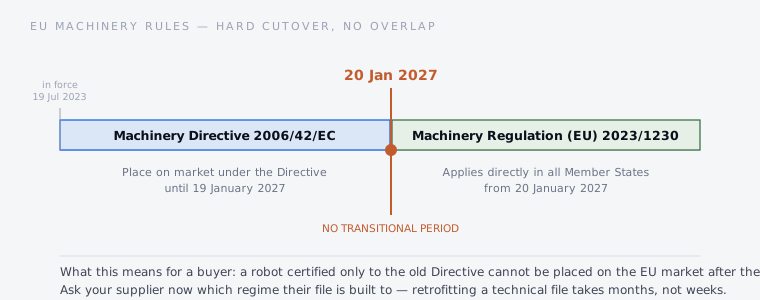
Machinery Regulation (EU) 2023/1230 replaces Machinery Directive 2006/42/EC and applies from 20 January 2027, directly in every Member State. There is no transitional period. Machines may be placed on the EU market under the old Directive until 19 January 2027 — and must comply with the Regulation the next day.
If you are signing a supply agreement in 2026 for a fleet that will still be shipping in 2027, this is the first question to ask, ahead of price. A technical file built only against the old Directive does not automatically satisfy the new Regulation, and rebuilding one is a matter of months, not weeks.
The cutover has no overlap period. Source: Regulation (EU) 2023/1230, in force 19 July 2023, applicable 20 January 2027.
Autonomous cleaning machines are squarely affected, because the Regulation modernises the framework to cover digital aspects — software integrity, updates, connected functions, and machines whose behaviour changes after they leave the factory. That describes every fleet-managed cleaning robot with over-the-air firmware, which is to say all of them.
Three practical questions for any EU-bound quotation this year:
→Is the current technical file built to 2006/42/EC or to 2023/1230 — and if the former, what is the supplier's dated plan to transition?
→Who takes the manufacturer's obligations for units you place on the market under your own brand after the cutover?
→How are firmware updates handled in the file, given that the Regulation treats software as part of the machine's safety story?
Which documents actually matter?
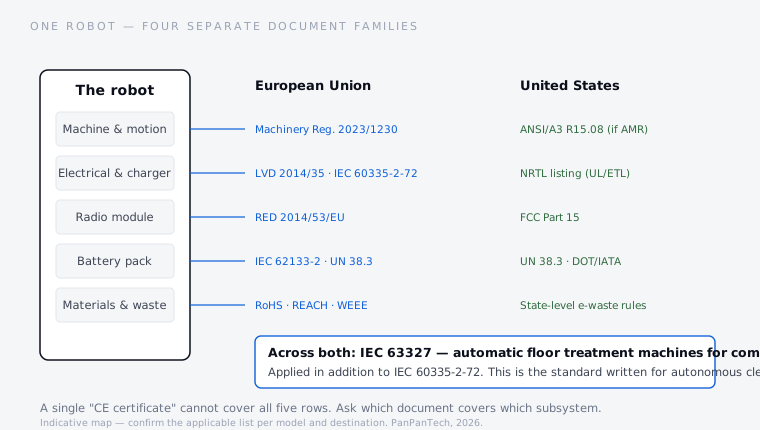
Most buyers need five families: machinery safety, electrical safety, EMC and radio, battery and transport, and restricted substances. A single "CE certificate" cannot cover all five — ask which document covers which subsystem.
The most common failure in robot sourcing is treating compliance as one binary attribute. It is not. One robot contains a machine that moves, a mains-connected charger, a radio, a lithium battery and a list of materials — and each of those is governed by a different instrument, sometimes by a different assessment route.
Indicative mapping of subsystems to document families. Confirm the applicable list per model and destination. PanPanTech, 2026.
Document familyEuropean UnionUnited States
Machinery safetyMachinery Regulation 2023/1230 (from Jan 2027); risk assessment and instructionsEmployer duties under OSHA; ANSI/A3 R15.08 where the platform is an AMR
Electrical safetyLow Voltage Directive; IEC/EN 60335 series for the machine and chargerNRTL listing (UL / ETL) commonly required by sites and insurers
EMC & radioEMC Directive; Radio Equipment Directive 2014/53/EUFCC equipment authorisation, typically Part 15
Battery & transportIEC 62133-2 for cells and packs; UN 38.3 for transportUN 38.3; DOT and IATA packing rules by mode
Substances & wasteRoHS, REACH, WEEEState-level e-waste and packaging rules
Beyond the regulatory set, a commercial purchase also needs the documents that make the regulatory ones usable: final datasheet, user manual in the destination language, rating and warning labels, packing list, and warranty and service terms. For distributor programmes, agree neutral model names and obtain final document copies before catalogues are printed or public claims are published.
The standards behind the marks — and the one written for autonomous machines
IEC 63327, "automatic floor treatment machines for commercial use", is the standard written specifically for autonomous cleaning machines. Its requirements apply in addition to IEC 60335-2-72, the base standard for commercial floor treatment machines. A supplier who has never referenced it is treating an autonomous machine as though it were a manual one.
CE and FCC are marks, not standards. Behind them sit the technical standards a laboratory actually tests against, and those are what tell you whether the assessment matched the product you are buying.
StandardWhat it coversWhy it matters to a buyer
IEC 60335-1General safety of household and similar electrical appliancesThe base electrical safety standard everything else builds on
IEC 60335-2-72Floor treatment machines for commercial use, with or without traction driveThe product-family standard for scrubbers and sweepers
IEC 63327Automatic floor treatment machines for commercial use — particular requirementsThe autonomy layer, applied on top of 60335-2-72. Written for machines working near crowds
ISO 3691-4Driverless industrial trucks and their systemsRelevant when the platform carries loads, not just cleans
ANSI/A3 R15.08Industrial mobile robot safety, US contextAsked for by US integrators and safety officers; pairs with a documented risk assessment
IEC 62133-2Safety of lithium secondary cells and batteriesCovers the pack, not only the cell — confirm which was actually tested
IEC 63327 deserves the emphasis because of what its scope says: these machines may need to operate in close proximity to large groups of people — shopping malls, schools, transport hubs. That is a fundamentally different hazard analysis from a manual scrubber pushed by a trained operator, and it is exactly the gap left open by a robot certified only against the manual-machine standard.
Battery and shipping documents — where shipments actually get stuck
UN 38.3 is not optional. Lithium cells and packs need a UN 38.3 test summary, a safety data sheet, and packing documentation matched to the transport mode. Missing or mismatched battery paperwork is one of the most common reasons a robot shipment is held at origin.
Cleaning robots carry substantial lithium batteries, which makes them dangerous goods for transport purposes. Three documents travel with them, and each is checked by a different party:
UN 38.3 summaryCovers altitude simulation, thermal cycling, vibration, shock, external short circuit, impact, overcharge and forced discharge. Carriers and freight forwarders routinely refuse shipments without it.
Safety data sheetRequired by forwarders and customs in most destinations. Must match the actual cell chemistry and pack configuration, not a generic template from a different product.
Packing & modeAir and sea freight follow different packing instructions and state-of-charge limits. A pack cleared for sea can be refused for air. Decide the transport mode before the documentation is prepared, not after.
Two traps recur. First, the UN 38.3 summary sometimes covers the cell while your robot ships with an assembled pack — the pack needs its own testing. Second, when a supplier changes cell vendor mid-production, the paperwork silently becomes invalid. Ask for the summary to be reissued against the actual bill of materials at the time of shipment, and put cell-change notification into the supply agreement.
How to verify a certificate is real and relevant
Two separate questions: is the document genuine, and does it cover the product you are buying? Most problems are the second kind — a real certificate for a slightly different model, adapter, radio module or battery.
Work through these checks before payment. They take under an hour and settle most disputes before they exist.
CheckWhat you are looking forCommon failure
Certificate holderThe legal entity named matches your actual supplierCertificate belongs to a trading company or a former partner factory
Model & versionExact model string, including suffixes and hardware revisionCovers the previous revision; your unit ships with a new mainboard
Rating labelVoltage, current and frequency on the label match the certificateAdapter substituted after certification
Radio moduleModule part number and its own approval identifiersModule swapped for a cheaper equivalent; grant conditions not met
BatteryCell and pack match the tested configurationCell vendor changed; UN 38.3 no longer applies
Issuing bodyAccredited lab; for EU notified-body work, a valid four-digit NB numberUnaccredited lab, or an NB number whose scope does not cover this work
Report, not just coverThe underlying test report exists and is providedOnly a one-page "certificate" with no traceable report number
Validity & scopeDates current; scope covers your destination and configurationExpired, or scope covers a different market
Three distinctions worth internalising, because suppliers blur them constantly. A test report records what a laboratory measured; it is not an approval. A declaration of conformity is the manufacturer's own statement — necessary, but self-issued. A certificate from a notified or accredited body is third-party assessment. All three have their place; a supplier presenting the first as though it were the third is either careless or counting on you not to notice.
Finally, verify against physical goods. Ask for photographs of the actual rating label, adapter and battery on a production unit — not renders, not the sample from two years ago. Compliance documentation describes one specific physical configuration, and the whole exercise is worthless if the configuration has drifted.
Cleaning robots versus warehouse AMRs
A compact cleaning robot and a warehouse AMR need overlapping but distinct files. Cleaning robots are assessed as floor treatment machines plus electrical, radio and battery. AMRs add payload, vehicle movement, docking, traffic management and route control — a heavier safety case, usually anchored on ISO 3691-4 in Europe and ANSI/A3 R15.08 in the United States, with a documented risk assessment for the specific site.
Robot classExtra document focusBuyer action
Compact cleaning robotWireless, charger, battery, cleaning moduleRequest model-specific CE/FCC/IEC and battery documents; confirm IEC 63327 was considered
Facade / window robotFall arrest, tether, wind limits, work-at-height rulesLocal work-at-height regulation usually dominates — see our facade robot guide
Warehouse AMRPayload, speed, obstacle detection, docking, route controlRequest the risk assessment and mobile robot safety documentation — see AMR vs AGV
One point buyers often miss: for a machine placed in a workplace, part of the compliance burden sits with the operator, not the manufacturer. In the United States, OSHA duties around walking-working surfaces apply to the facility, which means wet-floor signalling, route planning and staff training belong in your deployment plan regardless of how complete the supplier's file is. Background on machine selection is in our commercial cleaning robot guide.
A certificate names a holder and a model. Putting your brand on a robot does not automatically transfer its documentation — and in the EU, the party placing a product on the market under its own name generally takes on manufacturer obligations.
This is the single most expensive thing distributors discover late. The sequence that causes trouble looks reasonable at each step: agree a private-label model name, print catalogues, publish the product page with the factory's CE claim, sell into three countries, then receive a market surveillance enquiry addressed to you rather than to the factory.
Settle these five points in writing before the first purchase order:
→Whether the existing certificate can be extended or reissued to the private-label model name, at whose cost, and on what timeline.
→Who is named as manufacturer for the destination market, and who holds the technical file — including who must produce it on request.
→What happens at the 2027 Machinery Regulation cutover: who rebuilds the file, and by when.
→Change control: the supplier must notify you before changing cell vendor, radio module, adapter or mainboard, because each invalidates part of the documentation.
→Which claims you may publish. "CE certified" as marketing copy attracts scrutiny that a factual specification page does not.
If you are running an OEM or private-label programme, our manufacturing and OEM capability page describes how we handle model-specific documentation and change control. The same discipline applies to our electronics work — the component-level view is in the ESL BOM teardown.
The RFQ document checklist
Send this with the enquiry, not after the quotation. A supplier's response to the list tells you as much as the documents themselves — the ones who answer precisely are the ones who have done it before.
StageRequestWhy
With the RFQFinal datasheet: model, dimensions, battery, charger, radio configurationEverything else is checked against this
With the RFQDestination-market document list, stated per countryReveals whether the supplier has shipped there before
Before orderCE / FCC / IEC documents plus the underlying test reportsCover certificates alone are not verifiable
Before orderMachinery regime statement: 2006/42/EC or 2023/1230, with transition dateDecides whether the product can ship to the EU after January 2027
Before orderBattery: UN 38.3 summary, SDS, packing instruction for your transport modePrevents the shipment being held at origin
Before orderUser manual, maintenance guide, warning labels, packing listRequired for handover and often for customs
Before orderSpare-part list and consumable replacement scheduleTotal cost of ownership, and evidence of a real service plan
Before orderWarranty terms, service workflow, response timeThe part of the deal you use most and negotiate least
At shipmentPhotos of the actual rating label, adapter and battery on production unitsConfirms the physical configuration still matches the paperwork
Source: PanPanTech export and OEM documentation practice, 2026. Adapt per destination market.
None of this replaces professional advice for your market — we are a manufacturer, not a certification body, and the definitive list for your product and destination should be confirmed with a notified body or a competent compliance consultant. What this checklist does is make sure the conversation with your supplier starts from the right questions.
FAQ
What certifications should I look for in a commercial cleaning robot?
For the EU, a CE declaration covering the machinery, EMC, radio and battery rules, typically demonstrated against IEC/EN 60335-2-72 plus IEC 63327 for autonomous operation. For the US, an NRTL listing (UL or ETL) for electrical safety and FCC Part 15 authorisation for the radios. For shipping, a UN 38.3 test summary for the lithium battery. From 20 January 2027, machines placed on the EU market must meet Machinery Regulation (EU) 2023/1230.
Is CE enough for a commercial cleaning robot?
No. CE is a marking that declares conformity with every EU rule that applies to the product — machinery, low voltage, EMC, radio, batteries, restricted substances. A single certificate cannot cover all of them. Ask which document covers which subsystem, and whether the file is built to the Machinery Directive or the Machinery Regulation that applies from 20 January 2027.
What changes on 20 January 2027 in the EU?
Machinery Regulation (EU) 2023/1230 replaces Machinery Directive 2006/42/EC and applies directly in all Member States. There is no transitional period: machines can be placed on the market under the old Directive until 19 January 2027, and must comply with the Regulation from 20 January 2027. Autonomous cleaning machines are affected because the Regulation adds requirements around software, updates and connected functions.
Which safety standard is written specifically for autonomous cleaning machines?
IEC 63327, automatic floor treatment machines for commercial use. Its requirements apply in addition to IEC 60335-2-72, the base standard for commercial floor treatment machines. If a supplier has never heard of IEC 63327, they are treating an autonomous machine as if it were a manual one.
Does a robot floor scrubber need FCC certification?
Yes, if it is sold in the United States and contains an intentional radiator — Wi-Fi, Bluetooth or a proprietary radio — which almost every robot floor scrubber does. That falls under FCC equipment authorisation, typically Part 15. The FCC ID may belong to the radio module rather than the robot, which is acceptable only if the module is used within the conditions of its grant.
How do I check a certificate is genuine?
Match the certificate holder, exact model and version, rating label, adapter, radio module and battery to the robot being purchased. Check the issuing body and, for EU notified-body work, verify the four-digit NB number in NANDO. Confirm the report number exists and ask for the report itself, not just the cover certificate. A test report is not a certificate, and a self-issued declaration is not third-party approval.
What battery and shipping documents are required?
A UN 38.3 test summary for lithium cells and packs, a safety data sheet, and packing documentation matched to the transport mode — air freight applies different packing instructions from sea freight. Missing UN 38.3 paperwork is one of the most common reasons a robot shipment is held at origin.
Are AMR certifications different from cleaning robot certifications?
They overlap but are not identical. Cleaning robots are assessed as floor treatment machines plus electrical, radio and battery. Warehouse AMRs add payload, traffic, docking and vehicle-movement questions, which fall under ISO 3691-4 in Europe and ANSI/A3 R15.08 in the United States, along with a documented risk assessment.
Can a certificate be reused for a private-label model name?
Sometimes, but not automatically. The certificate names a holder and a model. Rebranding may require the certificate to be extended, transferred, or reissued, and in the EU the party placing the product on the market takes on manufacturer obligations. Settle this in writing before printing catalogues or publishing public claims.
Tell us your destination markets and configuration — PanPanTech will return the document list we would prepare for that shipment, including our position on the 2027 machinery transition.