Home/Products/Mobile Manipulation/AHR-1636
AHR-1636 wheeled dual-arm humanoid robot

Mobile Manipulation · Humanoid

AHR-1636 Wheeled Dual-Arm Humanoid Robot

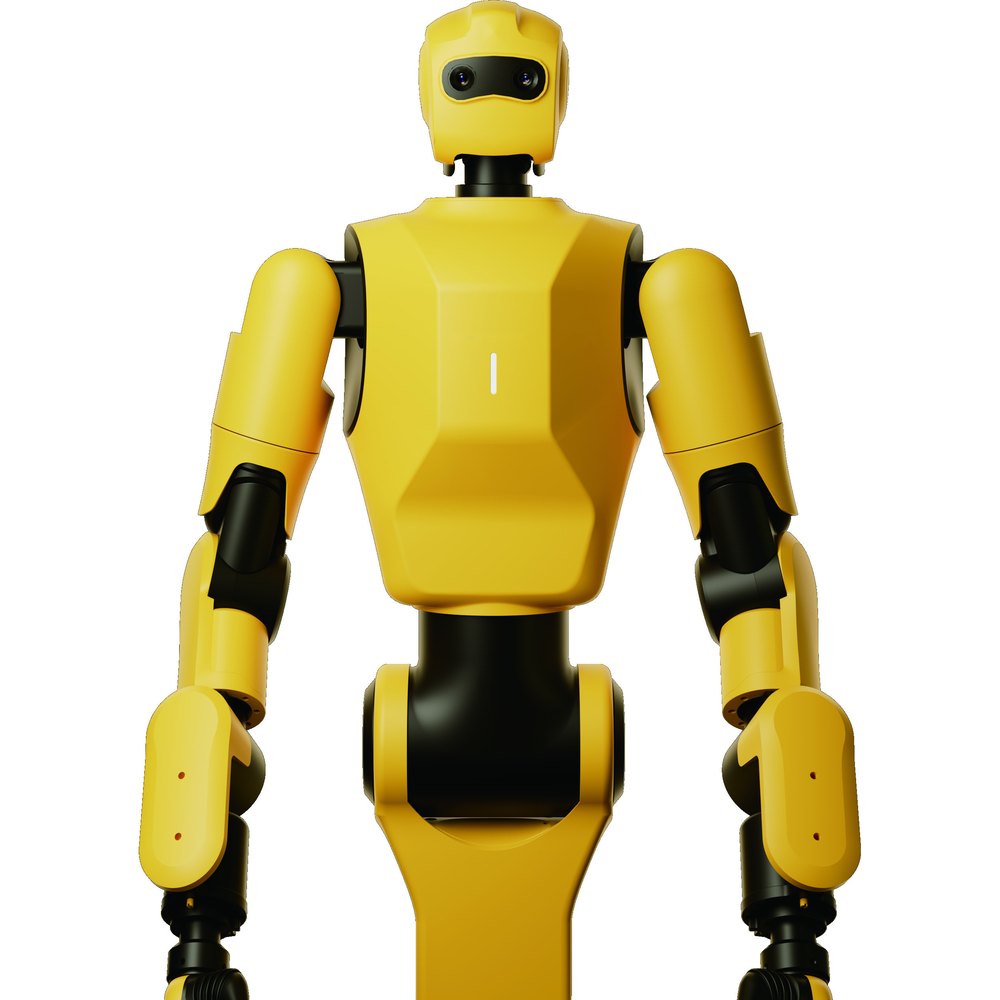
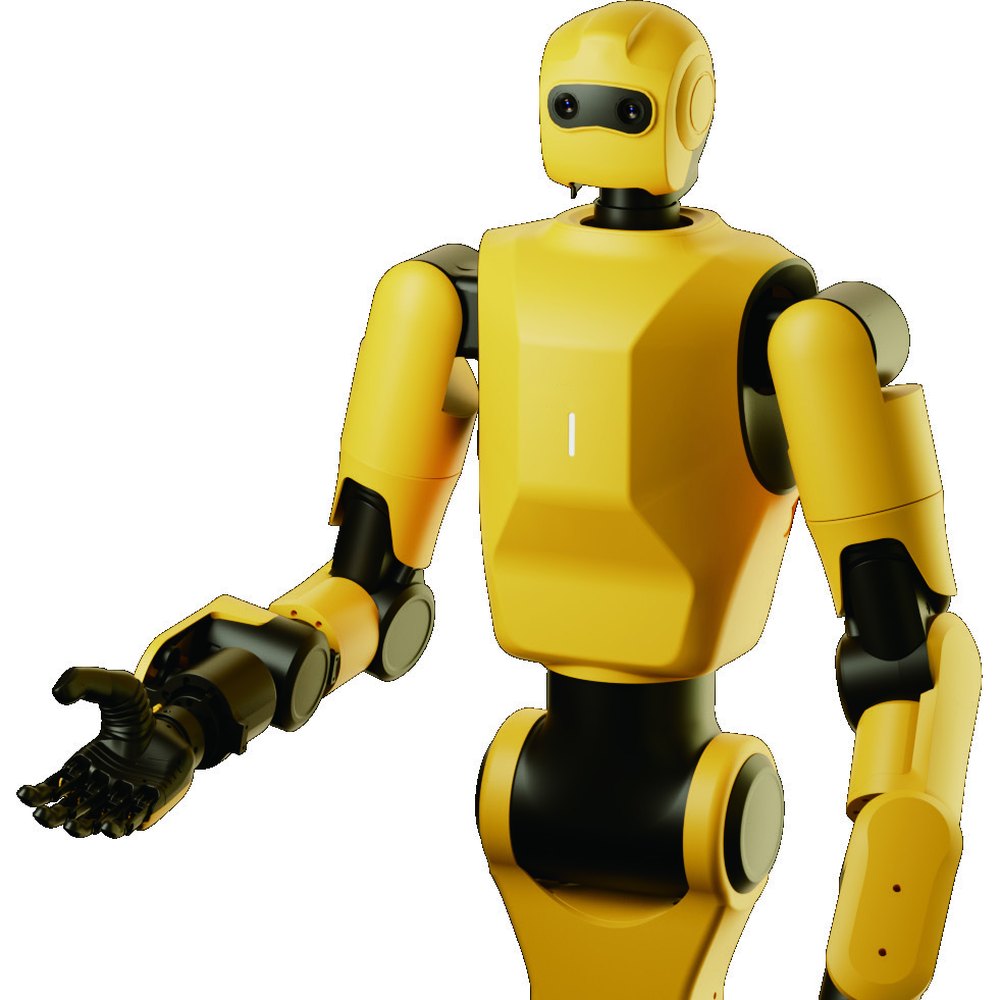
The AHR-1636 is a 1,636 mm wheeled humanoid robot for retail service, light manufacturing, logistics and research. Two 7-DoF arms rated 10 kg each, dexterous five-finger hands or two-finger grippers, a human-like stereo vision head and up to 40 degrees of freedom let it work at counters, shelves and workbenches built for people. A simulation-trained AI stack and an open ROS 2 SDK shorten the path from a new task to a working deployment.

40max. degrees of freedom
10 kgper arm at 0.5 m
±0.5mm arm repeatability
8 h+runtime

What it solves

A robot that fits workplaces built for people

/01
Works where people work

Human proportions, two arms and a 1,636 mm height let it use existing counters, shelves and workbenches instead of a site rebuilt around fixed automation.

/02
One body, many tasks

Hands or grippers, humanoid or industrial-style arms, differential or omnidirectional base and single or dual PC are configured to the job, so the same platform can greet, fetch, pick and assemble.

/03
Faster to new tasks

Training data is generated in simulation — lighting, friction, rigid and fluid dynamics — and transferred to the real robot. The manufacturer reports around 6,000 training samples a day this way, against 100–300 from teleoperation and manual labelling.

/04
Precise, gentle force control

Whole-body joints run at 1 kHz over an EtherCAT network with 0.1 N force sensitivity, and both arms support compliant control for safe contact with objects and people.

/05
Human-like stereo vision

A 6 cm-baseline stereo head with a large-model depth algorithm and microsecond multi-camera sync sees in changing light; wrist cameras are optional for close-range picking.

/06
Open for developers

ROS 2-based, with joint-level force/position control for researchers and drag teaching, impedance mode and industrial motion commands for application builders.

Best-fit applications

Start with tasks people already do at a counter, shelf or bench.

Convenience & unattended retailReception & guided shoppingLight assembly & sortingWarehouse picking pilotsResearch & educationElderly-care & service trials
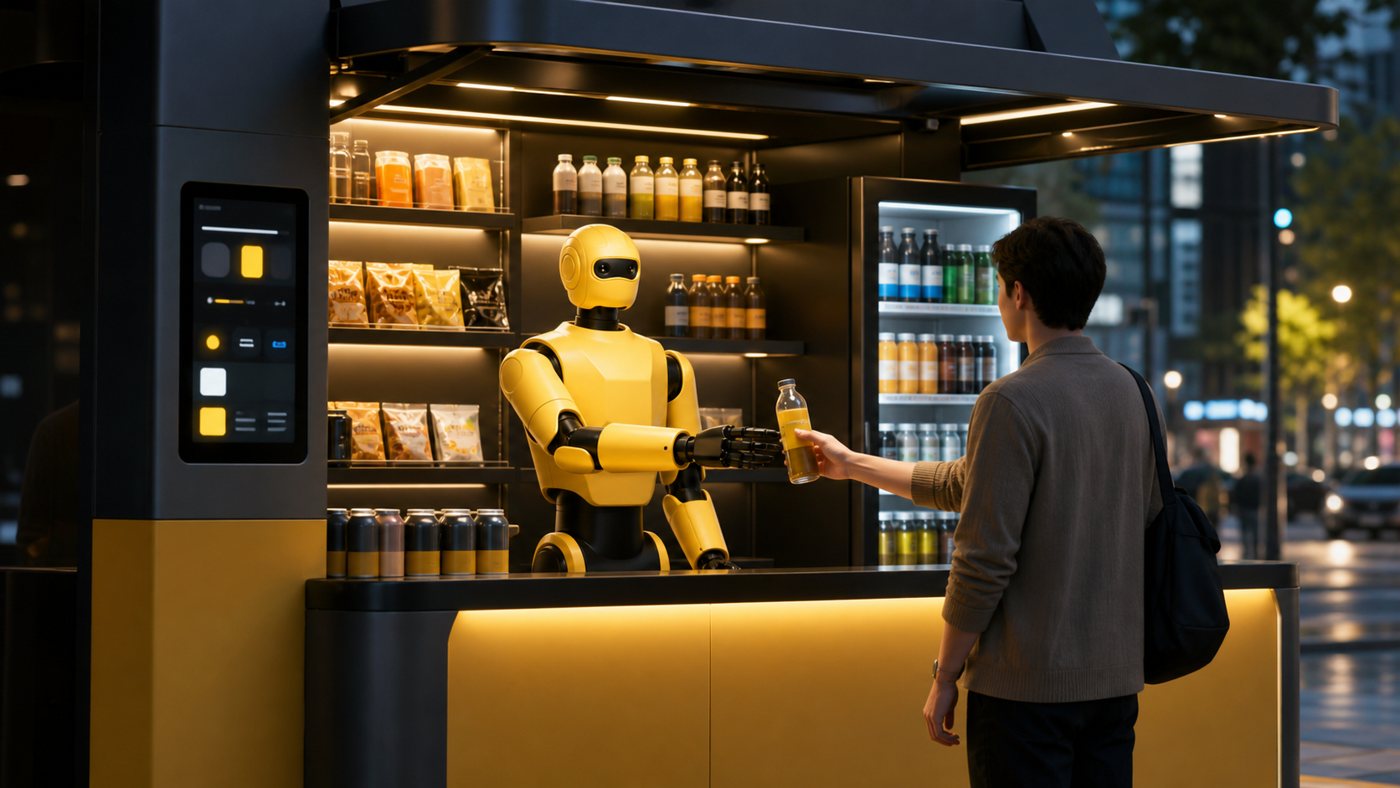
Concept rendering of a humanoid robot serving drinks from a retail kiosk
Concept rendering of an unattended retail kiosk. Illustrative only — not a deployed installation.

How it works

Body, eyes, brain and an open software stack

The hardware is designed and checked in simulation first, so the robot that arrives on site already matches the training environment its skills were learned in.

01

Humanoid body

34 degrees of freedom on the differential base or 40 with the omnidirectional base: two 7-DoF arms, a 2-DoF neck, 2-DoF waist and 2-DoF legs, with all cabling run inside hollow joints.

02

Stereo vision + SLAM

Humanoid stereo vision with a 90° × 60° field of view, plus laser and visual SLAM navigation repeatable to ±10 mm.

03

Simulation-trained skills

Synthetic data and auto-labelled scenes train the base model; a single human demonstration can be turned into a precise dual-arm trajectory without a teleoperation rig.

04

Layered open software

UI, API and voice on top; task planning with behaviour trees, state machines or LLM/VLM; manipulation, perception, navigation and VLA algorithms; an SDK over EtherCAT, Ethernet, USB, CAN and RS-485.

Deployment

From a task video to a running pilot

Most projects start with one well-defined task and a short supervised pilot before more skills are added.

STEP 01

Task & site review

A video of the task, the objects and their weights, counter or shelf heights, aisle widths, network coverage and where the robot will charge.

STEP 02

Configuration

Dexterous hand or gripper, differential or omnidirectional base, single or dual PC and optional wrist cameras are chosen for the task.

STEP 03

Train & validate

The task is modelled in simulation, training data is generated, and demonstrations or teleoperation fill the gaps before the robot touches real stock.

STEP 04

Pilot & scale

A supervised pilot on site, then OTA skill updates, automatic charging and additional tasks once the first one is stable.

Video

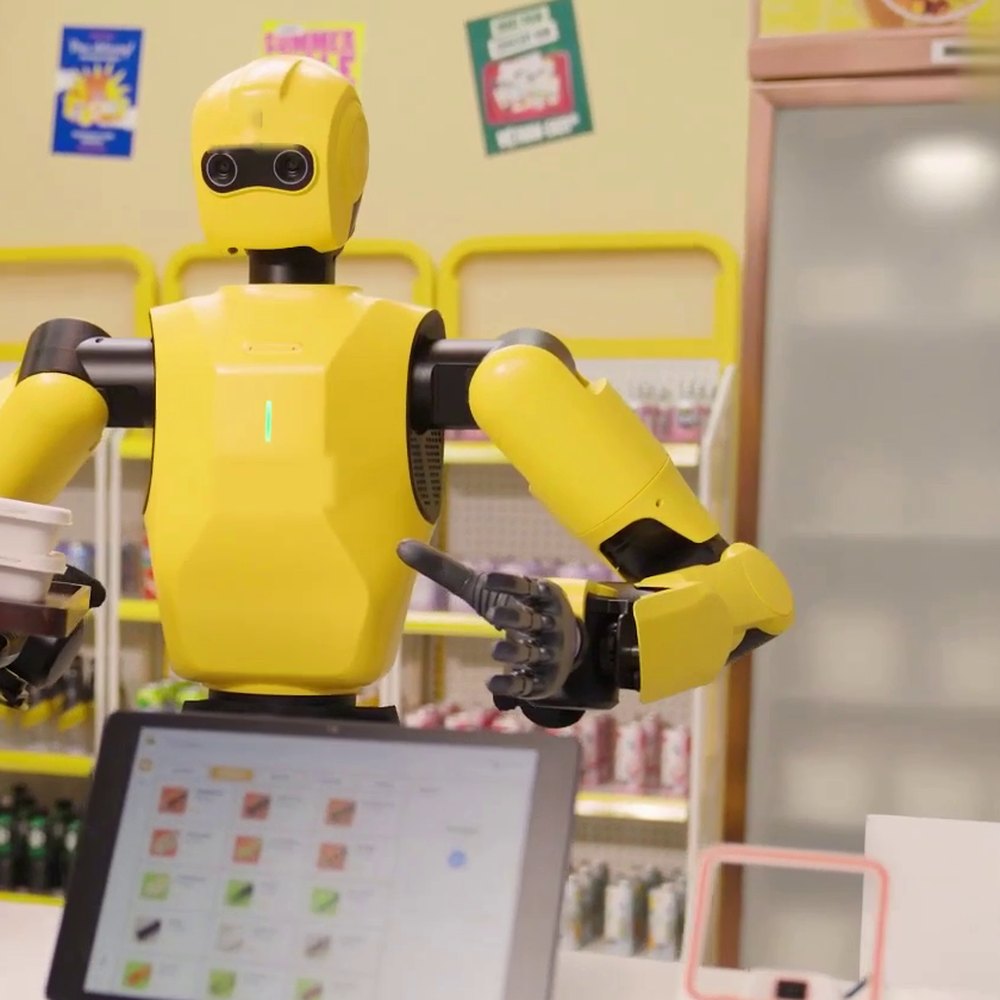
AHR-1636 serving in a convenience store

A staged demonstration in a store set: greeting, order confirmation, picking, handover and restocking. It shows the robot's capabilities under filmed conditions, not a productivity measurement.

Convenience-store service demoThe robot greets a shopper, confirms the order, picks items from the shelf, hands over heated food and restocks. On-screen subtitles are in Russian.

AHR-1636

Technical specifications

Body
Dimensions (L × W × H)682 × 550 × 1,636 mm
Weight≤ 100 kg
Max. degrees of freedom34 (differential base) / 40 (omnidirectional base)
TorsoNeck 2 DoF, waist 2 DoF, legs 2 DoF
Arms
Arm DoF7 per arm (shoulder 3, elbow 1, wrist 3)
Rated payload10 kg per arm at 0.5 m
Repeatability± 0.5 mm (without hand)
CablingFully internal through hollow joints
End Effectors
OptionsDexterous hand or two-finger gripper; wrist stereo camera optional
Dexterous hand6 active DoF, five-finger human-like design
Mobile Base
ChassisDifferential (2 DoF) or omnidirectional (8 DoF, optional)
Max. speed1.5 m/s
MotionForward, reverse, spin in place; sideways with omnidirectional base
Perception & Navigation
Vision6 cm-baseline humanoid stereo vision with large-model stereo algorithm
Field of view90° × 60°
NavigationLaser SLAM and visual SLAM
SLAM repeatability≤ ± 10 mm
Control & Computing
Computing≥ 100 TOPS; single or dual PC configuration
Real-time control1 kHz whole-body joint control over EtherCAT
Force control0.1 N sensitivity
Hand-eye calibrationAutomatic
UpdatesOTA
Power
Runtime≥ 8 h
ChargingAutomatic docking
Software
FrameworkROS 2-based open SDK with joint-level and high-level interfaces
Task planningBehaviour trees, state machines, LLM or VLM
TeachingZero-force drag teaching, impedance mode, industrial motion commands, teleoperation
InterfacesEtherCAT, Ethernet, USB, CAN, RS-485

Specifications are based on the manufacturer's technical data sheet. Training-efficiency figures are manufacturer-stated. Products are continuously improved and specifications may change without notice. Final configuration is confirmed in the quotation.
AHR-1636 FAQ

Questions buyers ask about wheeled humanoid robots

Does the AHR-1636 walk on legs?
No. It has a humanoid upper body on a wheeled base. Wheels give it a stable platform for two-handed work, a top speed of 1.5 m/s and a runtime of 8 hours or more, which matters more in shops, labs and factories than walking.
How much can it lift?
Each 7-DoF arm is rated at 10 kg at 0.5 m from the shoulder. For heavier parts or longer reach at a machine, the AMC-0010 mobile cobot or an AMR is the better fit.
How long does it take to teach it a new task?
It depends on the task. Simulation-generated training data, one-shot learning from a human demonstration, drag teaching and teleoperation all shorten the process compared with collecting real-world data from scratch. We recommend a supervised pilot on the real task before committing to a rollout.
Should I choose dexterous hands or two-finger grippers?
Dexterous five-finger hands (6 active DoF each) suit varied objects and human-facing service such as handing items to customers. Two-finger grippers are simpler and suit repeatable industrial picks. The choice is confirmed after we see your objects.
Can our own developers program it?
Yes. The software stack is ROS 2-based, with joint-level force/position hybrid control for researchers and high-level APIs, drag teaching, impedance mode and industrial motion commands for application developers. Task planning can use behaviour trees, state machines or LLM/VLM planners.
Where does it work best?
At counters, shelves and workbenches designed for people: convenience retail, reception and guided shopping, light assembly and sorting, warehouse picking pilots, research labs and service trials. Floors, slopes, network coverage and charging position are checked during the task review.
How is it different from the ASR-0012?
The ASR-0012 is a purpose-built retail robot with a 3 kg arm and zero-shot product recognition for stock checks, restocking and order picking. The AHR-1636 is a general-purpose two-armed humanoid with 10 kg arms for a wider range of service and light industrial tasks.
What documentation is available?
Configuration, certification coverage for your market and the technical documentation are confirmed in the quotation, together with training and support terms.

Related

Other mobile manipulation robots

Send a video of the task you want to automate.

Share the objects, counter or shelf heights, cycle time, floor layout and project country. We will confirm whether the AHR-1636 fits and which hand and base configuration to quote.

Open contact form→