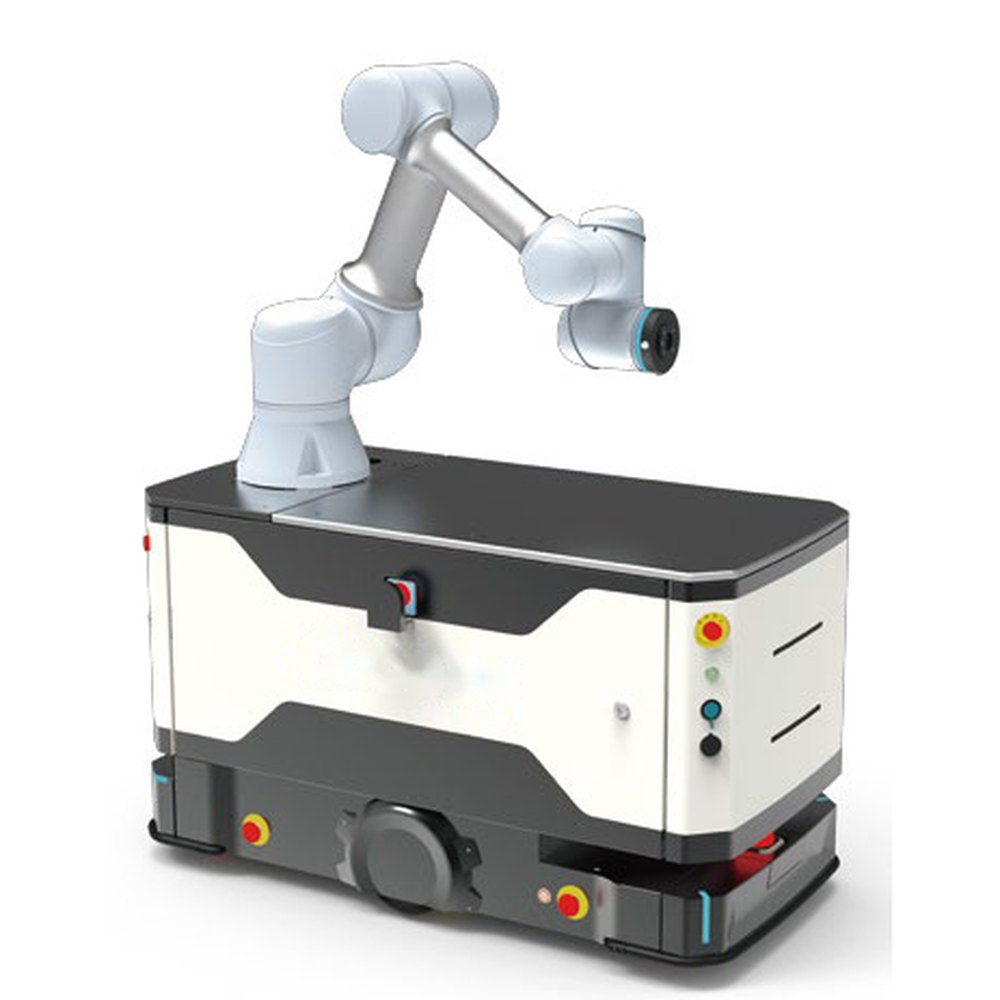
System
ConfigurationAutonomous mobile platform + 6-axis collaborative arm (10 kg class)
Platform dimensions800 × 600 × 700 mm (excl. arm and side lidar)
Total weightapprox. 260 kg
System accuracy± 0.3 mm (depends on end positioning device, docking and arm accuracy)
Mobile Platform
Platform payload120 kg max.
NavigationSLAM and QR code
DriveTwo-wheel differential
Max. speed≤ 1.2 m/s
Turning speed≤ 0.5 m/s
Min. turning radius500 mm
Min. aisle width900 mm
Docking accuracy± 5 mm, ± 1°
Step / gap10 mm step, 30 mm gap
Ground clearance30 mm
Gradeability< 5% (2.86°)
Collaborative Arm
Degrees of freedom6
Max. payload10 kg
Reach1,300 mm
Repeatability± 0.03 mm
Max. TCP speed3.8 m/s
Joint range± 360° on all joints
Powerapprox. 400 W typical
Arm protectionIP54 / IP65
Tool I/O2 DI, 2 DO, EtherCAT, RS-485
Battery & Charging
BatteryLFP, DC 51.2 V
Capacity / runtime28 Ah, approx. 5.5 h; optional 80 Ah, approx. 8 h
Charging time≤ 1.5 h (standard); ≤ 2 h (optional pack)
Charging methodsContact, wireless or battery swap — manual or automatic
Interfaces
HardwareCAN bus, RS-485, RS-232, RJ45, USB
ProtocolsCANopen, Modbus and others
ControlsStart, pause, reset and teach buttons
Environment
UseIndoor only
Temperature-10 to 45 °C
Humidity5 – 95% RH, non-condensing
Cleanliness optionsStandard, ISO Class 6 or ISO Class 5
Safety
Collaborative functionsCollision detection, force and power monitoring
Arm functional safetyTÜV SÜD certified to ISO 10218-1, ISO/TS 15066, ISO 13849-1 and IEC 61508
Specifications are based on the manufacturer's product catalogue for this platform with the 10 kg arm. System accuracy depends on the end positioning device, platform docking and arm accuracy; runtime depends on duty cycle. Products are continuously improved and specifications may change without notice. Final configuration is confirmed in the quotation.