Electronic Shelf Label Manufacturers: How to Evaluate One
Choosing an electronic shelf label manufacturer is not about the lowest unit price. It is about whether the factory controls the panel grade, the RF, the battery, the firmware and the documentation that decide whether your labels still work in year three. Here is the evaluation standard we would use — and the difference between a real factory and a trading company that simply re-badges one.
Updated 2026-07-24 · 19 min read
First, separate a real manufacturer from a trading company
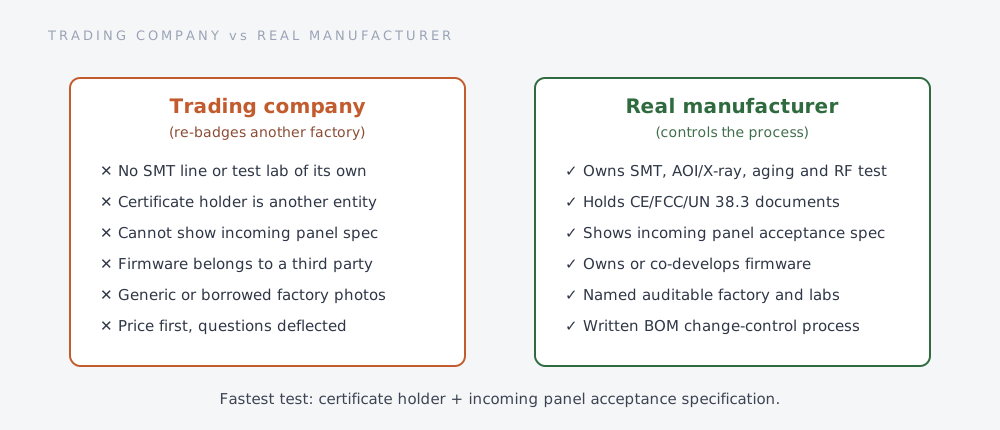
The fastest test in ESL sourcing: ask who legally holds the CE, FCC and UN 38.3 documents, and ask to see the incoming panel acceptance specification. A real manufacturer owns both, along with the SMT, test and reliability capability behind them. A trading company re-badges another factory's product and can produce neither.
A large share of "manufacturers" in this category are trading companies. That is not automatically disqualifying — but it changes everything about what you are buying. When you buy from a trader, you inherit the risks of a factory you cannot see, audit, or hold to a specification, and you pay a margin for the privilege. When you buy from the factory, you can verify, specify, and enforce.
The single fastest test: who holds the certificate, and can they show the incoming panel spec. PanPanTech, 2026.
The rest of this guide is the evaluation standard we apply — the concrete capabilities a top-tier electronics factory actually has, described so you can audit any supplier against them. It is deliberately specific, because vague advice ("choose a reputable factory") is exactly what lets a paperwork shop pass. The component-level view behind these criteria is in our ESL teardown, and the certificate mechanics in our certification guide.
The first filter: can they even make the technology you need?
Before evaluating quality, confirm capability. A factory that only builds monochrome E-Ink labels cannot serve an 80°C outdoor deployment or a full-colour promotional display. Match the technology to the environment first, then evaluate the factories that can actually build it.
E-paper is not one technology, and neither is ESL manufacturing. A supplier tooled for monochrome electrophoretic labels is a poor fit if your deployment needs the wide temperature range of cholesteric or ultra-stable LCD, or genuine full colour. Sending an outdoor, high-heat requirement to a monochrome-only factory wastes everyone's time — and worse, some will accept the order and ship a product that fails in the field.
Decide the display route from the environment before you shortlist factories. Our e-paper technology comparison lays out the routes: monochrome and colour E-Ink for ambient indoor shelves, cold-rated wide-temperature E-Ink for freezers, and cholesteric or ultra-stable LCD for outdoor, high-heat or full-colour work. Then ask each candidate factory which routes it actually manufactures — not which it can "source", which is the trader's answer.
The display supply chain: the question that separates serious factories
A serious ESL manufacturer buys display panels to a written incoming acceptance specification and can show it. That single document screens out the Grade B and reject panels that a suspiciously low quote hides. If a factory cannot produce it, it is not controlling the most important and expensive component.
The display module dominates both the bill of materials and the field failure rate. Panel makers sort their output by defect severity — Grade A meets the full cosmetic specification, Grade B carries minor or tolerated-zone defects at a discount, and reject panels fail outright. A factory that quietly buys Grade B (or worse) and sells it as though it were Grade A is the most common reason a label is cheap.
So the evaluation question is not "is your panel good?" — everyone says yes — but "show me the incoming panel acceptance specification you buy to, and your inspection records against it." A factory that controls this has a document and full-field inspection data. A factory that does not will change the subject. The grading mechanics, and how to inspect panels on full-white and full-black fields rather than on price text, are detailed in the teardown.
The hardware a real factory controls — and how to audit it
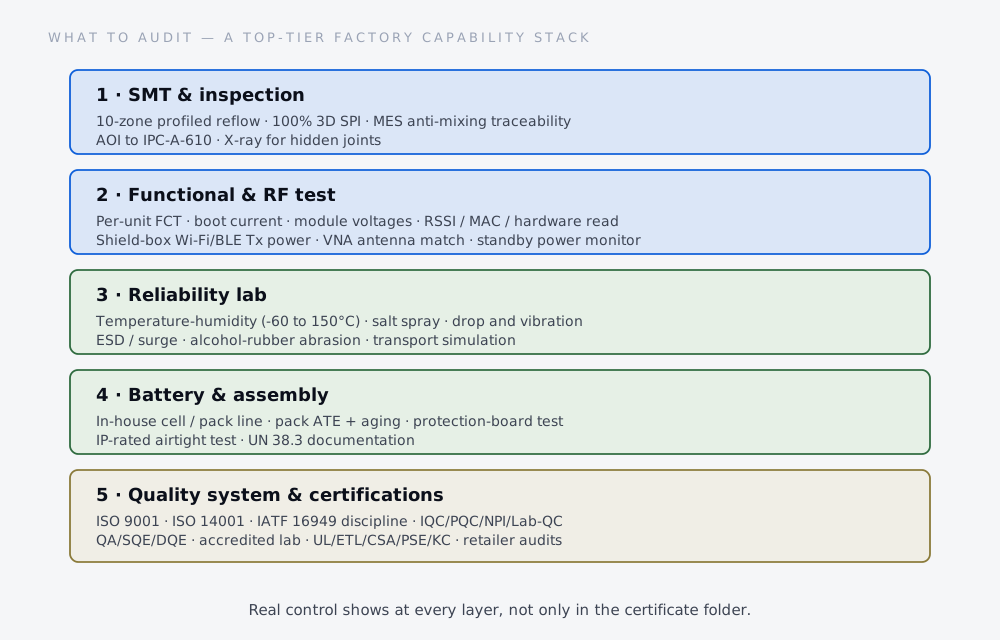
A top-tier electronics factory controls its board, its RF and its battery with specific, auditable capability: profiled SMT with 100% 3D solder-paste inspection and AOI to IPC-A-610, a shield-box RF line that tunes the antenna with a vector network analyser, and in-house battery pack testing and aging. These are the standards a well-run factory meets — measure any supplier against them.
What follows is the anonymised capability standard of a genuinely top-tier electronics manufacturer. Use it as your yardstick.
ASMT and inspection
ReflowA multi-zone (e.g. 10-zone) reflow oven running a profiled temperature curve matched to the components and solder — not a fixed profile applied to every board. Ask to see the reflow profile record for a board like yours.
Solder-paste inspection100% inline SPI with 3D measurement of paste height, area and volume, generating SPC data in a closed loop with the printer. This catches paste defects before components are placed — the cheapest place to catch them.
TraceabilityHigh-precision placement with an MES and anti-mixing system, so every reel is traceable and wrong-part errors are designed out. Ask how a bad batch would be traced back.
AOI & X-ray100% post-reflow AOI with inspection parameters set to the IPC-A-610 acceptability standard, plus X-ray for hidden joints under bottom-terminated packages. Ask for the defect-per-million trend, not a pass/fail claim.
BFunctional and RF test — with the right instruments
This is where a subtle but revealing distinction lives, and it is worth stating plainly because the shop-floor folklore gets it wrong. Different instruments answer different questions, and a real factory has the right one for each:
InstrumentWhat it correctly measuresOn an ESL line
Vector network analyserReturn loss / VSWR vs frequency — antenna impedance matchTunes and verifies the trace antenna in the assembled product
RF communication testerTransmit power, receiver sensitivity, throughputVerifies Wi-Fi/BLE performance, often in a shield box at simulated distance
Spectrum analyserPower vs frequency — noise, harmonics, spursCharacterises supply and RF noise, pre-compliance
OscilloscopeVoltage vs timeSupply ripple, power-on timing — NOT antenna matching
Power monitorCurrent draw over timeStandby current and battery-life validation
Source: anonymised standard of a top-tier electronics factory's test floor, 2026.
A factory that "tests the antenna with an oscilloscope" has told you something important about its RF competence. The antenna is a frequency-domain measurement — it needs a vector network analyser, as our teardown explains. On the functional side, a real line runs a per-unit test reading boot current, module voltages, RSSI, and MAC and hardware-version identifiers, and a shield-box Wi-Fi/BLE test at a simulated distance — so every unit, not a sample, is proven before it ships.
CBattery and assembly
The battery is the highest field-failure component. A serious factory tests it as a pack, not just as a cell: pack automated test equipment (ATE), pack aging to catch early-life failures, and a protection-board test. Better factories run an in-house cell or pack line, which gives them traceability a trader can never offer. And the assembled pack must carry its own UN 38.3 documentation — the cell's certificate does not cover the pack. Where the product is sealed, an IP-rated airtight test (for example IP66, tested at a defined depth and time) belongs on the line too.
The reliability lab: where "quality" becomes measurable
A real factory owns a reliability lab and, ideally, a third-party-accredited in-house laboratory. That is where display, enclosure, RF and battery are proven against temperature, humidity, corrosion, drop, vibration and static — the stresses that decide whether a label survives a summer storefront or a chilled aisle. A supplier without one is testing on your customers.
Certificates prove a design passed once. A reliability lab proves the factory can keep it passing, and can engineer to a target instead of guessing. The anonymised standard of a top-tier factory's lab covers the full stress set:
Temperature & humidityProgrammable chambers spanning roughly −60 to 150°C with controlled humidity — the test behind any claim about outdoor, high-heat or freezer suitability. Tie this back to the display route: it is how an 85°C rating is verified rather than asserted.
Salt sprayCorrosion testing (NSS/CASS) to JIS, ASTM, CNS and GB parameters — relevant wherever labels meet humidity, cleaning chemicals or coastal air.
Drop & vibrationFree-fall drop on faces, edges and corners, and electromagnetic vibration and transport-simulation rigs to GB/UL/IEC profiles — the abuse of installation and shipping.
ESD, surge & abrasionESD/surge generators for electrical robustness, and alcohol-rubber abrasion testing for printed marks and silk-screen — the detail that decides whether the label's printing survives cleaning.
The strongest signal here is a third-party-accredited in-house laboratory — where an internationally recognised accreditation body recognises the factory's own lab, allowing witnessed testing on site. That accreditation means the lab's personnel, equipment and environment have been independently judged to international standard. It compresses certification timelines and, for you as a buyer, means the reliability data you are shown was generated under external oversight rather than in a back room.
Audit top-down: a factory strong on certifications but hollow on SMT and reliability is a paperwork shop. PanPanTech, 2026.
Firmware and platform: who actually owns the software?
Ask whether the factory owns, co-develops, or merely resells the firmware. Firmware controls over-the-air updates, the scheduled full refresh that prevents ghosting, and fleet management. A factory that resells someone else's software cannot fix bugs, cannot guarantee long-term support, and can lock you into a protocol you cannot leave.
The hardware can be excellent and the deployment still fail on software. Three firmware capabilities matter most for an ESL programme, and they are worth probing directly:
→Over-the-air update with rollback. Can the fleet be updated safely, with a second image and rollback, so a bug is a patch rather than a truck roll across every store? This needs flash headroom designed in from the start.
→Scheduled full refresh. Does the firmware run an automatic full refresh (commonly every 24 hours) to clear the ghosting that otherwise accumulates on a price held for weeks? A factory that owns its firmware can tell you the default interval; a reseller often cannot. The mechanism is explained in the teardown.
→Fleet platform and protocol. Is the management software the factory's own, and is the radio protocol open enough that you are not locked to one vendor forever? Protocol lock-in is a strategic risk, not a technical detail.
A manufacturer that owns or co-develops its firmware is a partner you can grow with. One that resells is a middleman between you and a software vendor you never chose.
Certifications and export documents
Evaluate certifications at two levels. Company-level systems show how the factory runs; product-level marks show that a specific model was tested. The strongest single signal of discipline is automotive-grade IATF 16949 on an electronics factory that does not have to hold it.
The anonymised standard of a top-tier factory spans both levels:
LevelWhat to look forWhy it matters
Quality systemISO 9001Baseline quality management — table stakes, not a differentiator
EnvironmentalISO 14001Environmental management; increasingly required by retail buyers
Discipline signalIATF 16949 (automotive)Held voluntarily by an ESL factory, it signals process rigour far above consumer-electronics norms
Social & supply chainBSCI, Sedex, RBA, C-TPATAudited labour and supply-chain security — often mandatory to supply large retailers
Product safety marksUL, ETL, CSA, PSE, KCMarket-specific safety approvals for the actual model and destination
Compliance & transportCE, FCC, UN 38.3EU conformity, US radio, and lithium-battery transport for the exact configuration
Source: anonymised certification profile of a top-tier electronics manufacturer, 2026. Confirm scope and validity per model and destination.
Two cautions carried over from our certification guide. First, a single "CE certificate" cannot cover a whole product — machinery, low voltage, EMC, radio and battery are separate instruments; ask which document covers which subsystem. Second, verify who holds the certificate: if it names a trading company or a former partner factory rather than your supplier, it may not transfer to your order at all.
OEM and private-label specifics
A private-label agreement is where sourcing risk concentrates. Settle model naming, MOQ, who is named as manufacturer and holds the technical file, IP ownership of firmware and tooling, and — above all — change control, before the first purchase order.
The teardown and certification guides explain why change control is the clause that saves programmes: when a supplier changes cell vendor, radio module, adapter or mainboard mid-production, the paperwork can silently become invalid and reliability can shift. For an OEM buyer placing your own brand on the product, that is your liability. Nail down these points in writing:
→Model naming and whether existing certificates can be reissued to your private-label model, at whose cost and on what timeline.
→Who is named as manufacturer for each destination market, and who holds and must produce the technical file on request.
→IP ownership — firmware, tooling and any custom design — and what happens to it if the relationship ends.
→Change control: written notification before any change to cell vendor, radio module, adapter or mainboard, because each can invalidate certification.
→MOQ, lead time, spare-part and consumable supply, and end-of-life notice for the platform.
If you are running an OEM or private-label ESL programme, our manufacturing and OEM capability page describes how we handle model-specific documentation and change control across exactly these points.
The factory audit checklist
Condensed into what to verify on a visit or a video audit. A factory that can walk you through all of it — with records, not just a tour — is a real manufacturer. Print it and tick as you go.
AreaWhat to verifyEvidence to request
SMT & inspectionProfiled reflow, 100% 3D SPI, MES traceability, AOI to IPC-A-610, X-rayReflow profile record, SPI/AOI defect trend, IPC-A-610 class statement
Functional testPer-unit FCT reading boot current, voltages, RSSI, MAC/HW versionFCT coverage list and failure rate by station
RF testShield-box Wi-Fi/BLE Tx power; antenna tuned with a VNA in the assembled productVNA return-loss data per batch; Tx power test records
DisplayWritten incoming panel acceptance spec; full-field inspectionThe spec document and inspection records
BatteryPack ATE, aging, protection-board test; UN 38.3 for the packATE/aging records; UN 38.3 summary for the assembled pack
CleanlinessDust-controlled workshop for optical/lamination steps; IP airtight testWorkshop grade; IP test parameters
Quality orgDefined IQC, PQC, NPI-QC, Lab-QC plus QA, SQE, DQE rolesOrg chart and headcount; control plan
CertificationsISO 9001/14001, ideally IATF 16949; UL/ETL/CSA/PSE/KC; CE/FCC/UN 38.3Certificates with holder, scope and validity per model
FirmwareOwnership, OTA with rollback, scheduled full refresh, fleet platformFirmware release notes; refresh default; protocol openness
Source: anonymised audit standard of a top-tier electronics manufacturer, 2026. Adapt to your product and destination markets.
Red flags
Any single one of these warrants a deeper audit before you commit. Two or more, and you are almost certainly looking at a trader or a paperwork shop.
Red flagWhat it usually meansWhat to do
Price far below the honest BOMGrade B/reject panels, thin firmware, or a missing test stepAsk which line item is cheaper — and why
No incoming panel specificationThe display — the key component — is uncontrolledRequest the document; treat absence as disqualifying
"CE" as one certificate for everythingCompliance is not actually understoodAsk which document covers which subsystem
No firmware ownershipMiddleman between you and an unknown software vendorAsk who fixes a bug in year two
No UN 38.3 for the assembled packShipment risk; battery not properly qualifiedRequire the pack-level summary before order
No in-house reliability labCannot engineer to a target; tests on customersAsk to see the lab; value third-party accreditation
Source: PanPanTech sourcing and OEM experience, 2026.
None of this requires you to become a manufacturing expert. It requires you to ask specific questions and insist on records rather than assurances — the same discipline the best factories apply to themselves.
FAQ
How do I tell a real ESL manufacturer from a trading company?
Ask two things: who legally holds the CE, FCC and UN 38.3 documents, and to see the incoming panel acceptance specification. A real manufacturer owns the certificates and the SMT, test and reliability capability behind them; a trading company re-badges another factory's product and can produce neither. A factory audit — SMT line, AOI/X-ray, RF test, reliability lab — settles it.
What certifications should an ESL factory hold?
At the company level, look for quality management (ISO 9001), environmental management (ISO 14001) and, as a strong signal of discipline, automotive-grade IATF 16949, plus supply-chain and social-audit programmes such as BSCI, Sedex, RBA and C-TPAT. At the product level, safety marks such as UL, ETL, CSA, PSE and KC, plus CE, FCC and UN 38.3 for the specific model. A third-party-accredited in-house laboratory is a further strong sign.
What manufacturing capability should I audit?
SMT with profiled reflow and 100% 3D solder-paste inspection, MES traceability, AOI to the IPC-A-610 standard and X-ray on hidden joints; per-unit functional test; RF test with a shield box and a vector network analyser for the antenna; an in-house reliability lab (temperature-humidity, salt spray, drop, vibration, ESD); and battery pack ATE and aging. Weakness at any of these layers is where field failures come from.
Why does the display supply chain matter when choosing a factory?
Because panel grade decides how the labels look in year three. A serious ESL manufacturer buys to a written incoming panel acceptance specification and can show it — screening out Grade B or reject panels that a low-cost quote hides. If a factory cannot produce that specification, it is not controlling the most important component.
What should a private-label or OEM agreement cover?
Model naming, minimum order quantity, who is named as manufacturer and holds the technical file, certificate reissue for your brand, IP ownership of firmware and tooling, and — critically — change control: the factory must notify you before changing cell vendor, radio module, adapter or mainboard, because each change can invalidate certification and alter reliability.
Does the factory need to own the firmware?
It is a major advantage if it does. Firmware controls over-the-air updates, the scheduled full refresh that prevents ghosting, and fleet management. A factory that resells someone else's firmware cannot fix bugs, cannot guarantee long-term support, and can lock you into a protocol. Ask whether firmware is owned, co-developed or merely resold.
What are the red flags of a weak ESL supplier?
A price far below the honest bill of materials; no written incoming panel specification; a single CE certificate presented as covering everything; no firmware ownership; no UN 38.3 for the assembled battery pack; and no in-house reliability lab or third-party accreditation. Any one of these warrants a deeper audit before you commit.
Send your specification — or this checklist — and our OEM team will respond with the panel grade, RF validation, battery test data and certification position behind the quote.