Industrial Robot Vacuum for Warehouse Floors: A Buyer Guide
A warehouse is not one cleaning problem, it is four — dock debris, tyre marks, packing-line dust and outdoor yard litter — and each needs a different machine. Before comparing models, answer two questions: where is the soil actually generated, and is your dust combustible? The second one can rule out a standard robot vacuum entirely.
Updated 2026-07-21 · 15 min read
What warehouse problem are you actually solving?
Warehouse cleaning problems fall into four groups: dry dust and debris, tyre marks and spills, outdoor loading-area litter, and proof-of-work reporting. A robot vacuum handles the first. It does nothing for the second, and it is the wrong machine entirely for the third.
An industrial robot vacuum should be evaluated as part of a facility workflow, not as a standalone gadget. The right answer depends on floor area, dust load, forklift traffic, aisle width, shift timing, and whether the robot must produce cleaning records for a contract or an audit.
The mistake that costs the most is buying one machine to solve all four problems. Warehouses are large enough that a single robot rarely covers everything anyway, and the four problems have genuinely different physics. Splitting the requirement early usually produces a cheaper and better-performing answer than looking for one machine that claims to do it all.
ProblemWhat it needsWhat fails if you get it wrong
Dry dust and debrisVacuum or sweep with adequate bin capacityBin fills constantly; staff empty it more than the robot saves
Tyre marks and traffic soilingScrubbing — water, detergent, brush pressure, recoveryA vacuum passes over it and the floor still looks grey
Outdoor yard and dock apronSweeper with a real hopper, weather-ratedAn indoor machine clogs or is damaged within weeks
Proof of workFleet software with coverage maps and exception logsNo evidence for the client, the auditor or the contract
Map where the dirt is generated, not where it ends up
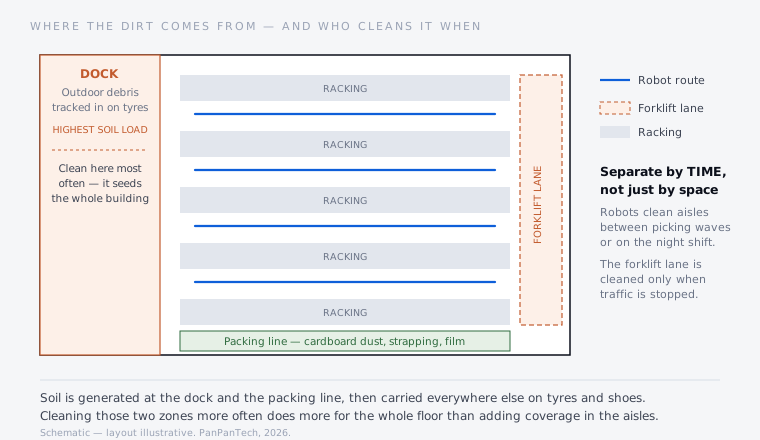
Most warehouse floor soil originates in two places — the inbound dock and the packing line — and is then carried across the building on tyres and shoes. Cleaning those two zones more often does more for the whole floor than adding coverage in the aisles.
This is the single most useful reframing for a facility team planning a robot deployment. The instinct is to measure total floor area and buy coverage to match. The better approach is to find the sources and interrupt the transport path.
Schematic: soil sources, robot routes and the forklift lane. Layout illustrative. PanPanTech, 2026.
Walk the building and mark five things on a floor plan: inbound docks, packaging and strapping stations, forklift lanes, pedestrian corridors, and any production-side transfer route. Those are your generators and highways. Aisles deep in racking are usually the cleanest part of the building and the least worth spending coverage on.
Two consequences follow. First, a smaller machine cleaning the dock apron three times a day can outperform a larger machine cleaning the whole floor once. Second, if a robot cannot reach the dock area because of pallet congestion or traffic, its value drops sharply regardless of specification — so check access to the dirty zones before sizing anything.
Before anything else: is your dust combustible?
If your facility handles grain, flour, sugar, wood, metal powders, plastics, pharmaceuticals or similar materials, the dust may be combustible — and a standard robot vacuum is the wrong machine. Cleaning equipment must be approved for that duty, and housekeeping falls under a dust hazard analysis. Settle this before you compare any models.
This question gets skipped in most cleaning-robot conversations, and it is the one with the highest consequences. A vacuum works by moving air and suspending particulate. In an environment with combustible dust, that is precisely the mechanism that creates an explosible cloud, and a motor or static discharge is a plausible ignition source.
Two points from the standards worth carrying into your supplier conversation:
Thin layers matterDust layers as thin as 1/32 of an inch — under a millimetre — can be hazardous. Warehouse teams routinely underestimate this because such a layer looks like ordinary light dust on a beam or ledge.
Analysis before equipmentNFPA 652 requires a dust hazard analysis for existing processes and facilities. Housekeeping method and equipment selection follow from that analysis — not the other way round. OSHA guidance likewise directs facilities to use only vacuum equipment approved for dust collection in these environments, and to avoid methods that raise dust clouds.
Most general-merchandise, e-commerce and cold-chain warehouses are not in this category, and the conversation ends here. But if any part of your operation touches those materials, tell the supplier at the enquiry stage. A vendor who responds by asking about your dust hazard analysis knows this territory; one who simply quotes a standard machine does not.
Robot vacuum, sweeper, or scrubber?
Once soil type and dust classification are settled, the machine class usually chooses itself.
Robot typeBest warehouse useLimitation to check
Commercial vacuum robotDry dust and light debris in offices, mezzanines and support areasNot designed for wet or heavy soil; bin capacity limits run length
Autonomous scrubberHard-floor cleaning across large indoor routes; removes tyre marksNeeds water supply, drainage and wet-floor controls; heavier and wider
Sweeper (indoor)Coarse debris, packaging waste, cardboard dust near packing linesHopper size and dust containment; fine dust may need filtration
The realistic answer for a mid-size distribution centre is usually two machines: a scrubber for the main hard-floor routes, and a sweeper or compact vacuum for the packing area and support spaces. Sites with an outdoor yard add a third. Presenting that as one line item to management is harder than presenting a single robot, but it is the honest sizing — and it prevents the far worse outcome of one machine visibly failing at three jobs.
Forklift traffic and safety planning
Separate cleaning robots and forklifts in time, not just in space. Powered industrial trucks account for a small share of warehouse incidents but a disproportionate share of serious injuries, and a cleaning robot adds a slow-moving obstacle to lanes designed for fast vehicles.
The scale is worth stating plainly. OSHA estimates tens of thousands of forklift-related injuries annually in the United States — commonly cited in the range of 35,000 to 62,000 — with roughly 85 fatalities a year. Powered industrial trucks are involved in about 1% of warehouse and factory accidents but around 11% of physical injuries, which is the signature of a low-frequency, high-severity hazard.
A robot does not cause those incidents, but it changes the traffic picture, and the deployment plan has to account for that. The practical rules that work:
→Clean aisles between picking waves or on the night shift; clean main forklift lanes only when traffic is stopped.
→Define no-go zones and time windows in the fleet software, and review them after layout changes — warehouses reconfigure constantly.
→Brief forklift drivers directly. Most near-misses trace to a driver who did not expect a machine there, not to a sensor failure.
→Place charging and water stations off traffic routes, and make the robot's parked position visible and consistent.
→Agree what happens when a route is blocked by a pallet: re-route, wait, skip and report — and make sure it reports rather than silently skipping.
Control pointWhy it mattersReference
Walkway conditionFloors kept clean, orderly and dry where possible; wet-floor signalling during scrubbingOSHA 1910.22
Driverless industrial vehiclesAMRs and AGVs require safety design and operational controlsISO 3691-4
Industrial mobile robot safetyRisk assessment covering people, payload and work areaANSI/A3 R15.08
Product documentationCertificates matched to the exact model and configurationSee our certification guide
Compliance summary, not legal advice. Confirm the applicable requirements for your site and jurisdiction.
Cleaning robots and AMRs in the same building
Many warehouses want both clean floors and automated material movement, and the two systems have to share the same aisles. The coordination problem is real but tractable, provided it is designed rather than discovered.
Cleaning robots should avoid peak transport routes. AMRs should avoid zones with wet floors until they are dry — a scrubber leaves a short window where traction and sensor reflections both change, which matters more for a loaded transport robot than for a person. If both fleets run on managed traffic systems, agree in advance which has priority at intersections, and how an exception is escalated to a human.
On the material-handling side, the AMR-0300 supports 300 kg delivery workflows and the AMR-0600 targets 600 kg rack and industrial transport — background on platform selection is in our AMR versus AGV guide, and the site-level view is in warehouse and logistics solutions. One supplier can coordinate both categories, which simplifies commercial handling. Evaluate the two capabilities separately even so: a strong AMR platform does not imply a strong scrubber.
Sizing and scheduling for warehouse scale
Size against the shift window, not the floor area. The question is not "can this robot clean 20,000 m²" but "can it clean the zones that matter, inside the hours when the aisles are actually free, without more staff intervention than it saves."
Three variables decide whether a deployment works at warehouse scale, and only one of them appears on a specification sheet.
Practical coverageCatalogue m²/h assumes unobstructed travel. In racking with turns at every aisle end, plan on roughly 50–70% of the quoted rate. Ask the supplier for a practical figure from a comparable site and how it was measured.
The real windowAisles are rarely free for a full shift. Measure the actual uninterrupted window — often three to five hours overnight — and size against that, not against a nominal eight-hour night.
Intervention loadEvery tank refill, dump and bin empty is staff time. A machine needing four interventions per run in a building where the water point is 200 metres away has quietly recreated the job it replaced. Count the interventions and the walking.
On battery and recharge: confirm whether the machine auto-resumes at the point it stopped after charging, or restarts the route. On a large floor that single behaviour can be the difference between finishing the building in one night and never finishing it at all.
Send this with the enquiry. A supplier who asks for it unprompted has done warehouse work before; one who quotes without it is quoting a floor area, not your building.
→Floor plan or dock photos, total and cleanable floor area, floor material, and the narrowest aisle measured with a tape.
→Soil identified separately by zone: dry debris, tyre marks, wet spills, outdoor litter — and whether any dust is combustible.
→Forklift traffic hours, picking wave timing, and the genuine uninterrupted cleaning window.
→Water fill and drainage locations, charging power availability, and the distance staff must walk to them.
→Whether route reports are needed for contractor or facility audits, and in what format.
→Final datasheet, certification package, spare-part list and service response time — before purchase.
→A pilot plan on one building, on the dirtiest zone, before scaling across a network.
Multi-site operators should add one more item: agree how the fleet dashboard aggregates across buildings, and who owns exceptions at each site. A network of ten warehouses with no single view of robot status becomes ten separate problems within a year.
FAQ
Is a warehouse robot vacuum the same as an autonomous scrubber?
No. A vacuum picks up dry debris into a bin. An autonomous scrubber applies water and detergent, works the floor with brush pressure, and recovers the dirty solution with a squeegee and vacuum. Most warehouses need sweeping or vacuuming in dry zones and scrubbing where tyres leave marks.
What if our warehouse dust is combustible?
Then a standard robot vacuum is the wrong machine. Where combustible dusts are present, cleaning equipment must be approved for that duty, and housekeeping is governed by a dust hazard analysis under standards such as NFPA 652. Dust layers as thin as 1/32 inch can be hazardous. Resolve this question before comparing machines, not after.
Can cleaning robots work around forklifts?
Yes, when routes, timing, speed and stop behaviour are planned around traffic. The safest arrangement separates them in time as well as space: robots clean aisles between picking waves or on the night shift, and main forklift lanes are cleaned only when traffic is stopped. Forklifts remain a serious hazard, with OSHA estimating tens of thousands of injuries a year.
Where should a warehouse clean most often?
The inbound dock and the packing line. Those two zones generate most of the soil, which is then carried across the building on tyres and shoes. Increasing frequency there does more for overall floor condition than adding coverage in the aisles.
Which model fits a dusty warehouse?
For support areas and offices, a compact cleaning robot is usually enough. For large hard floors with tyre marks and traffic soiling, compare the ACR-0800 ride-on autonomous scrubber with the self-docking ACR-0600. Outdoor yards and loading areas need a sweeper with a real hopper, not an indoor vacuum.
How do cleaning robots and warehouse AMRs coexist?
Give each system its own schedule and rules. Cleaning robots should avoid peak transport routes; AMRs should avoid zones with wet floors until they are dry. If both run on managed traffic systems, agree in advance which has priority at intersections and how exceptions are escalated.
Can one supplier provide both cleaning robots and AMRs?
Yes, and it simplifies commercial handling — but evaluate cleaning performance and material-handling performance separately. A strong AMR platform does not imply a strong scrubber, and buying both from one vendor should not mean accepting a weaker machine in either category.
What is the first step for a warehouse quote?
Send a floor plan or dock photos, total and cleanable floor area, floor material, soil type by zone, narrowest aisle width, forklift traffic hours, shift schedule, whether cleaning records are required, and the destination country.
Send a floor plan, get a zone-based recommendation
Tell us your dock layout, soil types, aisle widths and traffic hours — PanPanTech will propose which zones to automate first and which machine class fits each one.