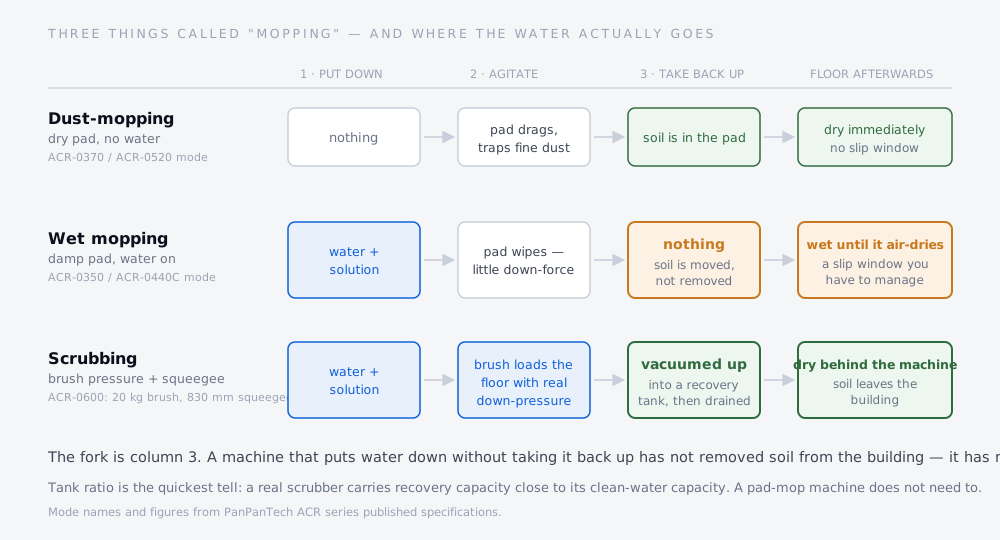
"Mopping robot" is almost always a mode, not a machine class — and two very different modes share the name. The question that actually decides your purchase is whether the machine takes back the water it puts down. A mopping pass moves soil and leaves the floor wet; a scrubbing pass removes soil and leaves it dry. Everything else — coverage, price, navigation — follows from that one difference.
Updated 2026-09-12 · 14 min read
Three different jobs share the word "mopping"
Dust-mopping uses a dry pad and no water. Wet mopping applies moisture and wipes it across the floor. Scrubbing applies solution, agitates it under real brush pressure, and vacuums the dirty water back up. Vendors use "mop" for the first two and sometimes loosely for the third, which is where most mis-purchases begin.
Search for a commercial mopping robot and you will be shown machines that do quite different things. The confusion is not deliberate so much as inherited: in manual cleaning, "mopping the floor" covers everything from a dust mop in a corridor to a wet mop in a washroom, and the robot market borrowed the vocabulary without tightening it.
It matters because the three modes leave your floor in three different states. Here is what actually happens in each:
The fork is the third column. PanPanTech, 2026, using published ACR series mode definitions.
Notice that on our own range the modes are listed as capabilities of multi-function machines rather than as separate product lines — the compact ACR-0350 lists sweeping, vacuuming, mopping and scrubbing on one chassis, while the ACR-0370 and ACR-0520 list dust-mopping alongside scrubbing. That is typical of the category and it is why a spec sheet saying "mopping" tells you very little on its own. You have to read which kind.
Water recovery is the fork in the road
A machine that puts water down without taking it back up has not removed soil from the building — it has relocated it, and left the floor wet while it dries. A machine with a squeegee and a recovery tank removes both the water and the soil suspended in it. This single difference drives cleaning result, safety exposure and running cost.
Think about what a cleaning pass is supposed to achieve. Soil sits bonded to the floor. To get it out of the building you need three things in sequence: something to loosen it, enough mechanical force to release it, and a way to carry it away. A wet mopping pass does the first, does very little of the second — a pad wiping under its own weight applies almost no down-pressure — and does none of the third. The soil ends up suspended in a film of water spread across the floor, which then dries in place.
That is not a failure of the machine; it is what mopping is. Manual mopping has the same physics and has been used for a century. The mistake is buying a mopping robot for a job that needed scrubbing, because the marketing language did not distinguish them and the price difference made the choice feel easy.
How to tell them apart on a spec sheet in ten seconds
Look for three fields: a recovery tank sized close to the clean tank, a stated squeegee width, and brush down-pressure in kilograms. A genuine scrubber lists all three. A pad-mop machine lists none of them, and no amount of "deep cleaning" copy changes that.
The tank ratio is the fastest tell, because it reveals design intent. A machine built to take dirty water out of a building must carry somewhere to put it. Compare two machines from the same range:
FieldMulti-function unit (ACR-0440C)Dedicated scrubber (ACR-0600)
The weight column is the quiet confirmation. Brush down-pressure has to be reacted by machine mass; a 42 kg robot cannot press 20 kg into the floor and stay planted. When a lightweight machine claims scrubbing performance, ask what down-pressure it applies and how it is achieved — the honest answer is usually that it scrubs lightly, which is fine for light soil and not for anything bonded.
The wet-floor window is a real liability, not a nuisance
A mopping pass leaves the floor wet until it air-dries, and that period is slip exposure you have to manage. Same-level falls are the second most expensive category of workplace injury in the United States, at roughly $10.5 billion a year in workers' compensation costs, and they concentrate hardest in leisure and hospitality.
This is the part of the decision most buyers skip, and it is the one with a number attached. Falls on the same level account for around $10.5 billion in annual US workers' compensation costs, ranking second among all injury causes; across the economy, cases involving falls, slips and trips totalled roughly 479,000 in a single recent year, and about 22% of slip-and-fall injuries put someone off work for more than a month. In leisure and hospitality specifically, same-level falls make up close to 30% of that sector's injury costs — the highest concentration of any sector.
There is also a standard that speaks to it directly. Under ANSI A326.3, hard-surface flooring in level interior spaces that are expected to be walked on while wet must achieve a wet dynamic coefficient of friction of at least 0.42 when tested with the specified sensor and solution — a requirement aimed at lobbies, entryways, restrooms, kitchens and similar areas. If you are going to introduce a machine whose normal operation leaves water on those floors, it is worth knowing where your flooring sits against that threshold before the machine arrives rather than after an incident.
None of this argues against wet mopping. It argues for scheduling it when the floor can be left alone, routing it away from entrances during trading hours, and being honest in the business case that "cleans during the day while customers browse" is a claim that needs qualifying for a wet pass in a way it does not for a dry one.
Moving soil around is not the same as removing it
The long-standing finding in cleaning research is that a contaminated mop redistributes soil and microorganisms rather than removing them, and that cotton performs worse than microfiber. A robot inherits exactly the same physics — automation changes who pushes the pad, not what the pad does.
Conventional mopping has a well-documented weakness: once the mop head touches a soiled surface it is contaminated, and returning it to the water contaminates the solution that then goes onto the next stretch of floor. Studies comparing materials have found more cross-contamination with cotton mops, which tend to absorb and then spread contamination, while microfiber is consistently recommended because it captures and holds soil instead of releasing it.
The practical consequences for a robot purchase are mundane and easy to get wrong:
→Pad change interval. Ask how many square metres a pad is rated for before it stops picking up. Then ask who changes it at 2am.
→Clean and dirty water separation. If there is a recovery tank, is the solution drawn from a genuinely separate clean tank throughout the run?
→Pad material and laundering. Microfiber, laundered properly and on a defined cycle — or the machine gradually becomes a very expensive way to spread a thin film.
→What happens in the docking station. Some machines refill, drain and rinse automatically; most compact ones do not, and that labour lands back on your team.
When a mopping robot is genuinely the right machine
When the area is small, congested or delicate, the soil load is light, and a scrubber would be oversized or unable to navigate it. That is a real and common situation — the mistake is not buying a mopping robot, it is buying one for a job that needed a scrubber.
SettingBetter fitWhy
Boutique retail, showroomsMopping modeTight aisles and fixtures; light soil; finish matters more than soil removal
Clinics, offices, corridorsDust-mop plus periodic wetMostly fine dust; a dry pass daily with wet work scheduled after hours
Hotel back-of-houseMulti-function unitMixed surfaces and short runs; one chassis switching modes beats two machines
Supermarkets, malls, airportsScrubberLarge open floors with real traffic film — see the scrubber buyer guide
Warehouses, production floorsScrubber or sweeperBonded soil and dust volume that a pad cannot address
Carpet and soft flooringVacuum, not mopWet work is the wrong tool entirely — see the robot vacuum guide
One pattern worth naming, because it is where most mid-size facilities land: a dry pass most days and a wet pass on a defined cycle. Dust-mopping daily keeps the floor presentable with no drying time and no slip window, while wet work happens weekly or nightly when the space is empty. Buying a machine that can do both on one chassis is usually cheaper than buying two, which is precisely why the multi-function units exist.
Sizing: the throughput gap is wider than it looks
Published throughput across the category spans roughly ten to one — about 200 m² per hour for a compact full-stack robot, around 800 m² per hour for a mid-size multi-function unit, up to 2,160 m² per hour for a dedicated 600 mm scrubber. Size the machine against the area you need covered in the window you actually have, not the area of the building.
Do the arithmetic before you shortlist. Take your hard-floor area, divide by the published rate of the machine you are considering, and compare the result with the length of your cleaning window. Then discount it — published rates assume continuous productive travel, and real rooms have turns, obstacles, docking trips and refills. A machine that looks adequate at brochure rates and marginal at realistic ones will be a daily source of frustration.
Two practical adjustments worth making. First, subtract the area a robot cannot reach: edges, under fixtures, behind obstacles. Somebody still does those by hand, and that work does not disappear from the rota — a point we worked through in what cleaning robots can and can't do. Second, if the window is genuinely short and the area genuinely large, the answer is a wider machine rather than a longer run — the same logic that governs robotic versus walk-behind scrubbers.
Eight questions before you sign
→1 · Which mode is being quoted — dry dust-mop, wet mop, or scrub? Get it in writing, because all three may appear in the same brochure.
→2 · Is there a recovery tank, and how big relative to the clean tank? Near parity signals a machine designed to take water back out.
→3 · What brush down-pressure, in kilograms? "Deep clean" is copy; kilograms are a specification.
→4 · How long does the floor stay wet, and who manages that window? Signage, routing and scheduling are the answer — get them agreed before purchase.
→5 · Pad material, pad change interval, and laundering. The consumable discipline determines whether hygiene holds up in month six.
→6 · What does the docking station actually do? Charge only, or charge plus refill, drain and rinse. This is the difference between unattended and semi-attended.
→7 · Realistic throughput on your floor plan, not the brochure rate. Ask for a site-specific estimate, and pilot it.
→8 · Safety and compliance documentation. Same rigour as any mobile machine — our certification guide sets out what to demand.
FAQ
What is a commercial mopping robot?
In practice it is a commercial cleaning robot running a mopping mode rather than a distinct machine class. Two different modes get the same name: dust-mopping, which uses a dry pad and no water at all, and wet mopping, which applies water or solution and wipes it across the floor with a pad. Neither recovers the water afterwards — that is what a scrubber does.
What is the difference between a mopping robot and a scrubbing robot?
Water recovery and down-pressure. A mopping robot puts moisture down and wipes; the floor then air-dries and the soil is redistributed rather than removed. A scrubbing robot applies solution, agitates it with real brush down-pressure, then vacuums the dirty water back into a recovery tank through a squeegee, leaving the floor dry behind the machine and taking the soil out of the building.
How can I tell a real scrubber from a mopping machine on a spec sheet?
Look at the tank ratio and whether a squeegee and brush pressure are listed. A machine designed to remove dirty water carries recovery capacity close to its clean-water capacity — for example 65 litres clean against 60 litres recovery — plus a stated squeegee width and brush down-pressure in kilograms. A pad-mop machine has no squeegee, no meaningful down-pressure figure, and often no recovery tank at all.
Do mopping robots leave the floor wet?
Yes, by design — a wet mopping pass leaves moisture to air-dry. That drying period is a slip-exposure window you have to manage with signage, scheduling or routing. It is the main reason wet mopping suits after-hours or low-traffic areas better than busy daytime floors, and why ANSI A326.3 wet slip-resistance requirements are worth checking for the floors involved.
Is a mopping robot hygienic?
It depends entirely on pad and water management. Research on conventional mopping is consistent that a contaminated mop redistributes soil and microorganisms rather than removing them, and that cotton mops perform worse than microfiber in this respect. A robot inherits the same physics. Ask how often pads are changed, whether clean and used water are separated, and how the pad is laundered.
When is a mopping robot the right choice over a scrubber?
When the area is small, congested or delicate, the soil load is light, and a scrubber would be oversized or unable to navigate. Boutique retail, clinics, offices, showrooms and back-of-house corridors are typical. Once you have thousands of square metres of open hard floor with real soil, a scrubber does the job better and faster.
How much floor can a commercial mopping robot cover per hour?
Far less than a scrubber, and the gap is bigger than most buyers expect. A compact full-stack robot may publish around 200 m² per hour, a mid-size multi-function unit around 800 m² per hour, while a dedicated 600 mm scrubbing robot publishes up to 2,160 m² per hour. Size the machine to the area you actually need covered in the window you actually have.
Send your hard-floor area, floor type, soil load and cleaning window. PanPanTech will tell you which mode fits — and say so plainly when one machine can cover both.