Home/ Blog/ Will Robots Replace Cleaners?

Smart Robots — The Bigger Picture

Will Cleaning Robots Replace Human Cleaners? What They Can and Can't Do in 2026

No — not in the way the question implies. In 2026 a commercial cleaning robot takes over the repetitive floor share of the work, while people keep doing the edges, detail, exceptions and judgement it cannot handle. The realistic outcome is not replacement; it is redeployment. Here is exactly where the line falls, and why cheaper robots have still been slow to take over.

Updated 2026-07-31 · 15 min read

First, clear up the question

Two different questions hide inside "will robots replace cleaners?" One is about a household robot that does everything — make beds, wash dishes, clean bathrooms. The other is about commercial floor cleaning in warehouses, stores and offices. The first is hard and far off; the second is already happening, but as redeployment, not replacement.

We build and deploy commercial cleaning robots, so we field this question constantly — usually phrased as "can robots fully replace maids and servants?" or "why do we still have humans manually cleaning buildings?". The honest answer starts by splitting the two cases, because conflating them is what produces both the hype and the disappointment.

A general-purpose "household robot" that tidies a messy home the way a person does requires manipulation, judgement and adaptation to constantly changing clutter — problems robotics has not solved and will not solve soon. Commercial floor cleaning is a completely different proposition: large, open, predictable surfaces, cleaned on a repeatable schedule. That is exactly the kind of work robots are good at, which is why it automated first. This article is about that second case — and it is the honest, manufacturer's-eye view of where the line between robot and person actually sits in 2026.

What commercial cleaning robots do well today

Robots own the repetitive, large-area, predictable share of cleaning: scrubbing hard floors, vacuuming corridors and offices, sweeping warehouses and yards, and running unattended night routes with the same coverage every time — logged as proof of work.

This is not speculative. These machine classes are deployed at scale now, and each has a mature buyer's guide behind it:

Autonomous floor scrubbers wash large hard-floor areas with water, detergent and recovery — see our floor scrubber guide and the robotic vs walk-behind comparison.
Commercial robot vacuums handle dry debris across offices, corridors and support areas — see what actually matters in a robot vacuum.
Warehouse and industrial machines cover big open floors and dusty environments — see the warehouse robot guide.
Facade and window robots clean glass and high exteriors that are dangerous for people — see the facade robot guide.

The common thread is repetition and scale. A robot runs the same route at the same pressure every night, lights-out, docking and recharging itself, and produces a coverage map afterward. For the full picture of what the category contains, our commercial cleaning robot overview walks through all six machine families, and the seven benefits article covers the measurable gains.

There is a second reason floors automated first, and it is easy to miss: floor cleaning is measurable. When a robot finishes a route it can show exactly where it went, how long it ran, and how much area it covered — a report a manager can audit. Most manual cleaning has never had that. "Was the warehouse floor actually scrubbed last night?" used to be an act of faith; with a robot it becomes a coverage map. That verifiability is a big part of why facility teams adopt floor robots even before the labour math tips over, and it is one more thing a person doing the same job cannot easily produce.
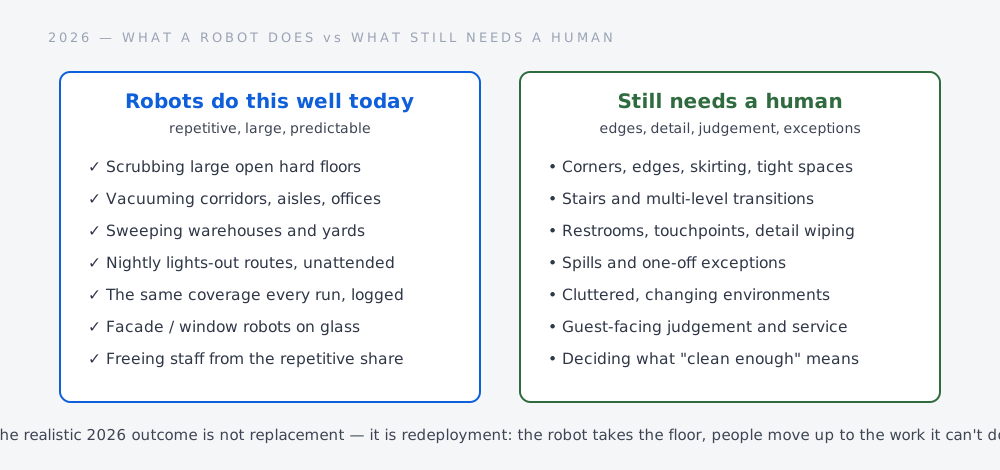
Two columns comparing what commercial cleaning robots do well today against tasks that still need a human cleaner
The 2026 division of labour: robots take the repetitive floor, people keep the rest. PanPanTech, 2026.

What still needs a human — and will for a while

Robots struggle with everything that is not a large, open, predictable surface: corners and edges, stairs and level changes, restrooms and touchpoints, spills and exceptions, cluttered or changing spaces, and the judgement of what "clean enough" means in front of customers.

Naming these honestly is what separates a manufacturer from a sales pitch. A cleaning robot in 2026 cannot reliably do the following, and pretending otherwise is how deployments disappoint:

Edges & detailCorners, skirting, under furniture, tight gaps — a robot follows a route and leaves a margin. Detail wiping and finishing are still human work.
Vertical & complexStairs, multi-level transitions without lifts, and highly cluttered or constantly rearranged spaces defeat autonomous navigation.
Restrooms & touchpointsSanitising fixtures, restocking, and disinfecting high-touch surfaces need dexterity and judgement a floor robot does not have.
Exceptions & judgementA spill, a broken bottle, an unexpected obstacle, or deciding a guest area needs extra attention — these require a person who can see the situation and act.

These are not temporary gaps that a firmware update closes next quarter. They are the hard part of cleaning — the part that always needed skill — and they are precisely why the realistic model is a robot plus a person, not a robot instead of one.

If robots are cheaper than staff, why hasn't every business bought one?

Because the barrier is almost never the headline price. Adoption is slowed by deployment friction, environment fit, service dependence and organisational change — and industrial machines are not actually cheap. The economics work on paper for large daily-cleaned floors and nowhere else.

This is one of the most common and most fair questions on the topic: a robot looks cheaper than a cleaner's annual wage, so why isn't adoption universal? The answer is that the wage comparison is the easy part; everything around it is the friction.

BarrierWhat it actually isWhy it slows adoption
Deployment frictionMapping the site, defining routes and no-go zones, training staff, integrating charging and waterReal project work before any value appears; a site that changes layout often needs re-mapping
Environment fitFloor type, aisle width, thresholds, traffic, clutterMany real sites are too small, too cluttered or too mixed for a robot to earn its keep
Upfront costIndustrial units commonly run tens of thousands of dollars — roughly US$50,000–150,000 at the high endA real capital outlay for small and mid-size operators, not a trivial swap
Service & sparesConsumables, spare parts, and response time when a machine stopsA robot waiting weeks for a part is a liability, not an asset
Organisational changeNew roles, new routines, and staff and manager buy-inTechnology adoption is a change-management problem, not just a purchase

Sources: market growth and adoption context from Grand View Research, Cleaning Robot Market, 2026–2033; B2B floor-cleaning robot segment data from Business Research Insights, B2B Floor Cleaning Robots Market, 2026–2035; labour data from the U.S. Bureau of Labor Statistics Occupational Outlook Handbook.

The labour pressure is real. The U.S. Bureau of Labor Statistics reports a May 2024 median hourly wage of $17.27 for janitors and building cleaners and projects about 351,300 job openings per year from 2024 to 2034, mostly replacement demand. At the same time, Grand View Research estimates the global cleaning robot market at USD 7.2 billion in 2025, growing from USD 8.8 billion in 2026 to USD 53.2 billion by 2033; Business Research Insights separately forecasts the B2B floor-cleaning robot segment from USD 2.53 billion in 2026 to USD 9.64 billion by 2035. But growth is concentrated exactly where the economics work: large facilities with big, daily-cleaned floors, where a robot can pay back in a predictable operating window. Outside that envelope, the honest answer is that a robot is not yet the right tool — which is why adoption is selective rather than universal. The full labour and payback arithmetic is in our seven benefits and cost comparison articles.

A worked example makes the envelope concrete. Take a 20,000 m² distribution centre with wide, mostly clear aisles cleaned every night: one scrubber robot can absorb the whole floor route, run unattended on the night shift, and pay for itself inside two years — a textbook fit. Now take a 400 m² boutique with fixtures every few metres, a changing floor plan and half the cleaning being glass, counters and a restroom: the same robot spends more time avoiding obstacles than cleaning, covers a fraction of the actual work, and never earns back its cost. Neither result is about the robot being "good" or "bad" — it is about whether the site matches what the machine is for. The mistake that produces disappointed buyers is applying the warehouse's logic to the boutique.

The real outcome: redeployment, not replacement

One robot running a nightly floor route typically offsets about one full-time-equivalent of repetitive floor work — in a facility large enough to justify it. Most operators do not cut headcount; they move those hours to detail cleaning, restrooms, touchpoints and inspection, and service quality rises with the same team.

This is the pattern we see across deployments, and it is worth stating plainly because it answers the fear directly. Floors are the most time-consuming, least skilled share of commercial cleaning. When a robot takes them, the human hours do not vanish — they shift to the work robots cannot do, which is also the higher-value work. A team that previously spent half its shift pushing a machine across an open floor now spends that time on the detail that actually gets noticed.

A hotel makes the pattern easy to picture. Before automation, the overnight team spends a large share of the shift running a machine up and down the lobby and corridors — low-skill, high-hours work — and squeezes detail, restrooms and guest-facing touch-ups into whatever time is left. Add a floor robot and the open-floor hours disappear from the human rota. The same team now spends the shift on the things guests actually notice: spotless restrooms, wiped touchpoints, tidy detail, and responding to the spill in the lobby the moment it happens. Headcount did not fall; the service the guest experiences went up. That is redeployment in one sentence — the robot took the part nobody was grading, and the people moved to the part everybody grades.

There is also a labour-market reality behind this. BLS expects hundreds of thousands of janitor and building-cleaner openings each year even with modest employment growth, because employers keep replacing people who transfer out, retire or leave the occupation. In many facilities the choice is not between a robot and a stable human workforce; it is between a robot and a night-shift floor route that is hard to staff consistently. In that context the robot is less a replacement than a way to cover work that is increasingly hard to keep covered, while redirecting the people you do have to where they add the most.

When it's worth automating — and when it isn't

The decision follows from everything above. Automate where the work is repetitive and the floor is large; keep it human where it is not.

Worth it: 3,000 m²+ of open hard floor cleaned daily — warehouses, malls, airports, supermarkets, large offices — on a stable layout with clear routes.
Worth it: night or off-peak floor cleaning you currently pay a shift for, or a position you struggle to keep filled.
Not yet: small, cluttered or frequently rearranged spaces, or sites where most of the work is edges, restrooms and detail rather than open floor.
Not yet: a building where the honest floor area cannot justify the upfront cost — a compact manual machine plus staff is cheaper and better.

If your site is in the "worth it" column, the machine-by-machine choice is covered in our commercial cleaning robot guide, and the deployment and safety details in the certification guide. If you are weighing a broader facility-automation roadmap that also includes material movement, see AMR vs AGV and our warehouse solutions.

Where this is actually heading

The near-term progress is not a single do-everything robot. It is incremental, and it widens the "worth it" column rather than eliminating the human one:

Better navigationMore robust autonomy in busier, less structured environments extends the range of sites where a robot is viable — but corners, stairs and detail remain human.
Fleet coordinationMultiple machines and machine types managed from one platform, so a large or multi-site operation runs as a coordinated fleet rather than isolated robots.
Multi-machine sitesCleaning robots working alongside material-movement AMRs in the same building, with shared traffic rules — the direction warehouses are already heading.

None of these is a robot that replaces a cleaner. They are robots that take a larger share of the repetitive floor work, in more places, while the person keeps doing what only a person can. That has been the real trajectory of automation in every industry, and cleaning is no exception: the machine takes the repetitive part, and the human moves up.

FAQ

Will cleaning robots replace human cleaners?
Not in the sense of eliminating the job. In 2026 commercial cleaning robots take over the repetitive floor share — scrubbing, vacuuming and sweeping large open areas — while people keep doing edges, detail, restrooms, exceptions and anything needing judgement. The realistic outcome is redeployment of labour, not full replacement.
Can a robot fully replace a cleaner or a maid?
No. A robot handles predictable, repetitive floor work well, but cannot reliably clean corners, stairs, cluttered or changing spaces, touchpoints and restrooms, respond to spills and exceptions, or exercise the judgement of what "clean enough" means in a guest-facing setting. Those tasks still need a person.
If a cleaning robot is cheaper than an employee, why hasn't every business bought one?
Because the barrier is rarely the headline price. Adoption is slowed by deployment friction (mapping, site changes, staff training), environment fit (floor type, aisle width, traffic), service and spare-part dependence, and organisational change. Industrial units can also run tens of thousands of dollars, and they only pay back on large, daily-cleaned floors.
How many staff does one cleaning robot replace?
Typically about one full-time-equivalent of repetitive floor work per nightly route, in a facility large enough to justify it. Most operators redeploy those hours to detail cleaning, restrooms and inspection rather than cutting headcount.
Why haven't perfect all-purpose cleaning robots arrived yet?
General-purpose cleaning — the "household robot that does everything" — requires manipulation, judgement and adaptation to messy, changing environments that remain hard for robots. Commercial floor cleaning succeeded first precisely because it is repetitive and structured. Progress is coming in navigation, fleet coordination and multi-machine sites, not in a single do-everything robot.
Which cleaning tasks are best suited to a robot?
Large, open, hard floors cleaned daily on a stable layout: warehouses, malls, airports, supermarkets, offices and corridors. The more repetitive and predictable the route, the better the fit. Small, cluttered or frequently changing spaces favour a person or a compact manual machine.
Are cleaning robots worth it for a small business?
Usually not yet. Small premises tend to have limited open floor, more fixtures and clutter, and a higher share of detail, glass and restroom work — exactly where robots are weakest. The upfront cost also spreads over too little floor to pay back. Most small businesses are better served by a compact manual machine plus staff. Robots earn their keep once you have a few thousand square metres of open floor cleaned daily.

Wondering if your site is in the "worth it" column?

Send your floor area, floor types and cleaning schedule — PanPanTech will tell you honestly whether a robot fits, which class, and where people are still the better answer.

Request a Quote