Electronic Shelf Label OEM & ODM: MOQ, Lead Time and Real Costs
Most buyers who ask for "ESL OEM" actually want ODM — an existing platform carrying their brand and connected to their systems. True OEM means a dedicated production run on the factory's own tooling, and it starts at roughly 2,000 pieces per model against 100 for a stock item. This is what each step actually costs, how long it really takes, and the four contract lines that decide whether you can ever leave.
Updated 2026-08-04 · 19 min read
OEM, ODM or white-label — what are you actually buying?
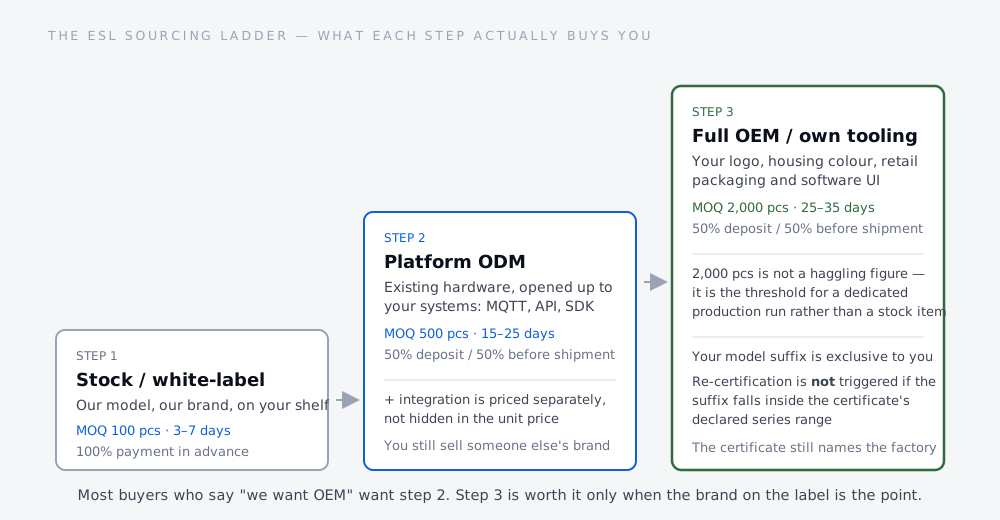
Three different transactions hide behind the word "OEM". Buying a stock model and reselling it is white-label. Taking the factory's existing platform and opening it to your systems and your brand is ODM. Building on tooling dedicated to your programme is OEM. They differ by an order of magnitude in minimum quantity, and by weeks in lead time.
The vocabulary is used loosely across the industry, which is why quotations so often fail to compare. When an enquiry says "we want to OEM your electronic shelf labels", the writer usually means one of the following three things, and the difference is worth thousands of dollars and several weeks.
What you getStock / white-labelPlatform ODMFull OEM
Typical MOQ~100 pcs per model~500 pcs per model~2,000 pcs per model
Typical lead time3–7 working days from stock15–25 days25–35 days
Payment structurePayment in advanceDeposit / balance before shipmentDeposit / balance before shipment
Whose brandThe factory'sYours on the software, theirs on the hardwareYours: logo, housing colour, packaging, software UI
System integrationStandard software onlyOpen protocol, REST API, SDK, POS/ERP connectorsSame, plus dedicated model suffix
Right answer whenLabels need to be on the shelf this monthLabels must talk to your systemsThe brand on the label is the point
Source: PanPanTech 2026 EXW price lists, issued 4 August 2026 — Swift, Classic, Lite, Slim and Rock series terms.
Each step up buys a different thing — and only one of them buys you the brand. PanPanTech, 2026.
The practical test is to ask which single constraint you are optimising for. In a hurry, or need a freezer or waterproof variant from stock? That is the white-label line. Need the labels to talk to your point-of-sale or ERP? That is the platform line, where open protocol access, an API and SDKs exist precisely for that. Need your own name on the housing? That is the tooled line. A shelf rarely needs two of these at once, and buying up the ladder for a capability you will not use is the most common way to overspend.
Why "what's your MOQ" has no single answer
MOQ is layered. The panel batch, the housing tooling, the printed packaging, the firmware customisation and the certification each impose their own floor, and the binding one is whichever you happen to trip first. A quoted MOQ is really the highest of those floors for the configuration you asked about.
This is the question every new buyer asks first and almost every supplier answers badly, because a single number is not a truthful answer. Here is what actually sets the floor.
LayerWhere its floor comes fromWhat happens below the floor
E-paper panelPanels are produced and cut in batches by sizeYou wait to share someone else's batch — cheaper than you fear, but it adds weeks
Housing toolingA dedicated mould has to be amortised over a runEither you fund the tooling outright, or you use an existing housing and give up the custom shape
Retail packagingPrint runs have their own minimums, unrelated to the hardwareGeneric packaging with a printed label, or a higher per-box cost
Firmware & software UIEngineering time, not units — a fixed cost however many you orderIt is charged as a one-time fee instead, which is why it belongs on its own quotation line
CertificationOnly binding if the model falls outside existing certificate coverageUsually no floor at all — see the certification section below
Battery cellsCell procurement and transport testing run in batchesRarely binding at commercial volumes; matters on unusual capacities
Read against that framework, the published tiers make sense rather than looking arbitrary. Around 100 pieces buys a stock item that already exists — no floor is being crossed at all, which is why payment is in advance and despatch is in days. Around 500 pieces schedules a short platform run. Around 2,000 pieces per model is the point at which a dedicated production run is worth scheduling instead of picking stock; it is a manufacturing threshold, not an opening bid, which is also why haggling it down rarely works and asking to share a panel batch sometimes does.
If you are still deciding which sizes and colours you need before you can answer any of this, our ESL BOM teardown walks through what is physically inside a label and which choices drive cost.
How a private-label programme actually runs
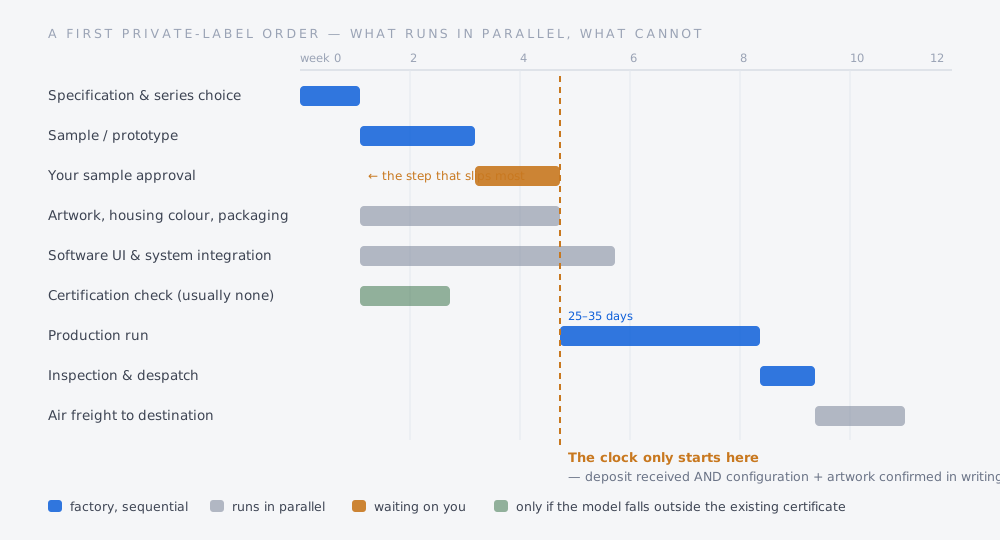
Eight steps, of which only three are really in the factory's hands. The two that slip most are your sample approval and your artwork sign-off — and both sit upstream of the production clock, which is why programmes routinely finish later than the quoted lead time while the factory technically hits it.
→1 · Specification and series choice. Store count, shelf type, sizes, colours and how the labels will connect. Output: a selection table, an indicative quotation and a schedule. Where it stalls: asking for a quotation before the sizes are fixed, then revising three times.
→2 · Sample or prototype. Physical labels in your hands, on your shelf, with your data on them. Samples are normally chargeable and the charge credited in full against the first production order — if it is not credited, ask why.
→3 · Sample approval. Yours to do, and the single most common delay in the whole programme. Nothing downstream starts until it is signed.
→4 · Artwork, housing colour, packaging. Runs in parallel with software work. Also yours, also frequently late.
→5 · Certification check. Usually a check rather than a submission — see below. A genuinely new size is the exception and needs real testing time.
→6 · Production run. The 25–35 day block for a tooled line. This is the part the quoted lead time refers to.
→7 · Inspection and despatch. Pre-shipment inspection, packing, documents. Balance payment typically falls due here, against a copy of the bill of lading.
→8 · Freight and deployment. Roughly 7–15 days by air from southern China. Gateway coverage depends on store layout and shelving material, so a site survey before finalising gateway quantities is worth the delay it costs.
What actually drives the calendar
Lead time is normally counted from receipt of the deposit and written confirmation of configuration and artwork — not from the purchase order. Everything before that point is on your side of the line, and it is where most of the elapsed time in a first programme is spent.
This one clause explains most disputes about delivery. A factory quoting 25–35 days is quoting a production window that has not started while your artwork is still in review. Read your quotation for the sentence that defines when the clock starts; if it is absent, ask for it in writing.
The production window is the blue block. Everything to the left of the dashed line is elapsed time nobody quoted you. PanPanTech, 2026.
StageCan it run in parallel?What compresses or extends it
SampleNo — everything waits on itFaster if you accept an existing housing; slower for every revision round
Artwork & packagingYes, with software workExtends whenever brand approval sits with someone who was not in the kick-off
Software UI & integrationYes, with artwork and toolingStart protocol work at sample stage, not after shipment — this is free calendar time
CertificationYes, when needed at allUsually zero if the model stays inside existing coverage; weeks if a new size is introduced
ProductionNo15–25 days platform, 25–35 days tooled; gateways typically 10–15 days
FreightNoAbout 7–15 days by air from southern China; sea freight trades weeks for cost
Source: PanPanTech 2026 price list terms and After-Sales & Technical Support Policy, Guangzhou PanPanTech Co., Ltd.
The useful consequence: a repeat order is dramatically faster than a first one, because sample, artwork and integration are already settled. Budget the calendar for programme number one, not for the steady state you will be in by order three.
The costs that sit behind the unit price
A quotation with one unit price and no one-time lines is not cheaper — it has amortised the software, integration and tooling into the per-piece figure, which means you keep paying for them on every repeat order long after they are paid off. Ask for the one-time costs to be listed separately even if the total is the same.
Hardware is only part of what an ESL programme costs. The rest divides cleanly into one-time and recurring, and how a supplier presents that division tells you a lot about how they will behave later.
Cost lineOne-time or recurringWhat to ask
Hardware unit pricePer pieceWhich volume band, and what happens at the next band up
Management software licenceOne-time, perpetual — or annualPerpetual and locally deployed, or a subscription you cannot stop paying? These are very different businesses
Protocol / MQTT accessOne-timeDoes the fee include engineering support, or only the specification and coding standard?
SDK licensingAnnualTiered by support level; check ticket allowances and response times before you pick the cheap tier
Deployment daysPer person-dayRemote and on-site are priced differently, and on-site normally carries travel at cost
Housing toolingOne-timeWho owns the mould, and is the cost separate or amortised into the unit price?
CertificationOne-time, often zeroOnly real if you introduce a size outside existing coverage
Freight, duty, destinationPer shipmentEXW quotations exclude all of it — get a landed-cost estimate before comparing suppliers
Two quotations for the same specification can differ by half, and it is almost never the electronics. The usual causes are the trade term (an EXW price and a delivered price are not comparable), what has been folded into the unit price versus listed separately, and whether integration was quoted at all or quietly deferred to a conversation after the deposit. A useful discipline when comparing: rebuild both quotations as landed cost per label over three years, including the software and integration lines, and see whether the ranking survives.
One structural note worth asking about directly: does the supplier operate reseller price brackets, or one list for everyone? A single published list for distributors, integrators and end users is unusual, and it changes the negotiation — there is nothing to extract, but also nothing being extracted from you because someone else negotiated harder. For a size-by-size price breakdown of the labels themselves, that belongs with the product catalogue rather than here; this article is about the programme around it.
Six things to write into the contract
Certification coverage, model numbering, tooling ownership, firmware and update rights, change control, and spares and end-of-life. These are cheap to agree before the deposit and expensive to argue about afterwards.
1 · Certification coverage and whose name is on itRadio certificates commonly declare a model family — a base code plus a declared series range — which is why adding a one-letter suffix for your line usually does not trigger re-certification. Confirm two things in writing: that your exact model string sits inside that declared range, and how it is punctuated. A suffix written with a slash is not self-evidently the same string as the suffix written directly against the base code, and that ambiguity is entirely avoidable. Separately, note that the certificate names the factory as holder and manufacturer, and carries its own trade mark field — align that deliberately with what appears on the product, or expect awkward questions from EU market surveillance.
2 · Model numberingAgree the scheme and freeze it. A disciplined supplier will have a written rule — for example a fixed prefix, a size code derived arithmetically from the diagonal, and a single series letter. Once a model number appears on a certificate, a declaration of conformity or an issued quotation, it should not change unilaterally; and when it does have to change, it has to change in five places at once — certificate, back label, datasheet, price list and website.
3 · Tooling ownershipIf you funded a mould, write down who owns it, at what cumulative volume it transfers, and whether it can be moved. Without that clause, tooling you paid for keeps you where you are.
4 · Firmware, updates and platformWho can push firmware, what happens if an update fails, and whether the management software is a perpetual licence on your own server or a subscription that can be withdrawn. Also fix compatibility: will the platform keep supporting label models bought two years from now?
5 · Change controlComponent substitution is normal and legitimate; unannounced substitution is not. Require written notification for changes affecting form, fit, function or certification, and specify what a re-qualification looks like.
6 · Spares, warranty and end of lifeWarranty on labels and gateways is commonly 12 months from shipment with a shorter term on batteries and accessories. What matters more is the replacement cycle: from approval to shipment a warranty return can run 25–45 working days, which is why holding roughly 1–2% spare labels per store and one or two spare gateways is standard practice rather than over-caution. Agree spare availability and minimum notice before end of life.
Support terms deserve the same treatment as the hardware. Ask for the response and resolution targets in writing by severity — a serious supplier will have a documented policy covering initial response, workaround and final resolution for each severity level, along with support hours, languages and channels. If none exists as a document, that itself is the answer.
De-risking the first programme
Nothing in an OEM relationship is as expensive as discovering the mismatch at volume. Four habits cost little and prevent most of it.
→Buy a sample before you buy a programme. Put real labels on a real shelf with real data. If the sample charge is credited against the first order, this step is close to free.
→Run a pilot store before the rollout. Gateway coverage varies with layout and shelving material more than any datasheet implies, and one store will tell you what a survey estimates.
→Start integration at sample stage. Protocol and API work runs in parallel with everything else. Teams that begin after delivery add weeks for no reason.
→Stage the money against milestones. Deposit, then balance against shipping documents, is the conventional structure for a reason — it keeps both sides exposed until the goods exist.
Red flagWhy it mattersWhat to ask for
One unit price, no one-time linesSoftware, integration and tooling have been amortised into the piece price, so you pay for them again on every repeat orderThe same quotation with one-time costs itemised separately
MOQ that drops the moment you pushReal thresholds come from panel batches and production scheduling; a number that halves under mild pressure was never a thresholdWhich layer sets the floor for your configuration
"Certification is no problem" — but no certificate numberCoverage is a matter of what the certificate literally declares, not of goodwillThe certificate itself, and confirmation that your model string sits in the declared range
The same model under three different namesIf quotation, datasheet and certificate disagree on the model number, customs and market surveillance eventually will tooOne model number reconciled across all documents before the deposit
No written support policyWithout documented severity levels and response targets, "we support you" means whatever is convenient at the timeResponse, workaround and resolution targets by severity, in writing
Lead time with no defined startA production window that has not started is not a delivery date, and this is the most common source of delivery disputesThe clause defining when the clock starts
If you are still at the stage of choosing between suppliers rather than structuring a programme with one, the companion piece is our guide to evaluating an ESL manufacturer — how to separate a real factory from a trading company, and what to audit when you visit. For the display technology decision that sits underneath all of this, see e-paper technology routes compared, and for the manufacturing capability behind an OEM programme, our manufacturing and SMT pages.
FAQ
What is the difference between ESL OEM and ODM?
In ODM the factory already owns the design and platform, and you put your brand and your system integration on top of it. In OEM the product is built on tooling dedicated to your programme — your housing, your colour, your packaging, your model suffix. ODM starts faster and cheaper; OEM is what you choose when the brand on the label is the point. Most buyers who ask for OEM actually want ODM.
What is the minimum order quantity for private-label electronic shelf labels?
It is tiered, not a single figure. Stock white-label models can start from around 100 pieces per model. An open-platform ODM line typically starts around 500 pieces per model. A dedicated OEM production run on the factory's own tooling starts around 2,000 pieces per model — that figure is the threshold at which a production run is scheduled rather than a stock item picked, not a negotiating position.
How long does an ESL OEM order take?
Stock models ship in about 3 to 7 working days. An open-platform run is typically 15 to 25 days. A dedicated OEM run on own tooling is typically 25 to 35 days, plus roughly 7 to 15 days of air freight from China. Critically, the clock starts on receipt of the deposit and written confirmation of label configuration and artwork — not on the day you send the enquiry.
Does private labelling an ESL require new CE or FCC certification?
Usually not, if the model code stays inside the range already declared on the certificate. Radio certificates commonly declare a model family such as a base code plus a series range, so adding a one-letter series suffix falls within existing coverage. Two things to check: that your exact model string is inside that declared range, and how it is written — a suffix separated by a slash is not self-evidently the same string as the suffix written directly, which creates interpretation risk. A genuinely new size is a different matter and does need certification.
Whose name is on the certificate in an OEM programme?
The factory's, normally — the certificate holder and the manufacturer are the producing entity, and the certificate carries a separate trade mark field. That is not a problem, but it is something to align deliberately: if the product carries only your brand while the certificate names another, market-surveillance questions in the EU become harder to answer. Agree in writing what appears on the certificate, the back label, the declaration of conformity and the product itself.
What one-time costs sit behind an ESL quotation?
Beyond the unit price, expect a management-software licence, protocol access if you self-integrate, SDK licensing if you build on the API, deployment days (remote or on-site), and tooling amortisation where the housing is dedicated to you. A quotation with a single unit price and no one-time lines usually means those costs were amortised into the unit price, which means you keep paying for them on every repeat order.
How many spare labels and gateways should we hold?
A common working figure is 1 to 2 percent spare labels per store plus 1 to 2 spare gateways. The reason is lead time, not failure rate: a warranty replacement cycle can run 25 to 45 working days from approval to shipment, so without local spares a single failure leaves a shelf blank for weeks.
Send your store count, shelf profile and the sizes you think you need. PanPanTech will confirm which line fits, the realistic lead time, and a landed-cost estimate — usually within one business day.