Why is facade cleaning a permanent market rather than a one-off?
According to CTBUH's 2025 Trends & Forecasts page, accessed on 29 September 2026, 2,594 buildings of at least 200 metres had been completed through 2024, including 257 of at least 300 metres. The page lists another 391 under construction and identifies 2024 as the eleventh consecutive year with more than 100 completions above 200 metres. CTBUH notes that it revises this dataset as completions are confirmed.
These figures describe a maintenance base, not 2,594 machine orders. They do not establish whether a particular facade suits a robot, and they exclude buildings below 200 metres. A shorter building with continuous surfaces and accessible roof anchors may be a better candidate than a taller, more complex facade.
The other driver is exposure to height. NIOSH identifies falls from elevation as the leading work-related cause of death in construction and recommends planning, suitable equipment and training. This is construction-sector guidance, not a window-cleaning accident rate. For facade work, assess how each proposed method changes worker exposure, rooftop tasks and rescue requirements rather than assuming automation eliminates risk.
Sources: CTBUH 2025 Trends & Forecasts; NIOSH Science Bulletin, Construction Falls: Progress and Prevention.
On cleaning frequency we will be straightforward: we could not find an authoritative industry-body figure for how often commercial facades are cleaned, and the numbers circulating online come mostly from contractor marketing pages. Frequency varies widely by climate, pollution, building class and lease terms, so any bottom-up model should use your own contracts rather than a borrowed average.
When were facade cleaning robots actually invented?
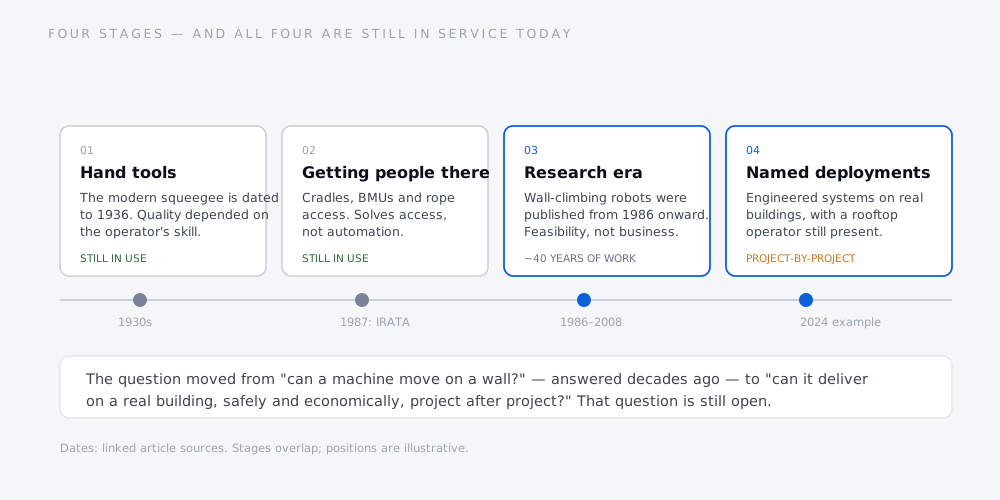
Stage 1 — Hand tools, and the skill of the operator
The early work was manual washing and squeegeeing, and the technical progress was in the tools and in how to reach the glass. Ettore's own company history dates the modern single-blade squeegee to 1936. For most of the twentieth century, cleaning quality was a function of operator skill rather than equipment.
Stage 2 — Solving access, not automation
High-rise maintenance produced suspended platforms, building maintenance units and rope access. It is worth being precise about what these achieved: they moved people to the work face safely and repeatably. They did not automate the cleaning itself. IRATA's industry framework, formed in 1987, marks the professionalisation of rope access — it is not the invention date of rope-based cleaning, and it should not be cited as such.
Stage 3 — Four decades of research, not two years
This is the stage most market commentary skips, and it materially changes how you should read the category. Work on wall-climbing robots was published by Japanese researchers from 1986 onward; the International Symposium on Automation and Robotics in Construction convened in Tokyo in 1988; propeller-type and suction-cup climbing designs followed through the 1990s; and pneumatic glass-wall cleaning climbers were documented in the published literature thereafter. In Europe, Fraunhofer was publishing on semi-automatic facade cleaning by 2008, and its SIRIUS project integrated cleaning, locomotion, fall protection and media supply into one system using adhesion rather than building-mounted rails.
A 2019 survey in the International Journal of Precision Engineering and Manufacturing-Green Technology catalogues these climbing mechanisms and cleaning methods across the field. The practical implication for a buyer is simple: early research establishes a long technical history, while current commercial suitability still requires site-specific evidence.
Early records: Design of a robot capable of moving on a vertical wall (1986); 1988 Tokyo symposium paper; Fraunhofer semi-automated facade-cleaning publication (2008).
Stage 4 — Named deployments, and what they actually show
Commercial engineering routes emerged in the 2010s, emphasising integration between the building, its anchor points and the robot system — which is why "buy the machine and start" rarely describes a real project. The clearest public datapoint is from August 2024, when the owner of 1133 Avenue of the Americas, a 45-storey office tower in New York, announced deployment of a robotic-armed window-cleaning system on the building.
Two things in that announcement deserve to be carried forward and one does not. Carry forward that it is a specific, verifiable deployment on a named building. Carry forward, especially, the announcement's own statement that the robot, while autonomous, is still operated by humans using a computer on the rooftop — the clearest available refutation of the idea that a robot means an unattended site. Do not carry forward the "world's first" framing: it is a company's characterisation of its own product in a press release, and extending it into a history of the whole category would contradict the published record above.
Sources: Ettore company history; IRATA history; Survey on Glass and Façade-Cleaning Robots; Fraunhofer IFF, SIRIUS; The Durst Organization, deployment announcement, 28 August 2024.
How do five facade-cleaning approaches differ?
This is a commercial screening taxonomy rather than a complete engineering classification. A demonstration can help explain movement and cleaning, but building suitability still needs a survey and trial. Staffing, rigging, supervision and rescue arrangements must be assessed for the chosen system.
How big is the market — and which number is which?
Where does the USD 40 billion figure come from?
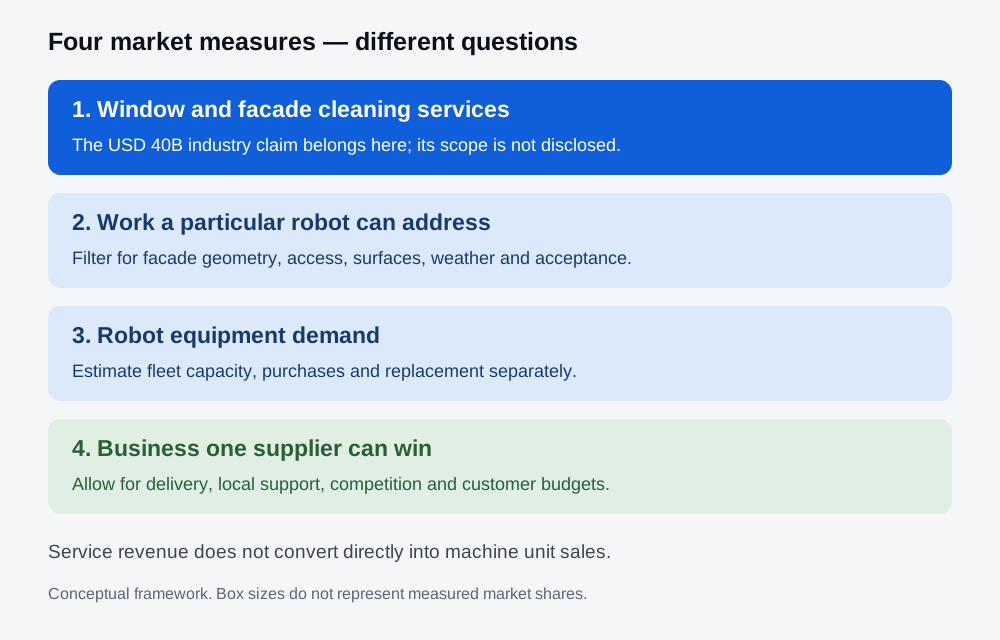
It comes from the August 2024 deployment announcement discussed above, where it appears twice — describing "the $40B window-cleaning industry" and, in the supplier's own boilerplate, an industry the product is "disrupting". Two observations matter. Its label is the window-cleaning industry, rather than robot equipment sales; the release does not define the included services or building types. And no methodology, scope or source is published alongside it in that release.
So it is not a measure of robot equipment sales, and it cannot be multiplied by an assumed adoption rate to produce one. A service market measured largely in labour hours does not convert into machine unit demand at any fixed ratio.
What can be measured?
Jobber's article, dated 31 May 2024, reports an IBISWorld projection of USD 2.9 billion in US window-cleaning services revenue for 2024 and USD 3.2 billion by 2029. These are projections quoted by a secondary source, not verified realised revenue or robot equipment sales. They concern residential and commercial window-cleaning services, not only high-rise facades.
The USD 2.9 billion US projection and the USD 40 billion industry claim answer different questions. They differ in geography, date, attribution and disclosed scope. The press release does not publish the methodology for USD 40 billion, and we have not reviewed the methodology underlying the US report either. Retain both labels when discussing them; neither provides a direct estimate of demand for facade-cleaning robots.
Sources: Durst Organization announcement, 28 August 2024; IBISWorld window cleaning services projections as reported by Jobber. We have not purchased the underlying report and cite these as secondary reporting.
On the robot equipment market specifically: our search did not find a verifiable global installed-base or unit-sales dataset that clearly excludes consumer window-cleaning gadgets and isolates commercial high-rise machines. Several paid reports exist; their scope and method are not visible from their sales pages, so we are not reproducing their headline figures or growth rates. We would rather publish the absence than a precise-looking number.
How do you size the opportunity in your own city?
Working it through: 1,000 × 20,000 × 4 gives 80 million m²-passes of annual cleaning demand. Half of that — 40 million — is addressable by the machine in question. Divided by 200,000 m²-passes per machine per year, that implies a theoretical fully-loaded fleet of about 200 machines. And that is an aggregate-capacity floor rather than a demand estimate: real operations face seasonal peaks, parallel projects on different sites, geographic dispersion and the need for spare units.
Now the conclusion that matters, and it is the one most market decks omit. That fleet is an installed base, purchased once. If machines were replaced on, say, a five-year cycle, steady-state annual demand would be roughly 40 machines a year, not 200 — and five years is an illustrative interval here, not a demonstrated service life. Cleaning recurs four times a year; buying does not.
This is why cleaning can be a large service business while the equipment market underneath it stays comparatively modest. It is also why a machine that transports easily between buildings may improve your customer's economics while reducing the number of machines that same portfolio requires.
Will a robot pay back?
Count the full deployment: transport to site and up the building, rigging and anchor preparation, water and power provisioning, pre-start checks, column changes on the roof, obstacle negotiation, manual touch-up, demobilisation, movement between sites, weather stoppages, maintenance, training, insurance and spares. A comparison that puts a machine's nominal hourly coverage against a crew's day rate is not an ROI calculation.
Because deployment cost varies by market and project, the honest way to publish a sensitivity is to normalise it. The table below shows what each USD 10,000 of deployment investment requires in order to be recovered, at three assumed levels of net saving per square metre.
To use it, divide your own deployment investment by 10,000 and multiply. These are illustrative assumptions for arithmetic only — not a payback promise, and they exclude financing, tax and the time value of money. Substitute your own labour rates and the results of an on-site trial.
One distinction is decisive and often missed. An established contractor with existing facade contracts is calculating a saving against a known cost base. A newly formed operator has no labour cost to save; for them the correct calculation is the cash contribution of new contracts they can win and deliver, which is a harder number to stand behind and a very different risk.
Who actually buys these machines, and what do they ask?
What they ask is remarkably consistent, and the questions are better than most sales material answers. In rough order of how often they come up: a complete unedited work video covering rooftop rigging, descent, cleaning, crossing mullions, column change and demobilisation — not a cut promotional reel. Which facades are suitable and which are not, covering frameless and framed glass, stone, aluminium panels, protrusions, deep recesses and corners. How many people are needed on site and how long a building takes to prepare. Operating temperature and wind limits — Gulf summers run hot, northern winters bring ice and snow. Roof anchor conditions, which industrial buildings frequently lack. Certification and local approvals. Realistic daily output rather than a nominal hourly rate, including the proportion needing manual touch-up. After-sales response, spare parts and whether anyone is local. Verifiable references in the same region, distinguishing a one-off demonstration from paid work from sustained operation. And the payback question that section six addresses.
Notice that most of those are evidence requests, not specification questions. That is the current state of the category: technical fit and proof of repeatable delivery both need evaluation. See our commercial facade robot buyer guide for building-fit and procurement checks.
Where is this heading?
Project-level evidence is likely to remain central to adoption. The 2024 New York announcement describes state labour department approval for that deployment, illustrating why permissions and operating procedures matter alongside hardware. This approval should not be treated as permission for other machines or jurisdictions. Contractors also need reliable staffing, local support and a repeatable process for moving equipment between buildings. A successful trial on one facade provides a useful reference, but extending it to a portfolio requires checking the conditions at each site.
For a buyer, the practical next step is a building survey followed by a measured trial. Record setup time, cleaning acceptance, intervention time and weather restrictions before extending the result to a larger portfolio.
How PanPanTech approaches facade projects
We are a robotics solution and integration company, and we work with manufacturing partners as a solution provider and integrator. Our starting point is the building, not the machine: photographs, height, facade type and roof conditions come first, and different buildings get different recommendations.
Send photographs, height, facade type and roof conditions, and we will tell you which approach fits — including when none does. See the AFR-1500, the full range and our facade robot guide.
FAQ
Is the facade cleaning robot market really worth USD 40 billion?
When were facade cleaning robots invented?
Can a facade cleaning robot work with nobody on site?
How do I size the facade robot opportunity in my own city?
Who actually buys facade cleaning robots?
How long does a facade cleaning robot take to pay back?
Which standards apply to suspended facade access equipment?
Sources
All accessed 29 September 2026.
Figures attributed to third parties are reproduced under each source's own scope and definitions and are not directly comparable with one another. Product specifications are manufacturer data. The sizing and payback arithmetic in sections five and six uses illustrative assumptions for demonstration only; it is not a survey, a forecast or a payback promise. This article is general commercial background, not safety, legal or regulatory advice, and it does not assess whether any particular jurisdiction's requirements are met.