Short answer: robot for repeat work, ropes and cradles for the rest
This guide is written from the questions building owners, facility managers and facade cleaning contractors ask us most often before they buy — about thirty buyer enquiries from the Middle East, Europe, Africa, South Asia and the Americas over the last few months. Nearly all of them start with the same three questions: who is up on the building, what happens when something fails, and how long a real building takes. We answer those first, then cost, quality and fit.
How are high-rise facades cleaned today?
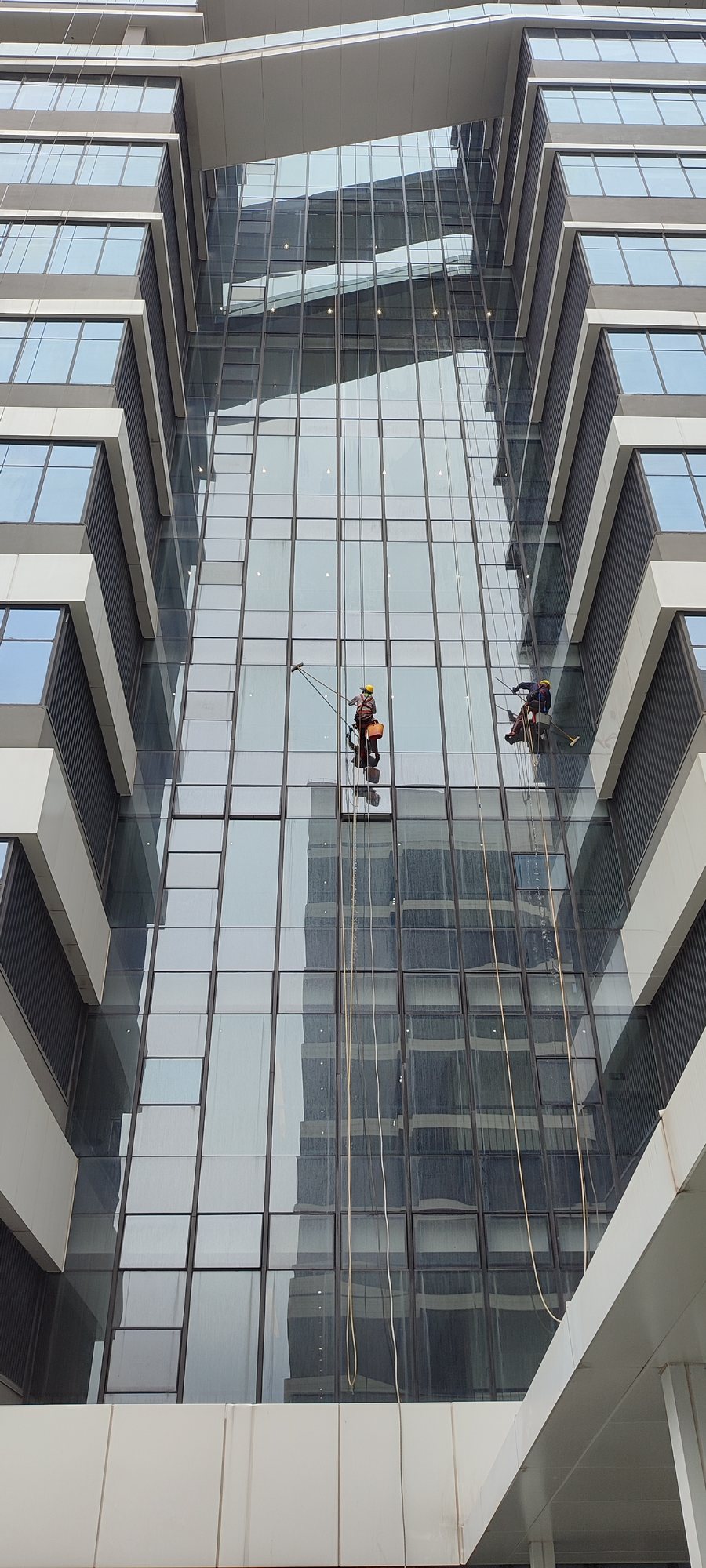
Three methods do almost all high-rise window and facade glass cleaning: rope access, suspended platforms (gondolas and building maintenance units) and, on lower buildings, boom lifts. Each one puts a person at the glass.
Sources: IRATA membership requirements; OSHA 29 CFR 1910.27; EN 1808 (suspended access equipment). See the links in the safety section.
All three methods work, and good contractors run them safely. The pressure on them comes from elsewhere: more glass towers, an ageing and hard-to-recruit workforce at height, stricter rules on anchorages and rescue, and clients who want the same building cleaned more often. Falls from height are still the leading cause of work-related death in construction, according to NIOSH, which is why owners keep asking whether some of that exposure can be removed. Our facade robot market history covers how the industry got here.
What is a facade cleaning robot, and how does it work?
A facade cleaning robot hangs from roof-anchored ropes like a rope technician, but the cleaning is done by the machine while the crew stays on the roof or the ground. On the AFR-1500, the robot climbs the rope with a powered rope-climbing system, coaxial twin rotors press it against the facade with positive thrust, and a wheel-leg chassis steps over transoms and raised frames up to 220 mm.
How is it different from window robots, drones and wall climbers?
Buyers often mix up four quite different machines. Portable suction window robots are household or small-office devices for single panes. Cleaning drones spray water or detergent from the air, usually without brushing, and work under aviation rules. Vacuum wall-climbing robots such as the AFR-0400 are built for spraying, washing and surface preparation on concrete and steel. A rope-suspended facade cleaning robot is the one designed to brush and squeegee whole elevations of a high-rise curtain wall. Our guide to robotic window cleaners explains the consumer and commercial split in more detail.
Safety: who is at height, and what happens if something fails?
With a robot, nobody hangs on the facade while it cleans; people work on the roof (rigging and moving ropes) and at the control panel. That is the biggest single difference from rope access and gondolas, where a person is at the glass for the entire job. The roof work still counts as work at height and is planned as such.
What happens if the robot loses power?
On the AFR-1500 the rope-climbing system locks automatically when power is lost, and the robot holds its position on the rope. It does not slide down. Power is restored or the robot is recovered by a planned procedure; ask any supplier to show you that recovery procedure in writing before the first drop.
What if it loses grip on the facade?
If thrust adhesion drops, or the robot detects over-speed, overload, abnormal attitude or a device fault, it raises an alarm on the robot and the ground panel, stops and holds. The robot is always carried by the rope; adhesion only keeps it against the facade so the brush can work. Losing adhesion means the robot swings away from the wall on its rope — which is why wind limits and drop planning matter.
What wind speed can it work in?
The AFR-1500 is rated to work up to Beaufort 6, that is 10.8–13.8 m/s. That is the working limit. Ask suppliers separately for the parking or survival condition — what the robot and rigging must withstand if wind rises while it is on the facade — and set a lower site stop limit in the method statement if local rules or the building's exposure call for it. The lighter AFR-1200 is rated to Beaufort 5 and is not used in rain or icing.
What about the ropes and anchors?
The working rope and safety line on the AFR-1500 are rated at 1–2 t by the manufacturer, against a 50 kg robot, and an independent safety line is available where local rules require redundancy. Roof anchors of about 15 kN each are recommended. For comparison, US rules for workers on rope descent systems require each anchorage to be tested and certified for at least 5,000 lb per attached person, a separate independent fall arrest system for each worker, prompt rescue, and no work in gusty or excessive wind (OSHA 29 CFR 1910.27). The same rule limits rope descent systems to 300 ft (91 m) unless other access is not feasible or more hazardous — one reason very tall towers rely on BMUs.
Pre-start checks on every drop
Certification and local rules
A robot does not remove local work-at-height law, permits or the building owner's duties for anchors and rescue. On certification, the AFR-1500 is CE certified: it holds an EU-type examination certificate issued by an EU notified body under the Radio Equipment Directive 2014/53/EU, covering electrical safety (EN IEC 62368-1, EN IEC 61851-1), RF exposure (EN IEC 62311), EMC (ETSI EN 301 489) and radio (ETSI EN 300 328 / 300 330). Certificate details, the Declaration of Conformity and the technical file are shared with buyers during quotation.
Cleaning speed: how long does a real building take?
Plan on daily output, not hourly peak: the AFR-1500 is rated 180, 360 or 500 m²/h on continuous facade, but manufacturer project records put real output at about 1,500–2,000 m² per robot per day. The gap is time spent rigging, moving the rope between drops, crossing obstacles, setting up water and waiting for wind.
Worked example: a 137 m office tower
A contractor asked us about a 137 m tower with about 32,500 m² of glass and aluminium facade. At 1,500–2,000 m² per day, one robot needs roughly 16–22 effective working days for a full clean. Add weather days and the time to rig the first drop, and a realistic programme is four to six weeks with one robot, or about half that with two. Corners, signage and recessed areas are cleaned by hand in parallel.
Calculation: facade area ÷ manufacturer project output for the AFR-1500. Excludes weather days and first rigging. Real output depends on facade layout, soiling, wind and crew organisation.
A second robot makes sense when one contractor serves a group of buildings, when the client wants the full cycle done within a short window (before an event, after a sandstorm season) or when a tower has several long, similar elevations that can be worked at the same time.
Labour: how many people does each method need?
A robot changes what the crew does more than how many people are on site: instead of several technicians on ropes, a smaller team rigs, operates and finishes details. The exact crew is set by the method statement, the building and local rules, so ask every supplier to state it in writing for your building.
Sources: IRATA membership requirements (all rope access operations supervised by a Level 3 technician); OSHA 29 CFR 1910.27; PanPanTech project practice.
For contractors the bigger point is recruitment. Experienced rope technicians are hard to hire and keep in many markets; training an operator to run a robot is a shorter path, and the work is done from the roof rather than on the rope. Operator training for our facade robots is given at the factory or on site, with remote technical support afterwards.
Operating cost and payback: how a contractor does the maths
Payback comes from the local price of manual facade cleaning, the area cleaned per year and the robot's running costs — so the same robot pays back in months in one market and years in another. Start with what clients pay for manual cleaning in your city, not with the robot.
The cost lines to include
Worked example: one contractor's numbers
A facade cleaning contractor in South Asia told us clients pay about PKR 18–20 per sq ft for manual cleaning of a high-rise facade. That is roughly PKR 194–215 per m², or about USD 0.70–0.77 per m² at around PKR 280 to the dollar. For the 32,500 m² tower above, one full clean is worth about USD 22,000–25,000 in revenue. Three full cleans bring in roughly the price of one complete robot set in the USD 60,000–90,000 class.
That is revenue, not profit. Subtract the crew, water, consumables, transport, insurance and the detail work still done by hand, and the payback is longer. It is shorter where manual rates are higher — in the Gulf, Europe or North America — and where one robot serves several buildings on rotating schedules.
Robot share of area is a planning assumption that depends on the facade; confirm it in the site survey. Exchange rate approximate, November 2026.
Cleaning quality: will a robot leave streaks?
A robot cleans every panel with the same brush pressure, water flow and speed, so results are more consistent than a crew whose quality varies person to person — but streaks still depend on water quality, soiling and weather. Nobody, robot or human, can promise a spot-free finish on every drop.
Which facades suit a robot, and which don't?
Robots suit large, regular elevations of glass, aluminium panel or stone with frames shallow enough to cross; they struggle with deep fins, heavy set-backs, balconies and highly irregular shapes. Send facade photos and a section drawing before you decide.
Rope access vs gondola vs facade robot: the full comparison
Sources: AFR-1500 and AFR-1200 manufacturer specifications; Brick Underground, 26 September 2019 (BMU cost, New York); EN 1808; OSHA 29 CFR 1910.27. The robot price range is a PanPanTech market range, not a quotation.
10 questions to ask any facade robot supplier
These are the questions our most careful buyers ask; a supplier who answers them in writing is easier to trust than one who only sends a video.
When should you keep rope access or a gondola?
Keep manual methods for spot repairs, sealant and glazing inspections, buildings cleaned once a year or less, highly irregular facades and any area the robot cannot reach. A permanent BMU that a tower already owns is also worth using, and a robot can sometimes be deployed from it.
The most common set-up we see is hybrid: the robot does the long open elevations, a small rope team follows for corners, signage and recesses, and the contractor bids the job at a lower cost per square metre with fewer people on ropes. For a contractor, that is a way to take on more buildings without hiring a larger rope team. For an owner, it means less time with people over the street and a more predictable cleaning cycle.