Home/ Blog/ Facade Robot Cost

Buying Guide · Cost & Price

Facade Cleaning Robot Cost Breakdown: Where the Money Goes

A complete facade cleaning robot set of the AFR-1500 class is typically quoted at USD 50,000–80,000, and the robot body is only about a third to two-fifths of that. The rest buys the rope-climbing and safety system, purified water and power, certification, software and engineering, training and warranty — the parts that let a robot work legally and safely on the outside of a building. Below is how that price breaks down, with public reference prices for comparable components.

Updated 2026-10-31 · 14 min read

AFR-1500 facade cleaning robot working detail

How much does a facade cleaning robot cost?

Expect USD 50,000–80,000 FOB China for a complete commercial set of the AFR-1500 class, depending on configuration, rope length, accessories and order volume. Treat any quote far below that range with care and ask which of the systems in the table below it leaves out.
USD 50–80k
Typical complete set, FOB China
33–43%
Robot body share of the set (estimate)
1,500–2,000
m² per robot per day in projects
GBP 13.9k+
One powered rope ascender, for comparison

Buyers usually meet this price after seeing consumer window robots for a few hundred dollars or floor-cleaning robots for USD 10,000–20,000, and the reaction is the same: why is this one so much more? The short answer is that a facade robot is not sold as a gadget. It is sold as a working system for height, and most of the cost sits in the parts of that system that are not the robot. Our commercial cleaning robot price guide covers floor robots; this article covers facades only.

The shares in this article are PanPanTech estimates built from our product configuration and public prices for comparable components. They are not a quotation, an audited cost or the cost structure of any single manufacturer, and the ranges overlap rather than adding to exactly 100%.

What is actually inside a complete facade robot set?

Seven groups of equipment, packed in two flight cases: the robot, a motorised rope-climbing system, a safety-line kit, a water supply with purification, a power supply system with cable, a ground control panel, and the cases themselves.

Using our AFR-1500 high-rise facade cleaning robot as the reference, a standard project set contains:
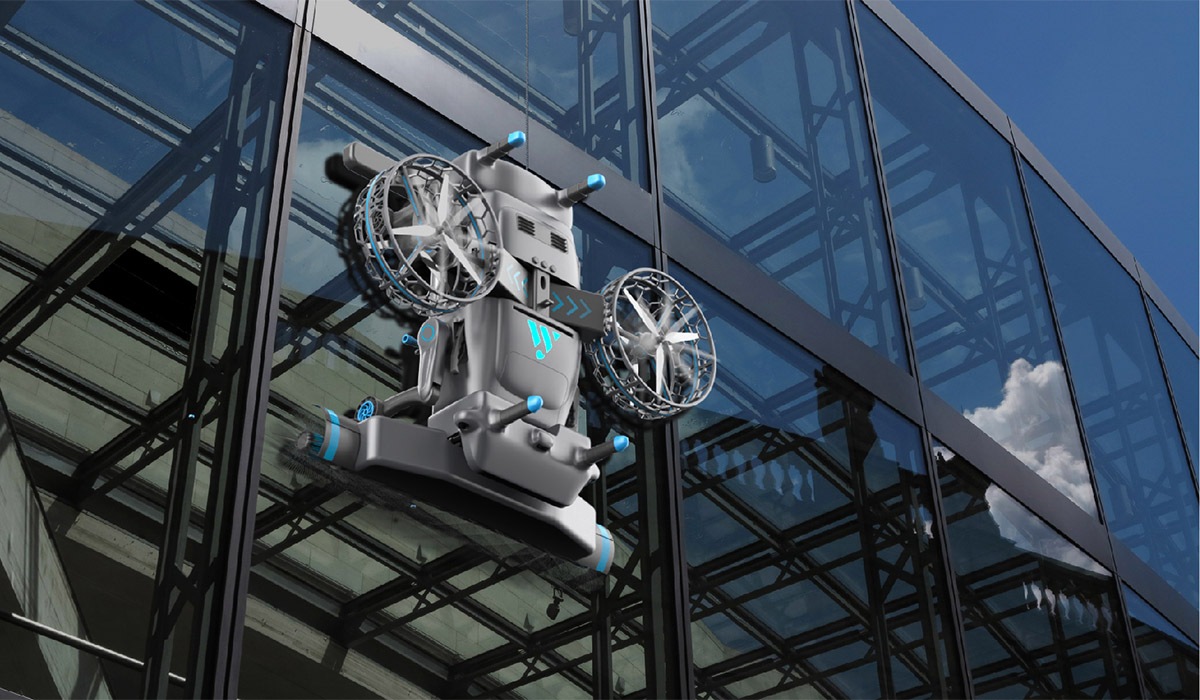
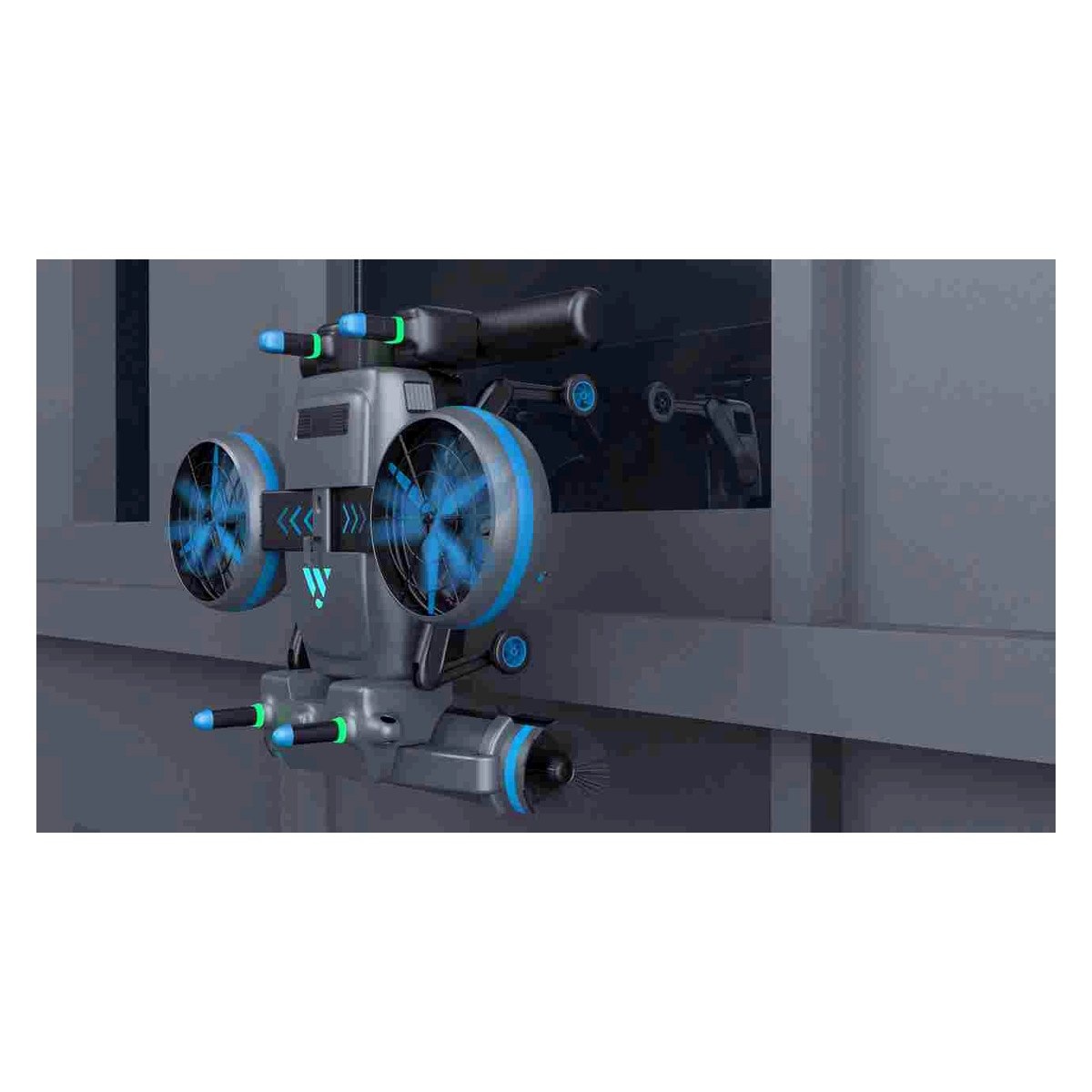
01Robot body, about 50 kg. Coaxial twin rotors press it against the facade with automatically adjusted force; a bionic wheel-leg chassis steps over frames up to 220 mm; an oscillating roller brush and flexible squeegee clean a 600–1,500 mm path; binocular vision and an onboard computer read the facade; the enclosure is rated IP54.
02Rope-climbing system. A motorised climber that moves the robot up and down the rope and locks automatically if power fails, with alarms and stop-and-hold for adhesion loss, over-speed, overload and abnormal attitude.
03Safety-line kit. 150 m of working rope and safety line rated at 1–2 t by the manufacturer, a descender and locking karabiners.
04Water supply and purification. A ground-fed water system and a purification unit, so the glass dries without spots.
05Power supply system. AC 220 V at about 0.6 kW rated power, delivered by cable so the robot can work all day.
06Ground control panel. 2.4 GHz frequency-hopping radio control with alarm display.
07Two flight cases. About 1.22 × 1.01 × 1.75 m and 161 kg for the robot, and 1.35 × 1.35 × 1.22 m and 234 kg for accessories.
AFR-1500 facade cleaning robot in service on a high-rise glass facade
The robot is the visible part of the set; the rope, safety, water and power systems stay on the roof and at street level. PanPanTech product image.

Where does the money go? The cost breakdown table
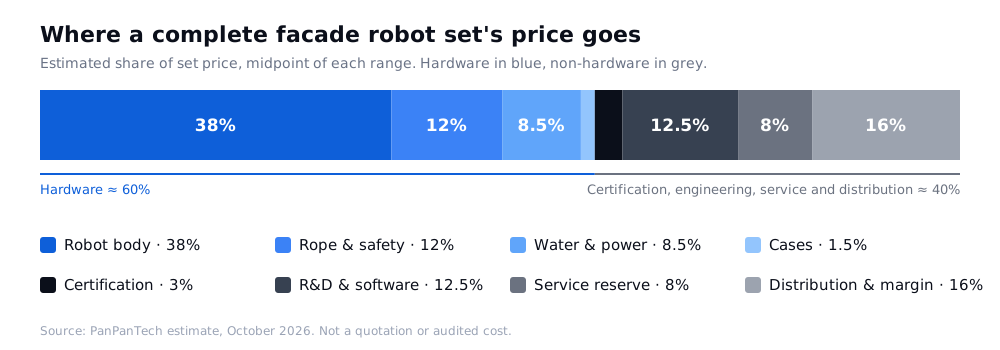
Roughly 33–43% for the robot body, 16–28% for the rope, safety, water, power and packing, and 30–49% for certification, software and engineering, training and warranty, and distribution — estimated shares of a complete set.
Stacked bar chart of estimated cost shares of a complete facade cleaning robot set: robot body, rope and safety, water and power, certification, R&D and software, service reserve, distribution
Estimated share of a complete facade robot set, midpoint of each range. PanPanTech estimate, October 2026.

The table reads from left to right: what each system is, what is inside it and why that line is difficult to cut, what a comparable component sells for publicly, and our estimate of its share of a complete set. Indented rows break the robot body into its parts.

SystemWhat is inside · why it is hard to cutPublic reference priceEst. share
Robot bodyThrust module, wheel-leg chassis, cleaning head, vision and edge computer, controller, IP54 enclosure, assembly and testThis is the part buyers see, and it is still well under half of a complete set.See the component rows below
— Rotor thrust moduleTwo coaxial rotors, motors, drives and guards that press the robot to the facadeAdhesion force is a safety function; it needs motors rated well above working load.Heavy-lift UAV motor of the 36 kg-thrust class: USD 689.90 each, before drives and propellers
— Wheel-leg chassis and frameStepping legs and wheels, actuators, structural frame, sealed IP54 enclosureCrossing 220 mm frames is what makes the robot usable on framed curtain walls.No off-the-shelf equivalent; low-volume machined and moulded parts
— Cleaning headOscillating roller brush, flexible squeegee, nozzles, pump and adjustable 600–1,500 mm widthEven contact pressure across a wide head decides whether the glass streaks.Custom assembly; brushes and squeegees are wear parts
— Vision and edge computingBinocular cameras and an edge AI computer for perception and controlModule prices rose up to 60% in 2026; compute is not getting cheaper.Edge AI module of the class used in mobile robots: USD 649–999 at 1,000-unit list price (July 2026)
— Electronics, wiring, assembly and testMain controller, drives, harnesses, sensors, final assembly and run-in testingEvery unit is tested as a safety-critical machine before it ships.Labour- and test-time driven
Rope-climbing systemMotorised rope climber with automatic self-lock on power loss, alarms and stop-and-hold logicSelf-locking under power loss is the feature you are really paying for.A single powered rope ascender for lifting one worker: GBP 13,920–16,200 at a UK reseller
Safety-line kit150 m working rope and safety line rated 1–2 t, descender, locking karabinersCheap per metre, but ropes are inspected and replaced on a schedule.EN 1891-A 11 mm low-stretch rope: GBP 1.95 per metre
Water supply and purificationGround water feed, hoses and a purification unit so glass dries spot-freeWithout purified water a robot leaves the same spots a bucket does.Window-cleaning RO/DI pure-water package with pole: USD 2,428–6,598
Power and ground controlAC 220 V supply system, long power and signal cable, ground control panel with 2.4 GHz radioMains power is why the robot can work all day without battery swaps.Cable and control hardware; the radio must pass EU radio and EMC tests
Cases and export packingTwo flight cases (about 161 kg and 234 kg packed)The kit is moved between buildings; cases protect the calibration.Industrial flight cases and crating
Certification and testingEU-type examination under the Radio Equipment Directive, safety, EMC and radio test reports, technical fileCertification cost is fixed, so fewer units means a bigger share each.Notified-body and laboratory fees, spread over a small production run
R&D, software and toolingControl and perception software, firmware updates, moulds, jigs and engineering timeThis is the share most likely to fall as volumes grow.Amortised over low early volumes
Training, warranty and spares reserveOperator training, remote technical support, 12-month machine warranty, spare-parts stockA robot that stops on a facade costs more than any discount saved.Service cost carried by the seller
Distribution, sales and marginExport documentation, sales engineering, site assessments, distributor and supplier marginIncludes the pre-sale building assessments buyers rely on.Typical of low-volume capital equipment

Shares: PanPanTech estimates, October 2026, not a quotation or audited cost. Reference prices: third-party listings accessed October 2026 — see Sources. Reference items are comparable components, not the parts fitted to any specific robot.

Three things the table shows

The robot is not most of the price. Even with every sensor and actuator counted, the robot body sits at roughly a third to two-fifths of the set. A quote that looks cheap is usually cheap because something in the lower rows is missing — a basic rope without self-locking, no purification, no certification file, or no spare parts.

Safety at height is priced like safety at height. The closest off-the-shelf comparison for the rope climber is a powered rope ascender built to lift one worker, and a single unit of that class lists at GBP 13,920–16,200 at a UK reseller. A facade robot's climber has to carry the machine, lock on power loss and work with alarms and stop-and-hold logic, so it is not a place to economise.

Fixed costs dominate early. Certification, tooling, software and engineering are paid once and spread across every unit sold. At today's volumes certification plus engineering and software come to roughly an eighth to a fifth of the price, which is the share that should shrink fastest as the market grows.

Why does a low-volume robot cost more than its parts?

Because engineering, tooling, certification and service are fixed costs, and in an early market they are divided by tens or hundreds of units a year rather than tens of thousands.

A floor-cleaning robot maker may ship thousands of units of one model, so a mould or a certification file costs a few dollars per robot. A facade robot maker ships a small fraction of that, so the same fixed costs appear in the price at a much larger share. This is the honest version of the "early market" explanation: it is not that the product is new, it is that the fixed costs have not yet been spread thin.

Component prices do not only move down, either. In July 2026 the list price of a widely used edge AI module class rose from USD 399 to 649 for the 8 GB version and from USD 599 to 999 for the 16 GB version at 1,000-unit quantities, according to CNX Software. Compute, cameras and motor drives are a smaller share of a facade robot than buyers expect, but they are not getting cheaper on their own.

Service is the other fixed cost. Every set sold carries training, remote support, warranty repairs and a spare-parts stock, and for an exporter that reserve has to cover customers on several continents. If you are comparing two quotes, ask each supplier what is held in stock and how long a replacement brush, squeegee or control board takes to reach you.

How does a robot set compare with other facade access equipment?

It sits between rope-access kit and a building maintenance unit: several times the cost of a single powered rope ascender, but a small fraction of a rooftop BMU — and unlike a BMU it moves from building to building.
EquipmentPublic price referenceWhat it buysMoves between buildings?
Powered rope ascender (personnel)GBP 7,200–16,200 per unitLifts one worker on a rope; cleaning is still manualYes
Pure-water RO/DI packageUSD 2,428–6,598Spot-free water for manual or robotic cleaningYes
Facade robot complete setUSD 50,000–80,000 classRobot, rope climber, safety kit, water, power, control, certification, trainingYes, in two flight cases
Rooftop building maintenance unit (BMU)USD 1–2 million average, unit and installation (New York, 2019)A permanent rooftop rig built for one buildingNo — designed for one building

Sources: Lyon Work and Rescue; XERO; PanPanTech; Brick Underground, 26 September 2019. Prices vary by market and date.

These are not like-for-like products, and we are not suggesting a robot replaces a BMU on a building designed around one. The comparison is useful for one decision: if you are a cleaning contractor or property manager covering several buildings without permanent rigs, the robot set is a portable capital asset in the same family as rope-access equipment, not a building-scale installation. Our guide to choosing a robotic window cleaner for high-rise buildings covers when each method fits.

Where can you save — and where should you not?

Save on quantity, timing and scope of accessories; do not save on rope locking, safety lines, purification or spare parts.

Reasonable ways to lower the cost

→Match rope length to your buildings. The standard 150 m rope suits buildings of about 60–100 m; specifying far more than you need adds rope and cable cost.
→Use equipment you already own if it meets the specification. An existing pure-water system or roof anchors can sometimes be used after review.
→Order more than one set. Fixed costs per unit fall with quantity, and two sets let one crew cover two elevations.
→Start with a pilot building. Proving output on one facade before a fleet order protects the larger budget.

Lines we would not cut

×Power-loss self-locking and alarms. This is what keeps the robot on the rope when something goes wrong.
×Rated safety lines and their inspection. Ropes are cheap per metre; replacing them on schedule is part of running the equipment.
×Water purification. Without it, the robot leaves spots and the client calls the result dirty.
×Spare parts and training. A robot waiting weeks for a part, or run by an untrained crew, costs more than the saving.

How do you turn the price into a payback period?

Divide the set price by the annual saving: square metres the robot cleans per year multiplied by the difference between your current cost per square metre and the robot's cost per square metre.

Use project output, not the hourly peak. The AFR-1500 is rated at 180, 360 and 500 m² per hour on continuous facade, but manufacturer project records put real output at about 1,500–2,000 m² per robot per day once rigging, drop changes and obstacles are included. Then count the robot's own running costs — operator time, electricity, water treatment, wear parts and insurance — before comparing with your current method.

Our facade cleaning robot market and ROI guide works through this method with a sensitivity table normalised per USD 10,000 of investment, so you can plug in your own price and labour costs. For specifications and deployment requirements, see the facade cleaning robot range, the lighter AFR-1200 rope-suspended robot and our overview of certifications for commercial cleaning robots.

FAQ

How much does a facade cleaning robot cost?
A complete commercial facade-robot set of the AFR-1500 class is typically quoted in the USD 50,000–80,000 range FOB China, depending on configuration, rope length, accessories and order volume. That price covers the robot, the rope-climbing and safety system, water supply and purification, power and control equipment, certification, training and warranty — not the robot body alone.
Why is a facade robot more expensive than a floor cleaning robot?
Three reasons. Volumes are a fraction of floor-robot volumes, so engineering, tooling and certification are spread over far fewer units. The machine works at height, so adhesion, rope locking and alarms are safety functions built with large margins. And a facade robot ships as a system — rope climber, safety lines, water purification and power — that a floor robot does not need.
What share of the price is the robot itself?
In our estimate the robot body — thrust module, chassis, cleaning head, vision, computer, controller, assembly and test — is roughly 33–43% of a complete set. The rest is the rope and safety system, water and power, certification, software and engineering, service reserve and distribution.
Why is the AFR-1500 wired instead of battery-powered?
It runs on an AC 220 V supply at about 0.6 kW rated power. Mains power lets it clean continuously through a working day without battery swaps, and avoids carrying battery weight on the facade. The trade-off is cable management, which is part of the rope and rigging plan.
Can I buy the robot without the rope or water system to save money?
We do not recommend it. The rope-climbing system with power-loss self-locking is a safety function, and without purified water the glass dries with spots. If you already own a pure-water system of equivalent specification, tell us and we will review whether it can be used.
What does certification cover?
The radio equipment is covered by an EU-type examination under the Radio Equipment Directive 2014/53/EU, with test standards for electrical safety (EN IEC 62368-1), RF exposure (EN IEC 62311), EMC (ETSI EN 301 489) and radio spectrum (ETSI EN 300 328). This covers the radio-equipment directive, not every directive that may apply to the machine; ask for the declaration and technical file for your market, and note that the EU Machinery Regulation (EU) 2023/1230 applies from 20 January 2027.
What are the running costs after purchase?
Wear parts such as brushes and squeegees, filter and resin changes for the purification unit, scheduled rope inspection and replacement, electricity, operator time, insurance and local work-at-height compliance. Ask for a spare-parts list with replacement intervals before you compare quotes.
Will facade robot prices come down?
The engineering, tooling and certification share should fall as production volumes grow. Component prices do not only go down, however: the edge AI module class used in mobile robots rose by up to 60% in list price in 2026. Expect the gap between low-volume and high-volume pricing to narrow gradually rather than collapse.

Sources

Third-party prices accessed October 2026. Prices change; check the listing before relying on a figure.

→T-Motor store — U15Ⅱ KV80 heavy-lift motor — USD 689.90; maximum thrust 36.5 kg.
→CNX Software, 22 July 2026 — Jetson price increase — Orin NX 8 GB USD 399 → 649 and 16 GB USD 599 → 999 at 1,000-unit list price.
→Lyon Work and Rescue — power ascenders — Powered rope ascender for personnel GBP 13,920–16,200; a lighter model GBP 7,200.
→Zero Gravity Safety — 11 mm low-stretch rope — GBP 1.95 per metre; EN 1891-A.
→XERO — Pure water package — USD 2,428–6,598 with pole; three-stage pre-filter, RO and DI.
→Brick Underground, 26 September 2019 — rooftop window-washing rigs in NYC — Average unit and installation cost USD 1–2 million.
→Regulation (EU) 2023/1230 on machinery — Official text, EUR-Lex; applies from 20 January 2027.
→PanPanTech AFR-1500 product specification and manufacturer technical confirmation — set contents, safety system, project output and case dimensions.

Get a quote for your building, not a catalogue price.

Send the building height, facade type, area and cleaning frequency. We will tell you which set fits, what it includes and how quickly it could pay back.

Request a quote →