A robot that ran all winter and never charged once
We are writing this because five separate enquiries landed on the same question inside a few weeks — from Italy, where −5 °C to −15 °C is described as unremarkable; from Moscow, where the buyer listed "operation during winter conditions" as a line item; from Canada, where the concern was lithium safety in warehouses and arenas; and from India, where there is no cold-weather requirement at all but battery life drives the residual value of a robot-as-a-service contract.
It is also worth saying plainly where we stand: across our own outdoor range, only one model currently carries a documented low-temperature figure, and on the four newest specification sheets that row is blank. This article is as much the question list we are sending to our own suppliers as it is a guide for buyers. We would rather publish the gap than paper over it.
Which battery chemistry survives the cold?
Outdoor cleaning robots have converged on lithium iron phosphate, and the reasons are sound: long cycle life and good thermal stability matter enormously in an unattended machine that lives outdoors. But it is worth being honest that the industry did not choose LFP for its cold-weather behaviour, and the published low-temperature numbers are not flattering to anyone.
Sources: Lithium-ion batteries for low-temperature applications: limiting factors and solutions, Journal of Power Sources; Sodium-Ion Battery at Low Temperature: Challenges and Strategies. Figures are as published under each source's own test conditions and are not directly comparable with one another.
Read that table for its shape rather than its numbers. The honest summary is that a percentage quoted without a discharge rate, a cut-off voltage and a specific cell is not information. Anyone who tells you "LFP keeps X% at −20 °C" as a general fact is quoting one test as though it were a property of the chemistry.
The more useful conclusion is that chemistry is only the starting point. What actually determines whether a machine is usable in February is thermal management and the battery-management strategy wrapped around the cells — which is where the rest of this article goes.
What does cold actually do to a battery?
Why is charging below freezing harmful?
At normal temperature, charging inserts lithium ions between the layers of the graphite anode. In the cold that insertion slows down. If charging current keeps arriving faster than the ions can be accommodated, the anode potential is driven toward — and can fall below — 0 V versus lithium metal. At that point the thermodynamically favoured outcome changes: lithium deposits on the anode surface as metal rather than intercalating into it.
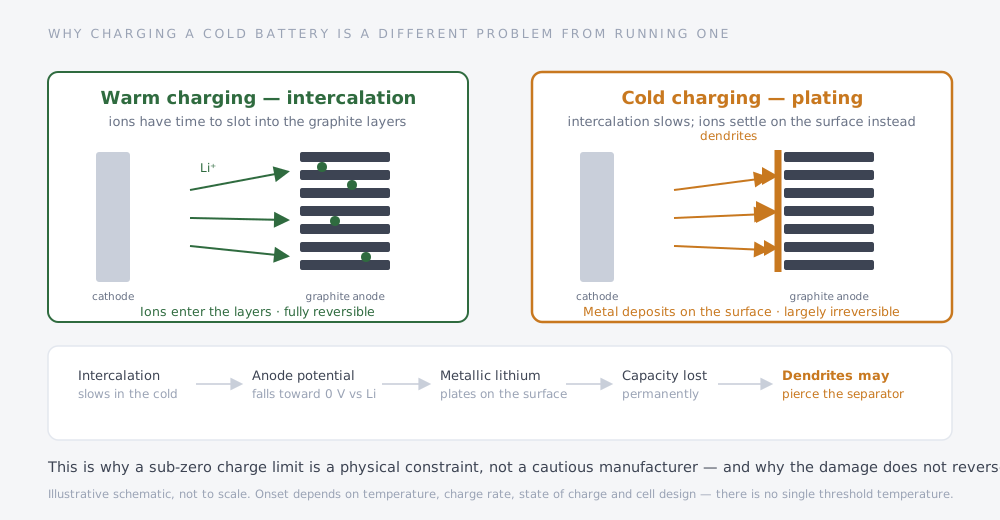
Three consequences follow, and all three matter commercially:
Sources: Underpotential lithium plating on graphite anodes caused by temperature heterogeneity, PNAS; Mechanistic understanding of lithium-ion adsorption, intercalation and plating during charging of graphite electrodes.
So why does this break the product rather than just slow it down?
Because of what an outdoor cleaning robot is. Its value proposition is that it works unattended: it leaves the dock, runs a route, notices it is low, returns, recharges, and goes again without anyone present. Remove the ability to charge and every other capability is still intact — and the product is finished for the season. That is the difference between a specification that degrades and a specification that collapses.
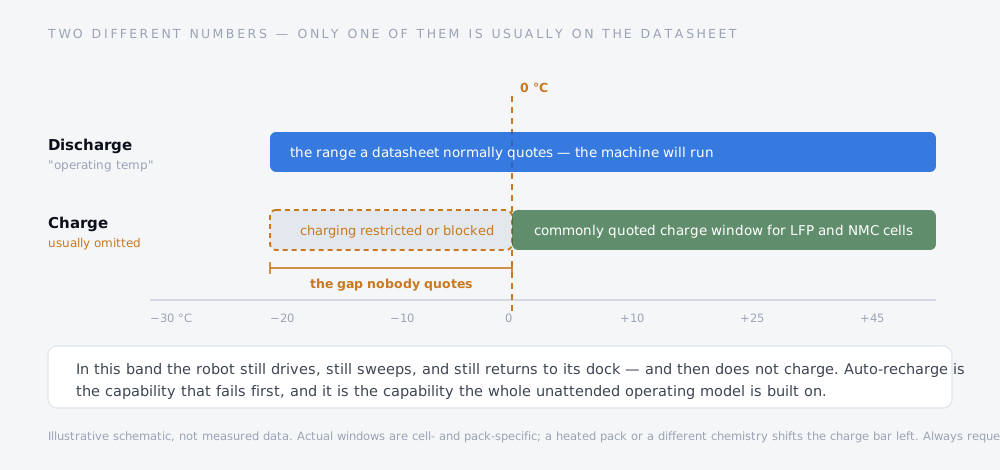
Why does the robot stop knowing how much charge it has left?
This is the least-discussed item on the list and often the one that actually strands a machine. State-of-charge estimation on LFP is hard even in a warm workshop, because the cell holds a nearly constant voltage across a wide span of remaining capacity — the very flatness that makes it well-behaved in service makes it opaque to a simple voltage-based fuel gauge.
Add cold. Internal resistance rises, the voltage under load sags further below the resting value, and whatever correction the battery-management system applies was probably characterised at room temperature. The robot's belief about its remaining runtime drifts away from reality in the direction that matters: it thinks it has more than it does.
For an indoor scrubber that means an awkward stop in a corridor. For an outdoor sweeper on a park route in January it means someone puts on a coat, walks out, and pushes several hundred kilograms of machine back to the dock. The technical defect and the operational consequence are worth keeping joined together, because only the second one appears in a service contract.
Why has nobody in the industry fixed this?
The contrast with electric vehicles is instructive. That industry has standardised range tests, an annual cycle of independent cold-weather testing covered in public, and in places a disclosure obligation. A car buyer can compare winter range across brands. A robot buyer has the supplier's word.
That fourth row deserves its own sentence, because it is the arithmetic buyers miss. Heating a pack costs energy, and that energy comes from the pack. If warming a cold battery to an acceptable charging temperature consumes a meaningful share of capacity before charging even begins, then winter effective runtime is a different number from the one on the sheet — and it should be quoted as such.
There is a structural reason the gap persists, and it is nobody's individual failure. Machines are developed for the climates where they are first sold. Exporters pass on the specification they were given, which has no row for charging temperature. Overseas distributors select on the published parameters. The end customer discovers the issue in the second winter, when capacity loss from a season of cold charging finally shows — often after the warranty has expired. Every party behaved reasonably and the information still never arrived. We are on that chain too, which is why this article exists.
One more blind spot worth naming: in regions with real snow, a sweeper often has no work to do for weeks at a time, so the machine is parked. Storage is its own risk — a pack left at low state of charge in the cold for months ages faster, and the capacity loss shows up at the first spring start-up rather than during the winter itself.
What can be borrowed from electric vehicles?
The electric-vehicle industry spent a decade and a great deal of money on exactly this problem. A cleaning robot can copy the results rather than repeat the research.
Which measure should a manufacturer do first?
Preconditioning is usually the first measure to examine. An EV heading for a fast charger warms its pack on the way so that it can accept full current on arrival. A cleaning robot can be well suited to this logic: it normally knows when it is about to charge, because the return is triggered by its own state-of-charge threshold or by a scheduled task. Warming the pack during the return leg — or on the dock before current is applied — may require no new hardware if the battery-management system, temperature sensing and task scheduler can coordinate it. It is often one of the lowest-cost, highest-leverage items on the list.
Close behind it is charge-current limiting rather than a blanket cut-off. Vehicle battery-management systems map permitted charge current against temperature, trickling gently when cold and increasing as the pack warms, instead of simply refusing. It is a software policy, and the difference in user experience between "charges slowly tonight" and "did not charge" is the whole argument.
Self-heating is the most interesting research direction. Work at Penn State on all-climate cells embeds a thin nickel foil inside the cell as an internal resistive heater, brought out as a third terminal; the published claim is rapid charging across a wide temperature span including deeply sub-zero conditions, by warming the cell from the inside rather than through its casing. A related sandwich self-heating structure was applied to vehicles serving the Beijing Winter Olympics. This is a cell- and pack-level design decision rather than something a robot integrator can retrofit, but it is the right thing to ask a cell supplier about.
Sources: Penn State — self-heating, fast-charging battery; Sandwich self-heating structure-based lithium-ion battery system and its application in the fuel cell bus for Beijing Winter Olympic Games.
The swappable-pack row is worth dwelling on, because it is one of the clearest ways to avoid cold outdoor charging rather than merely manage it. A pack charged indoors does not have to accept current at outdoor temperature while it is in the machine. The cost moves from thermal engineering to logistics — spare packs, a swap routine, and someone to do it — and that is a question a facilities team can answer with a spreadsheet rather than a laboratory.
Eight questions to put to any supplier
If you are specifying machines for a cold market, these eight lines belong in the tender document rather than in an email after delivery. For the machines themselves, our outdoor range is set out on the robot product page — the ACR-1300, ACR-1330, ACR-1380 and ACR-1900 each publish their stated operating temperature, and where a charging figure is not yet published we will tell you that rather than infer one. Related reading: what to verify in a certification pack and the six commercial cleaning robot types.
FAQ
Does an operating temperature of −20 °C mean the robot can charge at −20 °C?
Why is charging below freezing harmful to a lithium battery?
Is there a single temperature below which lithium plating starts?
Which battery chemistry is best for outdoor robots in cold climates?
What does cold weather do to the robot's remaining-runtime estimate?
Can outdoor cleaning robots borrow the cold-weather solutions used by electric vehicles?
Is a swappable battery pack a realistic answer for winter?
This article is general engineering background for procurement and facilities teams, not battery-safety or regulatory advice. Battery handling, charging and storage should follow the instructions supplied with the specific machine. Figures quoted from published research are reproduced under each source's own test conditions and are not directly comparable with one another.