Tennant T300 Review: Specs, Parts and Autonomous Alternatives
The T300 is a well-built mid-size walk-behind scrubber sold in seven configurations from a 17 in / 430 mm to a 24 in / 600 mm cleaning path. The number that should drive your decision is not the coverage rate — it is the 2.5 to 3.8 hours of published run time, every minute of which needs an operator walking behind the machine. Here is how to read its spec sheet honestly, where to get parts and manuals, and the one situation where a different machine class fits better.
Updated 2026-08-18 · 15 min read
First: there are two unrelated machines called T300
The Tennant T300 is a walk-behind floor scrubber made by Tennant Company. The PanPanTech T300 is an autonomous mobile robot in the 300 kg class that moves material around a warehouse and does not clean floors. Same model number, different companies, different machines. PanPanTech is not affiliated with, authorised by, or a dealer for Tennant Company.
We publish this article because buyers researching a T300 scrubber deserve a straight technical read rather than a sales page, and because the model-number collision sends a steady trickle of people to the wrong product. If you arrived looking for a material-transport robot, that is our AMR guide. If you are evaluating a floor scrubber, read on — every figure below is as published by Tennant Company, cited so you can check it.
One accuracy note before the numbers. The publicly circulated T300 specification sheet carries a 2015 revision date, and Tennant has continued to develop the platform since — battery options in particular have moved on, with lithium now offered where the original sheet lists wet and AGM cells. Treat the figures here as the published baseline for the classic configurations, and confirm the exact build you are being quoted against Tennant's current documentation.
The seven configurations, and how to tell them apart
The T300 is not one machine. Tennant publishes seven builds across three cleaning paths, two propulsion types and three scrub-head technologies. Choosing wrongly among them costs more in daily productivity than the price difference between brands.
Three decisions define which T300 you end up with, and they matter in this order:
→Cleaning path — 17 in / 430 mm, 20 in / 500 mm or 24 in / 600 mm. Wider is faster in open areas and worse in congested ones. Measure your narrowest regular aisle before anything else.
→Pad-assist or self-propelled. Pad assist uses the scrub head to help pull the machine along; self-propel adds a drive motor. On the 17 in build, going from pad assist to self-propel lifts published conventional coverage from 9,340 to 12,453 ft²/hr — a third more floor per hour from the same cleaning path.
→Scrub head — disk, dual cylindrical or orbital. Disk is the default. Dual cylindrical sweeps debris into an onboard hopper as it scrubs, which matters where the floor carries loose litter. Orbital runs at high frequency with a rectangular head that reaches closer into corners and is generally the choice for finish work and chemical-free stripping.
ConfigurationConventional coverageDown pressure optionsPublished run time
17 in disk, pad assist9,340 ft² / 868 m² per hrThree-stepup to 3.4 h
17 in disk, self-propel12,453 ft² / 1,157 m² per hrThree-stepup to 3.1 h
20 in disk, pad assist11,208 ft² / 1,041 m² per hrThree-stepup to 2.8 h
20 in disk, self-propel14,943 ft² / 1,388 m² per hrThree-stepup to 2.6 h
24 in dual disk, self-propel18,264 ft² / 1,697 m² per hr57–97 lb / 26–44 kgup to 2.9 h
20 in dual cylindrical14,943 ft² / 1,388 m² per hrThree-stepup to 2.5 h
20 in orbital, self-propel14,943 ft² / 1,388 m² per hr63–109 lb / 29–49 kgup to 3.8 h
Two things stand out in that table. The orbital head posts both the highest run time and the highest down-pressure range — it is doing more work per pass at lower travel speed. And the 24 in machine buys roughly 22% more coverage than the 20 in for a machine that is 6 in wider and about 25 lb heavier, which is a good trade in open retail and a poor one in a congested stockroom.
How to read the coverage-rate claim
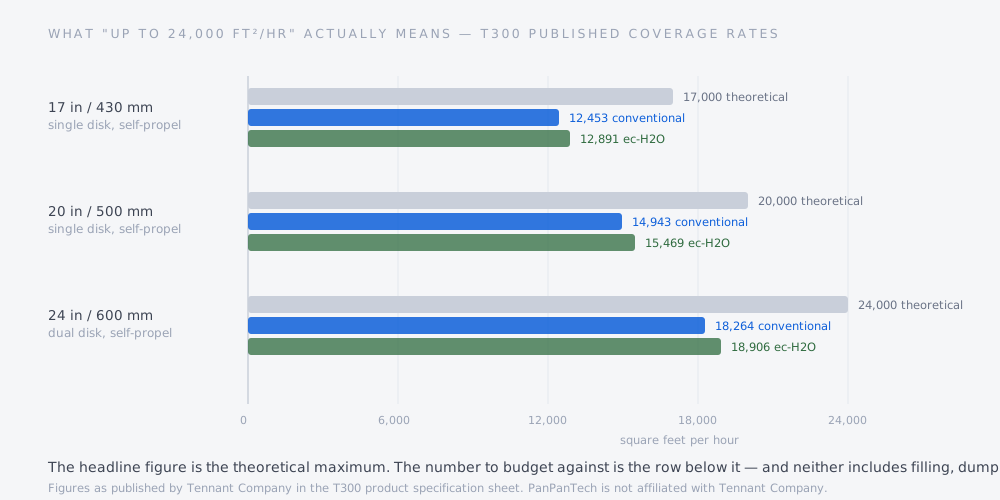
Tennant publishes three coverage numbers per configuration: theoretical maximum, conventional, and with ec-H2O NanoClean. The headline "up to 24,000 ft²/hr" is the theoretical maximum — path width multiplied by transport speed, with no turns, no overlap and no stopping. The row to budget against is 20 to 30 percent lower.
This is not a criticism of Tennant; publishing all three numbers is more honest than most of the industry, which quotes only the first. But buyers routinely build a cleaning plan on the headline figure and then find the machine takes a third longer than budgeted.
The gap between the headline figure and the realistic one runs 20–27% across the range. Figures as published by Tennant Company.
Note also that ec-H2O NanoClean coverage is slightly higher than conventional, not lower — about 3–4% across the range. That is the productivity effect of not stopping to mix and change detergent, and of a lower water-flow rate meaning fewer tank refills. The technology electrically converts water into a cleaning solution, so on suitable soils it removes the detergent step; on heavy or greasy soil you will still want conventional chemistry.
The water-flow figures make the same point quantitatively. Conventional flow runs 0.15, 0.35 and 0.5 gpm across low, medium and high; with ec-H2O NanoClean the same three settings run 0.12, 0.25 and 0.35 gpm — roughly a quarter to a third less water for a given setting, which directly extends the interval between refills on an 11 gallon solution tank.
Run time, tanks, and the shift maths nobody does upfront
Tennant publishes 2.5 to 3.8 hours of run time on a 24 volt, two-battery system. Combined with an 11 gallon solution tank, this is what actually caps a walk-behind's daily output — and unlike coverage rate, it is a hard ceiling you cannot work around with technique.
Work the arithmetic for a realistic case. Take the 20 in self-propelled machine at its published conventional rate of 14,943 ft²/hr and its 2.6 hour run time. At best that is roughly 38,800 ft² on one battery charge, before you subtract anything. Now subtract the real interruptions: filling the solution tank, dumping and rinsing the recovery tank, and the walk to and from the fill point. On an 11 gallon tank at medium conventional flow you are refilling roughly every half hour of scrubbing.
The important part is what that time costs. Every one of those hours is attended — an operator is walking behind the machine for the entire run, plus the fill and dump cycles, plus the transit. That is the structural difference between this machine class and an autonomous one, and it is why the honest comparison is not about coverage rate at all.
Published figureValueWhat it means on a shift
Solution tank11 gal / 42 LRefill interval, not a performance number — the smaller constraint on long runs
Recovery tank14 gal / 53 LLarger than solution by design, so recovery is rarely the binding limit
Battery run time2.5–3.8 hThe real ceiling. A longer shift needs a battery plan or a second machine
Scrub / transport speed200 / 240 ft per minTransport speed is why the theoretical rate is unreachable — you scrub slower than you drive
Sound at operator ear64.9–66.5 dBAQuiet-Mode brings this to 57.6–59.1 dBA, which is what makes daytime use in occupied space viable
Weight with batteries366–415 lb / 166–188 kgMatters for lifts, ramps and upper floors more than most buyers expect
Tennant publishes the T300 operator and parts manual on its own site, and distributor documentation libraries mirror the brochure, operator manual, parts manual, specification sheet and service manual. Order against the part number in the manual that matches your serial number — never against a description.
Three practical points from people who maintain these machines:
→The T300 and T300e are not the same parts list. They share a platform and a documentation family, but part numbers diverge. Check which one is on your data plate before ordering anything.
→Scrub-head type changes the consumables entirely. Disk, dual cylindrical and orbital take different brushes, pads and drivers. A parts list pulled for the wrong head is the most common ordering error on this machine.
→Squeegee blades and vacuum hoses are the recurring spend. They are also the parts most responsible for a machine that "stopped picking up water". Before diagnosing the vacuum motor, check blade wear and the hose run — the same advice applies to every scrubber, robotic or manual.
Tennant's warranty terms as published on the specification sheet are unusually legible for this category: 10 years on the rotomoulded tanks, 3 years parts, 2 years labour, 6 months travel. Rotomoulded tanks with a decade of cover is a meaningful signal, because tanks are what usually ends a scrubber's economic life. Whatever machine you buy, ask for the warranty split by component this way rather than as a single headline number — our certification and compliance guide covers what else to demand in writing.
When the T300 is the right machine
When the soil is heavy, the floor plan is variable, the cleaning is done by someone who is already on site, or the area is too small and too congested to justify autonomy. In those cases a walk-behind with a skilled operator is not a compromise — it is the better tool.
It is worth being explicit about this, because "alternatives" articles usually are not. A T300 with a 24 in dual-disk head offers a published down-pressure range of 57 to 97 lb (26 to 44 kg), and the orbital head goes to 109 lb (49 kg). Those figures are higher than typical robotic scrubbers in the same path width, and down pressure is what removes bonded soil. If your floors have ground-in traffic film, a machine that leans harder on the pad will clean them better, and a person can see where to lean hardest.
→Heavy or bonded soil — manufacturing floors, back-of-house kitchens, entrances in wet climates.
→Congested or frequently rearranged space — where routes change weekly and mapping never settles.
→Small total area — under a few thousand square metres, where an operator can finish inside one run time anyway.
→An operator already on site — if someone is there for other reasons, the marginal labour cost of the scrubbing hour is low.
The autonomous alternative — and what it actually changes
An autonomous scrubber in the same 600 mm path class does not clean much faster than a T300. It removes the operator from the run. If your problem is throughput, buy a wider walk-behind. If your problem is that nobody is available to walk behind it at 10pm, that is a different purchase.
Here is the honest apples-to-apples, using the widest T300 against a robotic scrubber with the same cleaning path:
SpecificationT300 · 24 in dual diskAutonomous scrubber · ACR-0600
Cleaning path24 in / 600 mm600 mm
Coverage (published)1,697 m²/hr conventional; 2,230 m²/hr theoreticalup to 2,160 m²/hr
Read that table carefully and the conclusion is not "the robot wins". The T300 applies more down pressure and will out-clean the robot on hard soil. The coverage rates are close enough to be a wash. What changes is the labour model: 2.9 attended hours versus 5 unattended hours plus a dock that refills, drains and recharges without anyone present. You are not buying a faster machine — you are buying back the hours of a person who is hard to hire at 10pm.
That framing decides the purchase. We wrote about it at length in what cleaning robots can and can't do: robots take the repetitive open-floor share and people keep the edges, detail and judgement. If your building genuinely needs both — a robot for the main floor and a walk-behind for the loading dock — that hybrid is the outcome most facilities land on, and our robotic vs walk-behind comparison works through the cost side.
The T300 is a battery-powered walk-behind floor scrubber made by Tennant Company. It is offered in seven published configurations covering 17, 20 and 24 inch cleaning paths, in pad-assist and self-propelled versions, with disk, dual-cylindrical and orbital scrub heads. It is a mid-size machine aimed at retail, education, healthcare and light industrial floors.
What is the cleaning path and tank capacity of a Tennant T300?
Cleaning paths are 17 in / 430 mm, 20 in / 500 mm and 24 in / 600 mm depending on configuration. Tennant publishes an 11 gallon / 42 litre solution tank and a 14 gallon / 53 litre recovery tank across the range. Always confirm current figures against Tennant's own specification sheet for the exact build you are quoted.
How long does a Tennant T300 run on a charge?
Tennant publishes battery run times of up to 2.5 to 3.8 hours depending on configuration and battery choice, on a 24 volt two-battery system. This is the number that usually decides machine strategy: the run time is attended, meaning an operator is walking behind it for the whole period, and a shift longer than the run time needs either a battery plan or a second machine.
Where can I find the Tennant T300 parts manual?
Tennant publishes the operator and parts manual for the T300 on its own website, and distributor documentation libraries mirror the brochure, operator manual, parts manual, specification sheet and service manual. Work from the manual that matches your machine's serial number, because part numbers differ between the T300 and T300e and between scrub-head types. Always order against the part number in the manual rather than a description.
Is the PanPanTech T300 the same as the Tennant T300?
No. They are unrelated machines from different companies that happen to share a model number. The Tennant T300 is a walk-behind floor scrubber. The PanPanTech T300 is an autonomous mobile robot in the 300 kg class used for material transport, not floor cleaning. PanPanTech is not affiliated with, authorised by, or a dealer for Tennant Company.
What is a good alternative to the Tennant T300?
It depends on which constraint you are solving. If you need aggressive soil removal on variable floors with a person present, another walk-behind in the same class is the right comparison. If the floor is large, open and cleaned on a repeating schedule, an autonomous scrubber with a comparable cleaning path removes the operator from the run instead of speeding it up — a different purchase, not a faster one.
Does a robot scrubber clean as well as a Tennant T300?
Not identically. A T300 offers higher published brush down-pressure than typical robot scrubbers in the same path width, which matters on heavy or bonded soil. Robots generally offer larger tanks, longer runtime and unattended operation. On lightly to moderately soiled open floors the finish is comparable; on heavy soil the walk-behind with a skilled operator still wins.
Tennant, T300 and ec-H2O NanoClean are trademarks of Tennant Company. PanPanTech is not affiliated with, authorised by, or a dealer for Tennant Company. All Tennant figures quoted here are as published by Tennant Company for reference and comparison; confirm current specifications with Tennant or an authorised dealer before purchase.
Comparing a walk-behind against an autonomous scrubber?
Send your floor area, floor type and the shift you are trying to cover. PanPanTech will tell you which class actually fits — including when a walk-behind is the better answer.