UV & Disinfection Robots for Commercial Facilities: What They Do and What They Don't
A UV disinfection robot is a second step layered on top of cleaning, not a replacement for it. What decides whether it worked is the ultraviolet dose delivered to a given surface — not how long the machine ran — and that dose collapses with distance and falls to near zero in shadow. We do not make one, which is exactly why this is a straight read rather than a sales page.
Updated 2026-10-15 · 14 min read
What a UV disinfection robot actually is
A mobile platform carrying germicidal ultraviolet lamps — usually UV-C around 254 nm — that drives to a position in an empty room and irradiates whatever surfaces it can see for a set period. It is a no-touch surface-treatment device. It does not sweep, scrub or vacuum, and it removes no soil.
A disclosure first, because it shapes everything below: PanPanTech does not manufacture UV disinfection robots. Our robot range is floor cleaning and material transport. We are writing this because buyers keep asking us to compare the two categories, and the honest comparison is more useful than a brochure from someone who needs you to buy one.
Three form factors get called "UV disinfection" and they behave very differently:
Mobile UV-C tower robotThe machine most people mean. Lamp array on a drivable base, positioned in an empty room, run for a timed cycle, often at several positions per room. High output, strict exclusion of people.
Upper-room UVGIFixed fixtures that irradiate the air above head height while the room stays occupied. Treats air, not surfaces. Not a robot, and not a substitute for one.
Filtered far-UVC at 222 nmA different wavelength with a very different safety profile, discussed in the safety section below. Genuinely promising, and genuinely not the same product as the 254 nm robot you are probably being quoted.
The rest of this article is about the first one, because that is what "UV cleaning robot" almost always means in a commercial procurement conversation.
The number that matters is dose, not runtime
Germicidal UV works by delivering energy to a surface, measured in millijoules per square centimetre. Published requirements vary roughly fifty-fold between organisms — under 4 mJ/cm² for some common bacteria, up to 194 mJ/cm² for one adenovirus. A claim of "99.9%" with no organism, dose or distance attached carries no information.
This is the single most useful thing a buyer can learn about the category. In controlled hospital work, less than 4 mJ/cm² was enough to completely remove Staphylococcus aureus and Pseudomonas aeruginosa; around 38.8 mJ/cm² sufficed for other pathogens tested; and 194 mJ/cm² was required to completely inactivate adenovirus HadV5.
TargetPublished dose for complete inactivationWhat it means for a cycle
S. aureus, P. aeruginosaunder 4 mJ/cm²Reached easily at short range — the easy end of the scale
Other pathogens testedabout 38.8 mJ/cm²Roughly ten times the above; distance now matters a great deal
Adenovirus HadV5194 mJ/cm²About fifty times the easy end. A cycle sized for bacteria will not achieve this
So when a specification says the robot completes a room in fifteen minutes, the correct follow-up is: fifteen minutes delivers what dose, at what distance, to which surface, against which organism? A machine sized for the easy end of that table and marketed against the hard end is not lying about any single number — it is just letting you connect them yourself.
Distance and shadow decide the outcome
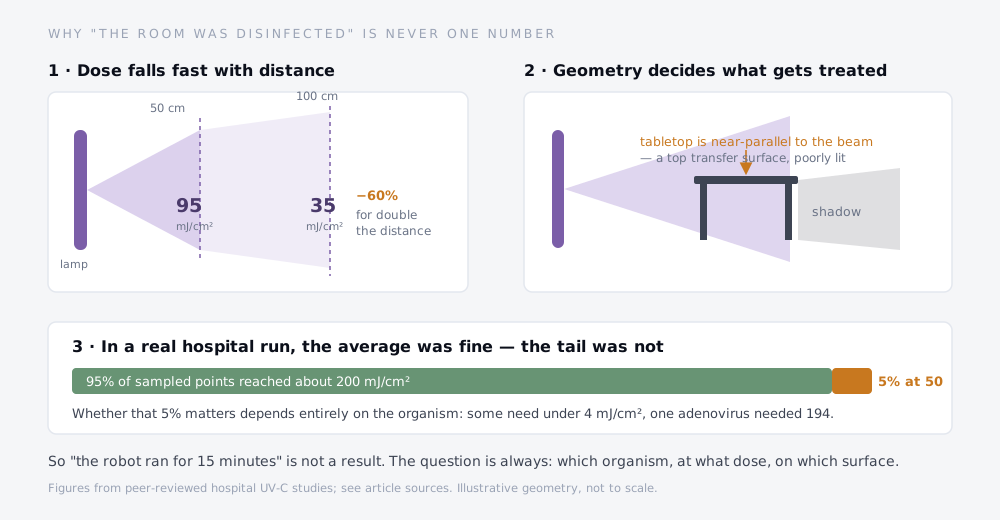
Dose falls steeply with distance and to near zero in shadow. In published measurements the average dose dropped about 60% — from 95 to 35 mJ/cm² — simply by moving from 50 cm to 100 cm from the lamp. Room layout, lamp position, lamp ageing and humidity all move the result as well.
Dose is a property of a surface, not of a room. PanPanTech, 2026, using published hospital measurements.
The shadow problem is subtler than it first appears, and it lands on exactly the wrong surfaces. Tabletops — among the most common transfer surfaces in any building — sit roughly parallel to the light emitted by a vertical lamp column, so they receive relatively little direct illumination even when nothing is blocking them. Anything behind furniture, inside a drawer, under a rail or on the far side of a partition receives effectively nothing.
The consequence shows up clearly in field data. In one hospital implementation, 95% of sampled points reached a medium dose of about 200 mJ/cm², which is a good result — but 5% of points received only 50 mJ/cm². Whether that 5% matters depends entirely on which organism you were worried about, which brings you straight back to the dose table above. This is why serious deployments use multiple robot positions per room and dosimeter cards to verify coverage, rather than trusting a timer.
It does not work through dirt — so it never replaces cleaning
Ultraviolet light cannot penetrate soil and residue. Surfaces must be physically cleaned before UV treatment or the result is unreliable, and this is particularly true against Clostridioides difficile spores. UV is a layer on top of cleaning, in a fixed order.
This is where a lot of procurement goes wrong. A UV robot is sometimes pitched as a way to reduce cleaning labour. The physics says the opposite: it adds a step that only works if the cleaning step happened properly first. Encouragingly, the research also shows the combination is strong — cleaning a surface with a microfiber cloth and water followed by UV-C exposure achieved non-inferior disinfection of a pathogenic S. aureus strain compared with germicidal wipes. That is a real and useful finding, and note what it requires: someone cleaned the surface first.
If your actual problem is that floors are not being cleaned consistently or that you cannot staff the night shift, a UV robot does not address it. That problem is what floor cleaning robots are for — see our commercial cleaning robot guide for the six machine types, and what cleaning robots can and can't do for an honest read on where automation actually removes labour.
Conventional UV-C at 254 nm is a genuine hazard to skin and eyes. The ACGIH threshold limit value at 254 nm is 6.0 mJ/cm² over an eight-hour day — a small fraction of a disinfection dose. Rooms must be empty, with door interlocks, motion detection and signage, and that requirement shapes the entire operating model.
Put those two numbers side by side and the operating constraint becomes obvious. A disinfection cycle aims to deliver tens or hundreds of millijoules per square centimetre to surfaces; the occupational limit for a whole working day is 6.0 mJ/cm². There is no version of this where people share the space with a running 254 nm machine. Every deployment therefore needs room vacancy procedures, interlocks that kill the lamps when a door opens, occupancy sensing, and staff training — and every one of those is an operational cost, not a hardware feature.
Filtered far-UVC at 222 nm is the developing exception and deserves an accurate description rather than either hype or dismissal. Because these wavelengths penetrate only the superficial layers of the corneal epithelium — cells shed within roughly 24 hours — the hazard profile is different from conventional 254 nm UV-C. Published exposure-limit discussions for filtered 222 nm systems are more permissive than for 254 nm, but that does not make every lamp or robot suitable for occupied use. Verify the exact wavelength, filter design, measured emissions, IEC 62471 report and local occupational-exposure basis before accepting any occupied-space claim.
In the United States the EPA treats ultraviolet radiation as an antimicrobial pesticide device under FIFRA. The devices need no registration because they contain no pesticidal substance — but unsupported efficacy claims are enforceable, and the EPA has issued stop-sale orders. Separately, FDA product code QXJ covers whole-room microbial reduction devices as Class II medical devices with 510(k) review when the intended use fits that category.
Both halves matter to a commercial buyer, and both are commonly misrepresented in sales conversations.
AuthorityWhat it coversWhat to check
EPA (FIFRA)UV as an antimicrobial pesticide device; no device registration required, but claims are enforceableAsk for the data behind any kill claim. "EPA registered" is usually not a meaningful statement about a UV device
FDA (510(k))Whole-room microbial reduction devices under product code QXJ are Class II devices reviewed through 510(k)If the intended use is healthcare, ask directly whether the exact device and claim match an FDA-cleared indication
Photobiological safetyIEC 62471 risk grouping for lamp and lamp-system hazardsAsk for the classification and the report, not a marketing line about being "safe"
Machine safetyGeneral machinery, electrical and, for autonomous units, functional safetySame rigour as any mobile robot — see our certification guide
Outside the United States the specifics differ, but the principle transfers: a device that claims a microbiological outcome is making a regulated claim somewhere, and a vendor who cannot produce the underlying test data is asking you to take the outcome on trust. The same discipline we set out for cleaning robot certifications applies here — demand the report, read the scope, and check the model number on it matches what you are buying.
Which buildings this actually suits
Facilities with a defined terminal-clean workflow on rooms that can genuinely be emptied. That means healthcare and laboratories first, hotel rooms and enclosed transport second, and open commercial floors barely at all.
SettingFitWhy
Hospital rooms, ORs, labsStrongTerminal-clean protocol already exists, rooms are vacated by design, and the infection-control case is measurable
Hotel roomsSituationalRooms are empty between guests, but the value is largely reassurance rather than measured infection outcomes — see hospitality solutions
Offices, lobbies, common areasWeakHard to vacate reliably, and most of the surface area is shadow — commercial property gains more from consistent floor cleaning
Retail floors, warehousesPoorLarge, cluttered, rarely empty, and dominated by floor area that a scrubber addresses far more cheaply
→1 · Which organism, at what dose? Any efficacy claim without both is unusable. Ask for the figure in mJ/cm².
→2 · At what distance was that measured? Then ask what the dose is at two metres, which is where much of a real room sits.
→3 · How many positions per room, and how is coverage verified? Dosimeter cards or a mapped survey — not a timer.
→4 · What is the lamp replacement interval and output decay curve? Lamp ageing quietly reduces delivered dose over the machine's life.
→5 · What safety interlocks are fitted? Door switches, motion detection, remote start, audible warning, emergency stop.
→6 · What is the photobiological classification, and can I see the report? Ask for the IEC 62471 documentation, and for healthcare use, the FDA position on the specific model.
→7 · What cleaning must happen before the cycle? If the answer is "none", the vendor is describing something UV cannot do.
FAQ
What is a UV disinfection robot?
A mobile platform carrying germicidal ultraviolet lamps, usually UV-C at around 254 nm, that drives to a position in an empty room and irradiates the surfaces it can see for a set period. It is a no-touch surface-treatment device. It does not sweep, scrub or vacuum, and it does not remove soil — it is designed to run after cleaning, not instead of it.
Do UV disinfection robots actually work?
On clean, directly illuminated surfaces, yes — germicidal UV-C is well established and peer-reviewed hospital studies show meaningful microbial reduction. The qualifier matters more than the claim. Effectiveness depends on delivered dose at the surface, which falls sharply with distance and drops to near zero in shadow, and it degrades in the presence of soil. A robot that ran is not the same as a surface that was treated.
How long does a UV robot need to run in a room?
There is no universal answer, because runtime is not the measure — delivered dose is. Published dose requirements span roughly fifty-fold between organisms: under 4 mJ/cm² completely removed Staphylococcus aureus and Pseudomonas aeruginosa in one study, while 194 mJ/cm² was needed to inactivate an adenovirus. Ask the vendor which organism, at what dose, at what distance, and how they verified it.
Does UV disinfection replace cleaning?
No. UV light cannot penetrate soil and residue, so surfaces must be physically cleaned first or the treatment is unreliable — this is especially true against Clostridioides difficile spores. UV is a second step layered on top of cleaning. Any vendor presenting it as a replacement for cleaning labour is describing something the physics does not support.
Is a UV cleaning robot the same as a floor cleaning robot?
No. A UV robot disinfects the surfaces it can directly illuminate; it removes no dirt. A floor cleaning robot scrubs or vacuums. Surfaces must be cleaned before UV treatment, so facilities that need both run them as separate steps — see our guide to commercial cleaning robots.
Is a UV disinfection robot safe to run around people?
Conventional UV-C at 254 nm is not. It is a genuine occupational hazard to skin and eyes, and the ACGIH threshold limit value at 254 nm is 6.0 mJ/cm² over eight hours — a fraction of a disinfection dose. Rooms must be empty, with door interlocks, motion sensing and clear signage. Filtered far-UVC at 222 nm is the developing exception, with much higher published exposure limits and certification for occupied spaces, but it is a different technology from a standard UV-C robot.
Are UV disinfection robots regulated?
In the United States, yes, in two ways. The EPA treats ultraviolet radiation as an antimicrobial pesticide device under FIFRA; the devices themselves do not require registration because they contain no pesticidal substance, but unsupported efficacy claims are enforceable and the EPA has issued stop-sale orders. Separately, FDA product code QXJ covers whole-room microbial reduction devices as Class II medical devices with 510(k) review when the intended use fits that category.
Are UV disinfection robots FDA approved?
Not in the sense most sales material implies. FDA does not “approve” UV robots as a category. When the intended use is whole-room microbial reduction in healthcare, a device falls under FDA product code QXJ as a Class II medical device reviewed through 510(k). Many UV robots sold for commercial facilities are not marketed for that use and have no FDA clearance. Ask for the 510(k) number and check that the exact model and claim match the cleared indication.
Which facilities actually benefit from a UV robot?
Settings with a defined terminal-clean workflow on rooms that can be emptied: healthcare, laboratories, and to a lesser extent hotel rooms and enclosed transport. Open retail floors, warehouses and busy offices are poor fits, because rooms cannot be reliably vacated and the surface geometry is mostly shadow. For those buildings, floor cleaning robots and a disciplined cleaning programme deliver more measurable benefit per dollar.
This article is general information for facility and procurement teams, not infection-control, medical or regulatory advice. Disinfection protocols should be set with your infection-prevention team and applicable local regulations. PanPanTech does not manufacture or sell UV disinfection robots.
Not sure whether the problem is disinfection or cleaning?
Send your building type, floor area and the shift you are trying to cover. PanPanTech will tell you which machine class actually addresses it — including when the answer is not a robot at all.