Hotel Cleaning Robots: What They Do, Where They Fit and How to Roll Them Out
Hotel cleaning robots clean public floors — corridors, lobbies, restaurants and ballrooms — at night or off-peak, while housekeeping stays focused on rooms. With 65% of surveyed US hotels still short-staffed and housekeeping the hardest role to fill, this guide covers which robot fits which area, noise and carpet limits, lifts, ROI and how to roll out without disturbing guests.
Updated 2026-10-05 · 9 min read
What a hotel cleaning robot actually does
A hotel cleaning robot cleans the public floors of a hotel — corridors, lobbies, restaurants, ballrooms and back-of-house — on a schedule, usually at night or off-peak. It does not clean guest rooms, make beds or clean bathrooms. Those stay with housekeeping.
That split is the key to every successful hotel deployment. Room attendants spend their shift on rooms; the long, repetitive floor routes in corridors and public areas are the part of the workload a robot can take over without changing the guest experience.
The pressure behind the interest is staffing. In an American Hotel & Lodging Association survey covering December 2024 to January 2025, 65% of surveyed hotels still reported staffing shortages, and housekeeping was the most affected role, cited by 38%. When a hotel cannot fill housekeeping shifts, the first thing that slips is the public-area floor round.
→Guest corridors — nightly vacuuming of carpet runners while guests sleep.
→Lobbies and lift lobbies — hard-floor scrubbing and dust-mopping off-peak.
→Restaurants and breakfast rooms — cleaning under tables after service.
→Ballrooms, meeting rooms and exhibition halls — fast floor resets between events.
→Back-of-house — service corridors, staff canteens and loading areas.
→Exterior — windows and curtain walls, with facade cleaning robots.
Which robot for which part of the hotel
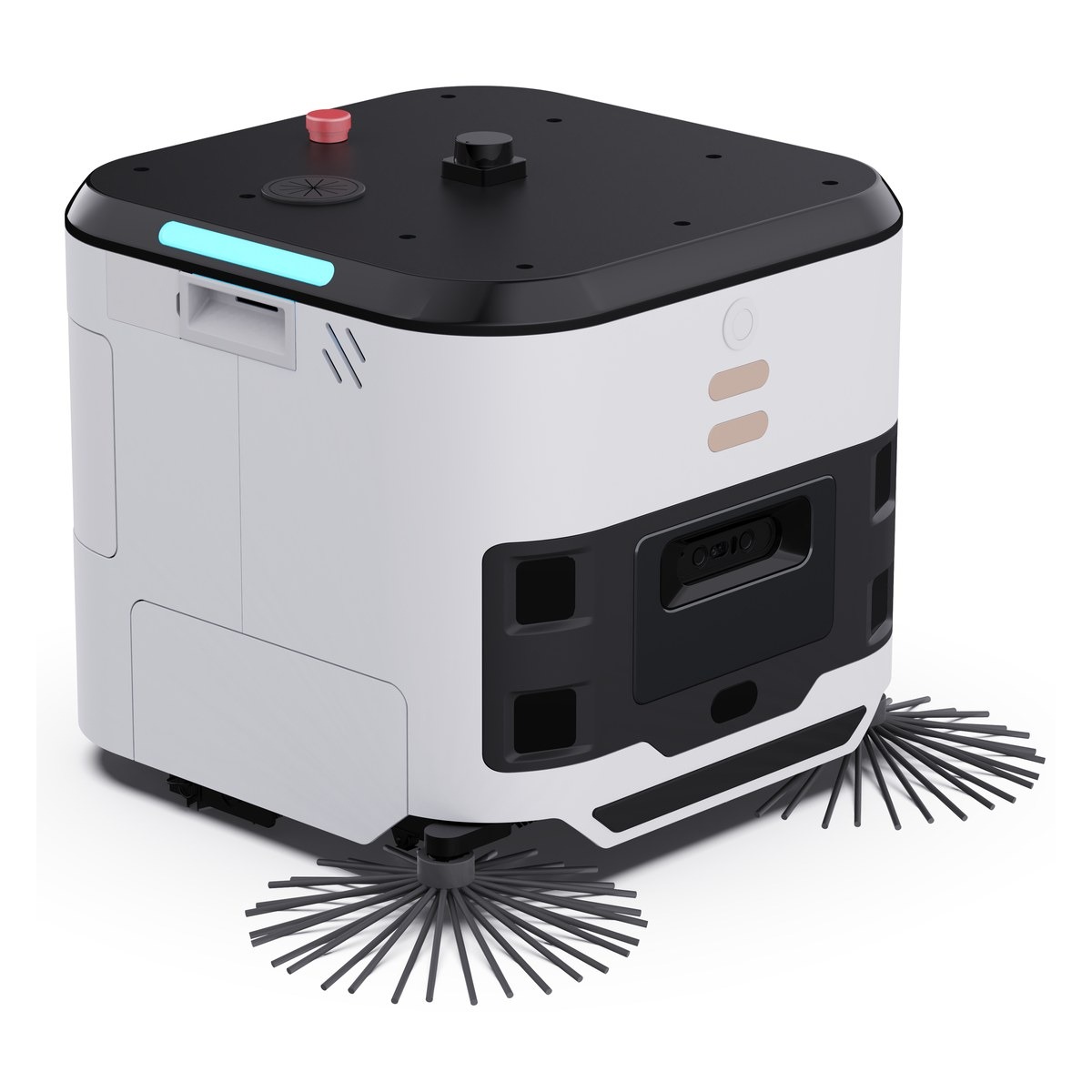
Match the robot to the area: quiet compact robots for corridors, self-service compact robots for restaurants, 6-in-1 robots for lobbies, large scrubbers for ballrooms, and facade robots for the exterior.
Hotel areaRobotKey specificationWhy it fits
Guest corridorsACR-0350Under 60 dB; fits 60 cm aislesQuiet enough for night routes past rooms
Restaurants and loungesACR-029022.3 kg; 283 mm tall; self-washing stationReaches under tables; no daily water handling
Lobbies and public areasACR-05206-in-1; ~1,197 m²/h scrubbingOne machine for vacuuming, scrubbing and dust-mopping
Spa, gym and clinicACR-0520V222 nm far-UVC; under 55 dBAdds a supplementary hygiene step after cleaning
Ballrooms and hallsACR-0800Up to 4,000 m²/hResets a large floor between events
Convention centresACR-0520M27-inch Full HD double-sided screenCleans while playing sponsor content
Windows and facadeAFR-1200 / AFR-1500Rope-suspended facade robotsTakes rope-access crews off routine cycles
Robot figures from PanPanTech product pages. Carpet performance depends on pile height; test on your own carpet.
The ACR-0350 runs below 60 dB and fits 60 cm aisles, the main requirements for night routes in guest corridors.
Noise, guests and timing
Noise decides when a robot can run. Under 60 dB is the practical target for corridors at night; lobbies and restaurants can use louder modes when they are empty.
Hotels are never empty, so the schedule is designed around occupancy rather than around the robot. A common pattern is corridors after 23:00 at the quietest setting, restaurants straight after breakfast and dinner service, lobbies in the early morning, and ballrooms whenever an event finishes.
→Check door seals and corridor acoustics. The same robot can sound different in two hotels. Test on one floor before scheduling a whole building.
→Use quiet modes in occupied areas. Many robots offer quieter modes; check how much suction or speed they give up.
→Avoid peak check-in and check-out. Lobbies are busiest mid-morning and mid-afternoon.
→Tell guests what the robot is. A small sign or a line in the welcome information prevents complaints and photos on social media from being misread.
Carpet, lifts and other hotel practicalities
Most hotel robots vacuum carpet well but do not replace periodic deep extraction. Lifts are the biggest practical limit: unless the robot is integrated with the lift, staff move it between floors.
→Carpet. Robots with vacuum modes keep corridor carpet clean day to day. Deep shampoo or extraction remains a periodic manual job. Send a photo of your carpet so the pile can be checked.
→Lifts. Cleaning robots are usually assigned per floor or moved by staff. Multi-floor autonomy needs lift integration, which is common on delivery robots and AMRs but should be confirmed per lift model.
→Thresholds and rugs. Door thresholds, loose rugs and cables are the usual cause of stuck robots. Mark them as no-go zones during mapping.
→Water and drain. A station that connects to water and drain, like the one on the ACR-0520P, removes the daily refill job entirely.
→Storage and charging. Plan a charging spot per floor or per zone, near a socket and out of guest sight lines.
What a hotel robot is worth
A hotel robot pays back when it reliably takes over hours of public-area floor work every night. Value it in housekeeping hours released to rooms, not in headcount reduction.
US BLS data for maids and housekeeping cleaners gives the wage benchmark for this work. A robot that takes over three hours of corridor vacuuming a night releases more than 1,000 hours a year — time that can go back into room turnover, where staff shortages hurt guest scores most.
→Hours taken over per night — the biggest input. Measure the current corridor and public-area round.
→Supervision time — someone still starts routes, empties bins and checks edges. Budget 15–30 minutes a night.
→Robot cost per year — purchase price over five years plus consumables and service, or a RaaS fee.
→Quality — consistent nightly coverage that is logged, instead of a round that is skipped when a shift is short.
Our ROI calculator works the numbers for your property, and the price guide covers what robots in each class cost.
How to roll out robots in an operating hotel
Start with one floor or one venue, measure for two to four weeks, then extend. The pilot answers the questions no spec sheet can: noise in your corridors, carpet results and staff acceptance.
An autonomous robot that cleans a hotel's public floors — corridors, lobbies, restaurants, ballrooms and back-of-house — on a schedule. It does not clean guest rooms or bathrooms; those remain with housekeeping.
Are cleaning robots quiet enough for hotel corridors at night?
Robots rated below 60 dB, such as the ACR-0350, are suitable for night corridor routes. Test on one floor first, because corridor acoustics and door seals vary.
Can a hotel cleaning robot clean carpet?
Robots with vacuum modes keep corridor carpet clean day to day. Periodic deep extraction is still a manual job.
Can a cleaning robot use the hotel lifts?
Usually not by default. Cleaning robots are assigned per floor or moved by staff unless lift integration is installed and confirmed for your lift model.
Will robots replace housekeeping staff?
No. They take over repetitive public-area floor routes so housekeeping can concentrate on rooms and guests. See our article on whether cleaning robots will replace human cleaners.
How much does a hotel cleaning robot cost?
Compact and mid-size commercial cleaning robots typically list between about $15,000 and $45,000 in 2026, with RaaS options from about $600 a month. Large scrubbers for ballrooms cost more.
Which hotel areas should we automate first?
Guest corridors at night and restaurant floors after service. Both are repetitive, happen every day and are easy to measure before and after.